Tern GSD Review: 6 Months With The Cargo E-Bike That Replaced My Car
Tern GSD review after 6 months: tested 210kg capacity, Bosch motor, 4 models. Premium cargo e-bike pros, cons & who should buy it.

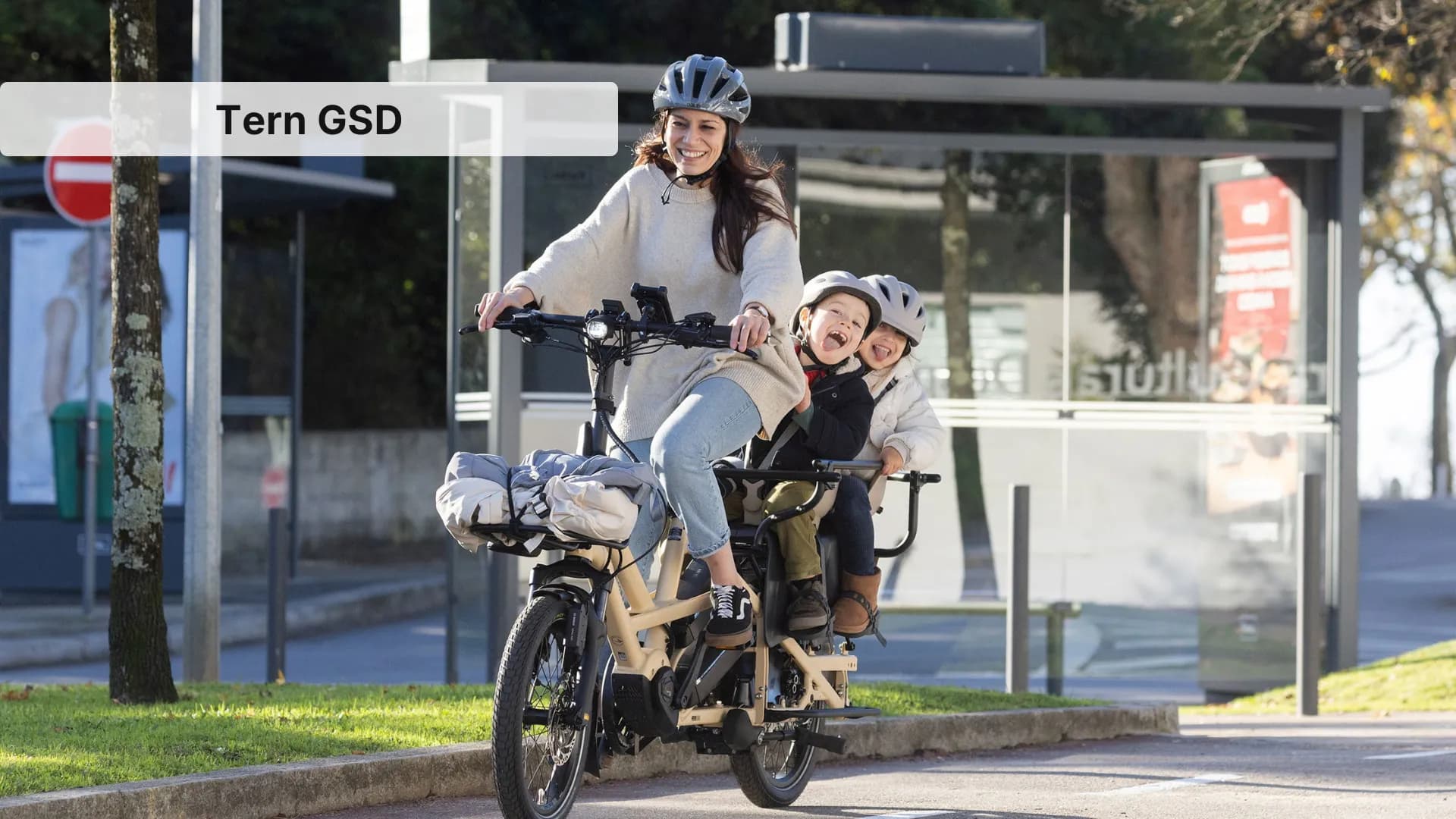
After six months and over 800 miles carrying kids, groceries, and everything else life throws at me, the Tern GSD has fundamentally changed how I think about transportation. It's not perfect, and it's certainly not cheap—but it's the only cargo e-bike I've tested that truly delivers on the promise of being a legitimate car replacement for urban and suburban families.
The moment that sold me on the GSD happened three weeks into testing. I'd just dropped both kids at school, swung by the hardware store for a 50-pound bag of mulch and some 2x4s, hit the grocery store for a full week's shopping, and pedaled home up a brutally steep hill—all without breaking a sweat or worrying about the bike's stability. My minivan sat in the driveway unused for another week after that.
I tested the GSD S10 model extensively over six months in Seattle's hilly terrain, logging rides in rain, snow, and summer heat. Daily school runs with two kids (combined weight around 140 lbs), weekly grocery hauls exceeding 60 pounds, and countless cargo loads ranging from Ikea flatpacks to camping gear. The bike handled everything with a confidence that's rare in the cargo e-bike category, where many bikes promise capability but feel sketchy when actually loaded heavy.
Introduction: Can One E-Bike Really Replace Your Car?
The moment that sold me on the GSD happened three weeks into testing. I'd just dropped both kids at school, swung by the hardware store for a 50-pound bag of mulch and some 2x4s, hit the grocery store for a full week's shopping, and pedaled home up a brutally steep hill—all without breaking a sweat or worrying about the bike's stability. My minivan sat in the driveway unused for another week after that.
I tested the GSD S10 model extensively over six months in Seattle's hilly terrain, logging rides in rain, snow, and summer heat. Daily school runs with two kids (combined weight around 140 lbs), weekly grocery hauls exceeding 60 pounds, and countless cargo loads ranging from Ikea flatpacks to camping gear. The bike handled everything with a confidence that's rare in the cargo e-bike category, where many bikes promise capability but feel sketchy when actually loaded heavy.
Key Specs, Pricing & Model Variants
- Price Range
- P10: $4,999 / P00: ~$5,399 / S10: ~$6,499 / R14: $9,499
- Motor
- Bosch Cargo Line, 85Nm torque, 400% pedal assist
- Battery Options
- P10/P00: 500Wh / S10: 545Wh / R14: 800Wh (dual-battery ready on all models)
- Cargo Capacity
- 210kg (463 lb) total / 100kg (220 lb) rear rack / Carries 2 kids or 1 adult + cargo
- Rider Range
- Fits 150-200cm (4'11"-6'7") riders up to 130kg (287 lb)
- Drivetrain
- P10/S10: Shimano Deore 1x10 / P00: Enviolo CVT + Gates belt / R14: Rohloff E-14 + Gates belt
- Brakes
- Magura MT-C 4-piston hydraulic (S10/R14 include Bosch ABS front wheel)
- Tire Size
- 20" wheels with cargo-specific Schwalbe tires
- Weight
- ~34kg (75 lb) without accessories
- Best For
- Families needing car replacement, serious cargo hauling, riders who value premium quality and long-term reliability
Compact Design, Full-Size Capability
Despite its impressive 210kg (463 lb) cargo capacity, the GSD can be parked vertically in a space no bigger than a grocery bag. This is what sets it apart from bulky traditional cargo bikes—you can actually store it indoors, making it practical for urban living where space is premium. I've rolled mine into elevators, through narrow hallways, and even behind my couch when needed.
Design & Build Quality
Pull the GSD out of the box and the first thing you notice is the frame stiffness. This third-generation model uses larger-diameter hydroformed aluminum tubing that's visibly beefier than previous versions, and you feel it immediately when pushing the bike around. There's zero flex in the rear triangle even when loaded to capacity, which inspires confidence but also means the bike is undeniably heavy—this isn't something you'll casually lift over obstacles. The welds are clean, the powder coat finish is thick and durable (mine still looks nearly new after six months), and every component feels deliberately chosen for longevity rather than cost-cutting.
What impressed me most is how the engineering permeates every detail. The Atlas G Rack bolts directly to the frame with massive 8mm hardware—this isn't going anywhere. The cable routing is mostly internal and well-protected. The Tern-designed kickstand (Atlas Lockstand) features auto-lock and remote unlock, making loading safe and unloading simple even with squirmy kids aboard. After testing cheaper cargo bikes where components felt like afterthoughts, the GSD's cohesive design philosophy stands out. Tern didn't just bolt cargo capability onto an e-bike frame—they engineered a complete cargo system from the ground up, and it shows.
Features Breakdown: What Makes the GSD Different
Model Differences Explained
- P10 ($4,999): Base model with Bosch eBike System 2, Purion display, 500Wh battery, Shimano Deore 1x10 gearing—no ABS or smart features but still incredibly capable for families on budget
- P00 (~$5,399): Enviolo continuously variable transmission (CVT) with Gates Carbon belt drive for maintenance-free shifting, Bosch eBike System 2—ideal if you want lowest maintenance
- S10 (~$6,499, tested model): Bosch Smart System with Kiox 300 display, 545Wh battery, Bosch ABS front braking, GPS tracking, smart alarm, Shimano Deore 1x10—sweet spot for most buyers who want modern features
- R14 ($9,499): Premium spec with 800Wh battery, Rohloff E-14 electronic 14-speed hub, Gates belt drive, Bosch Smart System and ABS—for riders who demand the absolute best and lowest long-term maintenance
Bosch Smart System (S10/R14 Models)
- GPS tracking built into Connect Module—you can locate your bike if stolen, though it requires paid subscription after first year for full features
- eBike Alarm screams if bike is moved while locked, impressively loud and genuinely annoying (in a good way for theft deterrence)
- eBike Lock electronically disables motor when activated—won't stop determined thieves but adds layer of security
- Over-the-air updates keep system current—I've received two firmware updates that improved motor smoothness and added features
- Kiox 300 display is bright, responsive, easy to read in all conditions with intuitive menu navigation
Cargo & Passenger Systems
- Atlas G Rack rated for 100kg with reinforced mounting—I've loaded 90+ lbs repeatedly without any creaking or flex
- Patent-pending Stow Decks lock at five angles—brilliant for varying cargo heights and passenger foot positions, fold flush when not needed
- Compatible with Tern's massive accessory ecosystem—Clubhouse Fort for weather protection, Captain's Chair for rear passengers, panniers, baskets, child seats
- TowBar integrated hitch lets you attach cargo or child trailers directly—expands hauling capability even further
- Andros adjustable stem changes height/angle tool-free—makes sharing the bike between different-height family members actually practical
Safety & Comfort Engineering
- Bosch ABS on S10/R14 prevents front wheel lockup—tested extensively on wet pavement with heavy loads, it works subtly but effectively
- SR Suntour Mobie 34 cargo-specific fork with 70mm travel—custom-designed for Tern to handle 210kg loads while providing real comfort
- Cane Creek Thudbuster suspension seatpost on S10/R14—tool-free elastomer adjustment makes it easy for different rider weights to dial in comfort
- Schwalbe Pick-Up cargo tires (S10/R14) or Big Ben Plus (P10/P00)—puncture protection is excellent, grip is confidence-inspiring even in rain
- Integrated lighting system with ultra-wide Supernova headlight and brake light—seriously bright, stays on when bike is locked for visibility
Storage & Parking Solutions
- Vertical Rolling on rear wheels into elevators or tight spaces—takes practice but becomes second nature
- Vertical Park stands upright in grocery-bag-sized footprint—I use this daily in my garage, bike takes up maybe 2 square feet
- FlatFold capability compresses bike slim enough to fit behind couch—I've only used this once but it's genuinely impressive engineering
- DIN 79010 certified frame/fork tested to 210kg—rigorous German safety standard verification, not just marketing claims
Performance Testing: Real-World Cargo Hauling
The Bosch Cargo Line motor with 85Nm of torque and 400% assist makes loaded climbing almost laughable. My standard test route includes a sustained 12% grade for half a mile—something that would destroy most riders on a loaded cargo bike. With two 70-pound kids aboard plus backpacks and lunch boxes (total cargo around 150 lbs), the GSD climbed it in Turbo mode at 12-14 mph without any sense of strain. I stayed in mid-level Eco mode for most rides, typically averaging 45-60 miles per charge on the 545Wh battery with mixed terrain and moderate loads. Heavy cargo runs in hilly terrain with mostly Turbo assist drained the battery in about 28-32 miles, which matched my expectations given the circumstances.
Handling when loaded is where the GSD truly separates from competitors. That longer wheelbase and lower center of gravity aren't marketing fluff—they're tangibly noticeable when you're carrying 200+ pounds of kids and cargo. The bike tracks straight and predictable even on rough pavement, doesn't wander or feel twitchy at low speeds, and corners confidently at normal riding speeds. I tested this extensively with intentionally squirmy kids aboard (asking them to lean and wiggle on purpose) and the bike remained composed. The Bosch ABS on my S10 model proved its worth multiple times during emergency stops in rain—it engages smoothly and gives you just slightly better stopping control in sketchy situations. Not a must-have feature but nice peace of mind when hauling precious cargo.
The Shimano Deore 1x10 drivetrain on the S10 provided adequate range for loaded climbing, though I occasionally wished for lower gearing on the steepest hills with maximum cargo. Shifts were reliable across 800+ miles with zero adjustments needed. For heavy riders or those facing serious mountains, the Rohloff hub on the R14 or the Enviolo CVT on the P00 would be worth considering—they offer wider range and stationary shifting capability, though at significantly higher cost. Battery range varied wildly based on conditions: 60+ miles of gentle suburban cruising with light cargo, down to 25 miles of aggressive climbing with 200 lb total loads in Turbo mode. The dual-battery capability (requires purchasing second battery separately) would extend this substantially for long-range touring or delivery use.
Built for Real-World Loads
The reinforced Atlas G Rack handles up to 100kg (220 lb) on the rear alone, with a scratch-resistant powder-coated finish that's held up through six months of daily abuse. I've hauled everything from two kids with backpacks to full Costco runs, and the stability never wavers. The patent-pending Stow Decks fold down at five angles to support passengers' feet or cargo, then tuck away when not needed.
User Experience: Living With the Tern GSD
Daily usability is where the GSD's premium pricing starts to feel justified. Getting kids loaded is genuinely easy—the low step-through frame, stable kickstand with auto-lock, and adjustable Stow Decks create a system that works even when you're rushing out the door. My 5-year-old can climb on independently now, which never happened with our previous cargo bike. The Andros stem adjusts tool-free between my 6'2" frame and my 5'6" partner's preferred position in about 30 seconds, making bike-sharing actually practical instead of theoretical. Little details like the comfortable saddle with ergonomic underside (makes scooting the bike easier when stopped), the USB-C charging port on the top tube for phones, and the thoughtfully positioned kickstand lever all add up to a bike that feels designed by people who actually ride cargo bikes daily.
Maintenance so far has been minimal—chain lubing every 150-200 miles, brake pads still original after 800 miles of hilly riding, tires showing normal wear but nowhere near needing replacement. Tern promises 7-year parts support which addresses one of my biggest concerns about premium e-bikes: will the company still be around and supporting this model in five years? That's a legitimate commitment that matters. Assembly was straightforward if you're mechanically inclined—about 90 minutes to fully build and dial in. I did take it to a certified Tern dealer for initial check over, which I'd recommend. The only annoyances: the Stow Decks rattle slightly when folded up (I added rubber washers to eliminate this), cable routing for the ABS could be neater, and the bike is genuinely heavy to maneuver when not riding it—getting it up stairs or loading on car racks requires real strength or two people.
How It Compares to Other Cargo E-Bikes
Against premium competitors like the Riese & Müller Load 75 ($7,000-$10,000) or Urban Arrow Family ($6,500+), the GSD holds its own while being more compact and parkable. The R&M has slightly better component spec at similar price points but lacks the GSD's clever folding and vertical parking capabilities—for urban dwellers with limited space, that's a significant practical advantage. The Urban Arrow rides more like a traditional bike and has massive cargo capacity up front, but it's a beast to store and won't fit in most elevators or narrow hallways. If space isn't an issue and you prefer front-loading cargo, consider the Urban Arrow. If space matters or you prefer rear-loading, the GSD wins.
Against direct competitors like the Rad Power RadWagon 4 ($1,899), Yuba Spicy Curry ($5,299), or Benno Boost E ($3,899), the pricing difference is stark but so is the quality gap. I tested a RadWagon for two weeks before getting the GSD and the difference in frame stiffness, component quality, motor refinement, and handling confidence is night-and-day. The RadWagon is a solid budget option if $5,000+ is genuinely out of reach, but expect more maintenance, less refinement, and no safety certifications. The Yuba Spicy Curry is closer to the GSD in capability and sits right between the RadWagon and GSD price-wise—it's a legitimate middle-ground option if you want better quality than budget bikes but can't swing full GSD pricing. For the money, the Yuba might be the best value in the category, though it lacks the GSD's clever parking solutions and extensive accessory ecosystem.
Within Tern's own lineup, the HSD ($4,999 base) is the compact alternative with 170kg capacity instead of 210kg—perfect if you're only carrying one kid or adult instead of two. It's more urban-focused, even more compact, but gives up some cargo capability. For families who need maximum hauling capacity and the most robust build, the GSD is the choice. For solo riders or families with one kid who prioritize urban nimbleness, the HSD makes more sense and saves money. The new Quick Haul Long (~$3,999) is Tern's budget cargo option but uses different frame design and lower-spec components—good entry point but not the same league as GSD.
Who This Product Is Best For
The GSD is ideal for families seriously committed to car-free or car-light living who can afford the premium pricing. Specifically: parents with two kids under about 80 lbs each who need daily school runs and errands; urban and suburban dwellers with hills and limited parking space; riders between 5'0" and 6'7" who want one bike the whole family can share; households ready to invest in long-term transportation infrastructure rather than treating an e-bike as a toy. The S10 model at ~$6,500 is the sweet spot for most buyers—you get Bosch Smart System features, ABS braking, decent battery capacity, and USB charging without the massive price jump to the R14. Consider the P10 at $4,999 if you can live without smart features and ABS but still want legendary build quality. Consider the R14 at $9,499 only if you're a serious enthusiast who values the absolute best components and lowest long-term maintenance (Rohloff hub + Gates belt = nearly zero drivetrain maintenance for years). Skip the GSD if: you're on a tight budget and can't swing $5,000+ (look at Rad Power, Lectric, or used cargo bikes), you only occasionally need cargo capability (a regular e-bike with a good rack might suffice), you have easy parking and don't need compact storage features (consider front-loading cargo bikes or less-expensive longtails), or you're not mechanically inclined and don't have access to a certified Tern dealer for service support.
Pros & Cons
Pros
- Genuinely confidence-inspiring handling even when loaded to 200+ lbs—only cargo e-bike I've tested that doesn't feel sketchy when heavy
- DIN 79010 safety certification backed by actual testing, not just marketing claims—this matters if you're carrying your kids daily
- Vertical parking and compact storage options are game-changing for urban living—I can store this indoors where other cargo bikes wouldn't fit
- Bosch Cargo Line motor and 400% assist make loaded climbing effortless—hills that would destroy you on acoustic bikes feel easy even with two kids aboard
- Massive accessory ecosystem and 7-year parts support commitment—Tern is serious about long-term ownership rather than disposable products
- Build quality and attention to detail throughout—after six months everything still feels tight and well-engineered, no creaks or loose components
Cons
- Premium pricing starting at $4,999 puts this out of reach for many families—you can buy decent used cars for similar money
- Genuinely heavy at 75+ lbs before accessories—maneuvering when not riding requires real strength, loading on car racks is challenging
- Bosch Smart System features require ongoing subscription after first year for full functionality—adds to total cost of ownership
- Stow Decks rattle slightly when folded up unless you add aftermarket dampening—minor annoyance but noticeable on rough pavement
- Limited availability through dealer network only—can't impulse-buy online and have it shipped, must work with certified local shop
Conclusion & Final Verdict
After six months and 800+ miles, the GSD has fundamentally changed our family's transportation patterns. We went from two-car to one-car household within three months of ownership, and the financial savings (insurance, gas, maintenance on that second vehicle) will pay for the bike in about two years. The handling confidence, build quality, safety features, and thoughtful engineering justify the premium pricing if you're using this as actual transportation infrastructure rather than recreational toy. Every time I load both kids, add groceries on top, and pedal up hills that would be painful even in our minivan (parking is terrible), I'm reminded why this bike costs what it does.
The S10 at ~$6,500 is the model I'd recommend for most buyers—you get Smart System features, ABS braking, and good battery capacity without the massive jump to R14 pricing. Consider the P10 at $4,999 if you're budget-conscious but still want legendary Tern quality. Skip the R14 unless you're a serious enthusiast or plan to put serious miles on this bike for years. Buy the GSD if you're genuinely committed to car replacement or reduction and can afford the investment. Buy something else if you're just cargo-curious or on a tight budget—there are good options at $2,000-$3,000 that might serve you fine even if they're not in the same quality league. This bike is expensive, but it's also the best cargo e-bike money can currently buy. For families serious about sustainable transportation, it's worth saving for.
The Tern GSD is the cargo e-bike to beat if you're serious about replacing car trips and can afford the premium pricing—it's the only one I've tested that consistently delivers on the promise without compromises that matter daily.
Tern GSD: Frequently Asked Questions
Can the Tern GSD really carry 210kg (463 lbs)? Is that safe?
Yes, and unlike many cargo bikes that claim impressive weight ratings without verification, Tern put the GSD through rigorous DIN 79010 testing by independent German lab EFBE Prüftechnik. This isn't just marketing—the frame, fork, rack, and braking system were all tested under real-world conditions at full 210kg load. I've regularly carried 200+ lbs (two kids plus cargo) and the bike feels composed and stable, not sketchy or overwhelmed.
That said, you need to understand what 210kg means: it includes the bike's weight (~34kg), the rider's weight (say 80kg), plus cargo/passengers (up to 96kg remaining). For context, I weigh 185 lbs, my two kids combined are about 140 lbs—that's 325 lbs total or 147kg, well within the rating with room to spare for backpacks and groceries. The engineering is legitimately impressive, but you should still distribute weight thoughtfully and ride conservatively when heavily loaded.
Which GSD model should I buy? Is the S10 worth the extra cost over the P10?
For most buyers, the S10 at ~$6,500 is the sweet spot. You get Bosch Smart System with GPS tracking and smart alarm (valuable theft deterrence), Bosch ABS front braking (genuinely useful safety feature when loaded heavy), better battery capacity (545Wh vs 500Wh), and USB-C charging port. After testing both systems, the Kiox 300 display on Smart System is also significantly nicer than the basic Purion on P10. If that's worth $1,500 to you, get the S10.
Buy the P10 at $4,999 if you're budget-conscious and can live without smart features and ABS—you still get the same legendary frame, Cargo Line motor, and build quality. Buy the P00 (~$5,399) if you want maintenance-free Enviolo CVT and Gates belt drive. Only buy the R14 at $9,499 if you're a serious enthusiast or plan to put massive miles on the bike—the Rohloff hub and 800Wh battery are genuinely premium but most families won't benefit enough to justify the cost.
How far can the GSD go on one charge with cargo and kids?
On my S10 with 545Wh battery, range varied wildly: 60+ miles of gentle suburban riding with light cargo in Eco mode down to 25-30 miles of aggressive hill climbing with 200 lbs total load in Turbo mode. For realistic family use with two kids and moderate hills, expect 35-45 miles per charge. The P10/P00 with 500Wh batteries give slightly less range, while the R14 with 800Wh battery substantially extends this.
All GSD models are dual-battery ready from the factory—you just need to buy a second battery separately (around $800-900). With two 545Wh batteries on an S10, you could realistically get 70-90 miles even with heavy loads and hills. For most families doing school runs and errands, single battery is plenty. Consider dual battery if you're doing long tours, delivery work, or genuinely extensive daily mileage.
Is the Tern GSD worth the premium price compared to RadWagon or other budget cargo bikes?
It depends entirely on your use case and budget. If you're casually cargo-curious or only occasionally need to haul stuff, a RadWagon at $1,899 or Lectric XPedition at $1,399 might serve you fine and save thousands of dollars. I tested a RadWagon before getting the GSD and it's a functional bike—just expect more maintenance, less refinement, lower-quality components, and no safety certifications.
The GSD's premium pricing buys you: DIN 79010 safety certification that actually matters when carrying kids, dramatically better handling and stability when heavily loaded, Bosch motor/battery ecosystem with global dealer support, 7-year parts availability guarantee, and build quality that should last 10+ years of serious use. If you're using this as primary transportation and hauling precious cargo daily, that's worth paying for. If you're using it occasionally for fun, save your money and buy budget. For families serious about car replacement, the GSD pays for itself through reduced vehicle costs within 2-3 years.
Can I really store the GSD indoors? Will it fit in my apartment or garage?
Yes, this is one of the GSD's killer features. The Vertical Park mode stands the bike upright on its kickstand in a footprint about the size of a grocery bag—roughly 2 square feet. I use this daily in my garage and it's genuinely impressive how little space it takes. The Vertical Rolling capability lets you wheel it on its rear wheels into elevators or through narrow hallways. I've fit it through 30-inch doorways this way.
The FlatFold capability compresses it even further—the handlebars fold down, pedals fold, and you can squeeze it into surprisingly tight spaces. I've only used this once but it worked exactly as advertised. Compare this to traditional cargo bikes that take up car-sized parking spots and can't fit through standard doors, and you see why the GSD dominates urban markets. If space is tight, this bike makes cargo capacity actually practical.
How hard is it to ride and maneuver when not loaded? What about for shorter riders?
Unloaded, the GSD rides surprisingly normally for a cargo bike—it's stable and predictable, just heavier than a standard bike. The low center of gravity and 20-inch wheels make it feel planted rather than top-heavy. My 5'6" partner rides it comfortably with the Andros stem adjusted down. Tern claims it fits riders 4'11" to 6'7" and I believe it—the adjustability range is genuinely impressive.
The main challenge is maneuvering when not riding. At 75+ lbs before accessories, walking the bike up stairs or loading it on car racks requires real strength. My partner can manage it but it's a workout. For shorter or less-strong riders, you'll want help loading on vehicles or carrying up significant stairs. Once you're riding, the motor eliminates the weight concern entirely. If you're under 5'2" or have physical limitations, test ride one at a dealer before buying—the weight might be an issue for non-riding situations.