Cube Cargo Hybrid Review: Real-World Urban Hauling
Cube Cargo Hybrid review: tested for 4 weeks hauling kids and cargo. Bosch motor, 200L box, stable handling. Honest pros, cons, and who it's for.

After four weeks hauling kids, groceries, and building supplies through urban streets, the Cube Cargo Hybrid proved itself as a seriously capable alternative to short car trips, though its £4,000-£5,000 price tag means you need to really commit to the car-free lifestyle to justify the investment.
Here's what sold me during testing: I loaded 40kg of groceries plus my 7-year-old in the front box, started up a 7% hill in my neighborhood, and the Bosch motor just… handled it. No drama, no strain, just smooth, consistent power. That moment crystallized what Cube's engineers got right. This isn't a bike with a box bolted on; it's a purpose-built cargo hauler that happens to have pedals.
I spent four weeks with the Cube Cargo Hybrid 800, putting roughly 180 miles on it through daily school runs, weekend grocery hauls, and one ambitious trip to the hardware store that tested every ounce of its 220kg total system weight capacity. The testing included steep hills, tight urban maneuvering, fully loaded rides with two kids up front, and enough rainy British weather to properly evaluate the waterproof box. My kids are 5 and 7, my regular route includes several challenging climbs, and I'm 5'10", weighing about 175 pounds—all relevant context for understanding how this bike performs in real-world family use.
Introduction: When a German Brand Takes On Urban Cargo
Here's what sold me during testing: I loaded 40kg of groceries plus my 7-year-old in the front box, started up a 7% hill in my neighborhood, and the Bosch motor just… handled it. No drama, no strain, just smooth, consistent power. That moment crystallized what Cube's engineers got right. This isn't a bike with a box bolted on; it's a purpose-built cargo hauler that happens to have pedals.
I spent four weeks with the Cube Cargo Hybrid 800, putting roughly 180 miles on it through daily school runs, weekend grocery hauls, and one ambitious trip to the hardware store that tested every ounce of its 220kg total system weight capacity. The testing included steep hills, tight urban maneuvering, fully loaded rides with two kids up front, and enough rainy British weather to properly evaluate the waterproof box. My kids are 5 and 7, my regular route includes several challenging climbs, and I'm 5'10", weighing about 175 pounds—all relevant context for understanding how this bike performs in real-world family use.
Key Specs, Pricing & Variants
- Price Range
- £3,999 (Cargo Hybrid 800) to £4,999 (Comfort Pro Family 800)
- Motor
- Bosch Cargo Line Gen 4, 85Nm torque, 250W (cargo-specific tuning)
- Battery Options
- 500Wh or 800Wh (single) / 1,000Wh (dual battery setup available)
- Cargo Capacity
- 200L EPP foam box, 60kg max load / 220kg total system weight
- Drivetrain
- Enviolo Cargo CVT (stepless) or Shimano Deore 10-speed
- Weight
- 45-51kg depending on spec (about 100-112 lbs)
- Wheels
- 20" front / 27.5" x 2.4" rear (stable, low center of gravity)
- Brakes
- Magura CMe 4-piston hydraulic disc, 180mm front / 203mm rear
- One-Size Fits
- Riders 5'2" to 6'2" (1.60m to 1.90m) via adjustable stem and seatpost
- Best For
- Families replacing car trips, small business deliveries, eco-conscious urban commuters
200-Liter Front Box Design
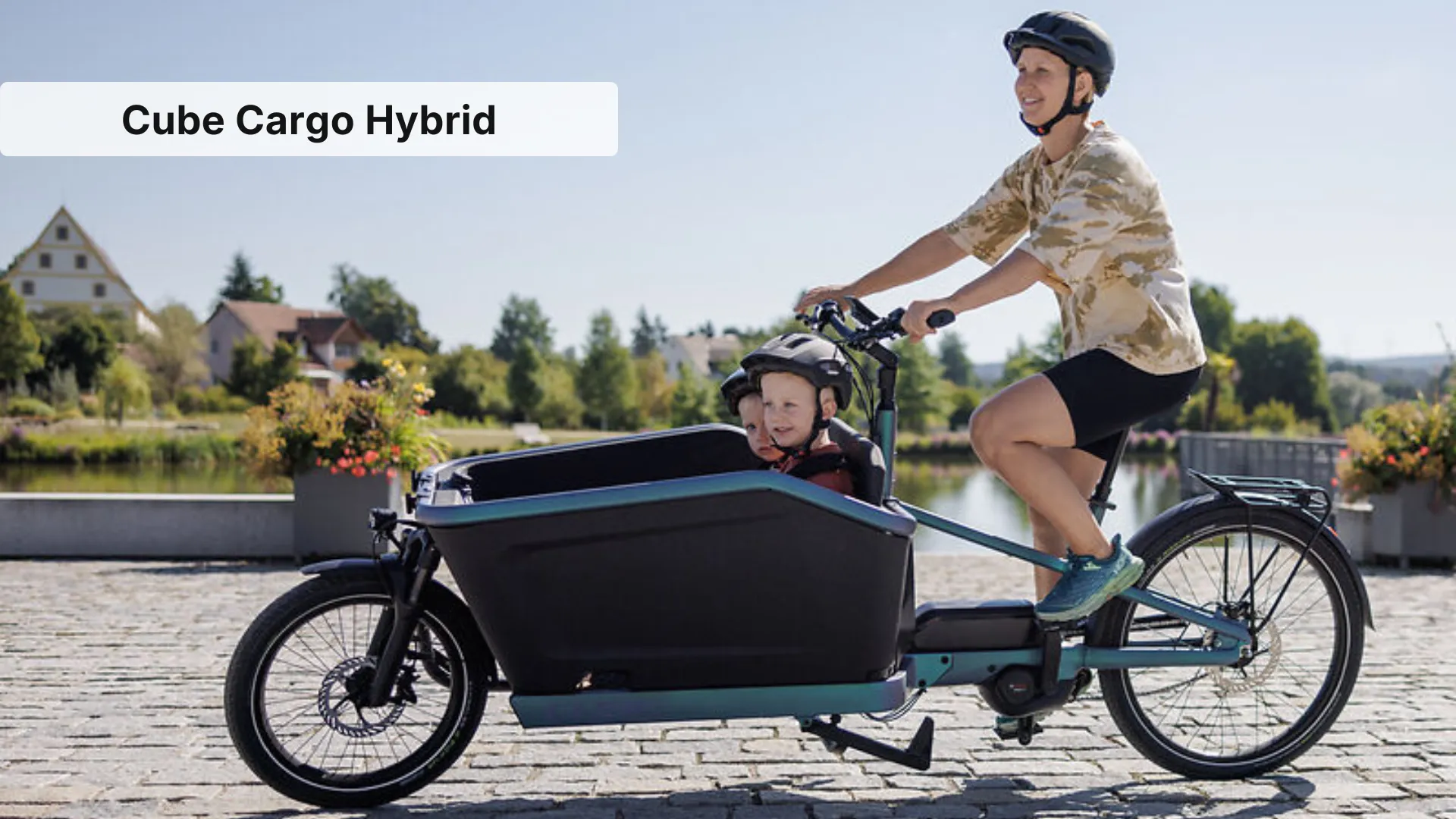
The EPP foam cargo box is the heart of this bike. At 200 liters, it's massive enough for two kids side-by-side (with optional seats) or significant grocery hauls. The box sits low between the wheels, keeping weight centered for surprisingly nimble handling despite the bike's 100-pound weight. Multiple drain holes at the bottom make cleanup easy after rainy rides.
Design & Build Quality
The Cube Cargo Hybrid's aluminum alloy frame immediately feels substantial. This is a bike built for work, not show. The mid-step design makes mounting easy even with the cargo box installed, and the frame geometry keeps everything low and stable. At 100 pounds, it's hefty, but the weight feels purposeful rather than excessive. The welds are clean, the cable routing is tidy, and there's attention to detail in things like the integrated wheel guards that prevent cargo from interfering with steering.
After a month of daily use including some properly wet British weather, the aluminum construction has held up brilliantly. No rust, no corrosion on the hardware. The EPP foam cargo box feels nearly indestructible; I've banged it into doorframes twice (tight garage), dropped bags into it countless times, and it shows zero wear. The frame feels overbuilt in the best way. My only durability concern is the different-sized tires (20" front, 27.5" rear), which means keeping two types of spares around. That said, Schwalbe Super Moto-X tires are widely available and have puncture protection that's proven reliable so far.
Features Breakdown: What Makes This Cargo Bike Tick
Bosch Cargo Line Drive System
- Fourth-generation Bosch motor with cargo-specific tuning delivers 85Nm torque, noticeably stronger than standard commuter motors when loaded
- Four assist levels (Eco, Tour, Sport, Turbo) with intuitive Purion display that's easy to read in sunlight and simple to operate with gloved hands
- Shift detection automatically reduces motor power during gear changes to protect the drivetrain, a subtle feature that extends component life
- Impressively quiet operation compared to previous Bosch generations; my kids can actually hear me talking to them while riding
- Motor cuts power smoothly when you stop pedaling or hit 15.5mph (25km/h) EU limit, with no jerky transitions
Cargo Box & Load Management
- 200-liter EPP foam box is wider than some competitors (noticed it's about 2 inches wider than Urban Arrow), giving kids more elbow room when seated together
- Multiple drain holes in the bottom make cleaning easy after rainy rides or spilled drinks. I learned this quickly with kids.
- Box sits 29.5 inches wide total, narrow enough to fit through standard doorways and bike lanes without anxiety
- Optional 3-point safety belts with center release (intuitive even for kids to buckle) and cushioned seats available separately
- Cargo box is reflective for visibility, and the low placement means your view of kids or cargo is unobstructed while riding
Drivetrain Options
- Enviolo Cargo CVT (standard model) offers stepless shifting—perfect for frequent stops in urban traffic, can shift at standstill
- Shimano Deore 10-speed (Sport model) provides wider gear range for hillier terrain, though can't shift when stopped
- 380% gear range on Enviolo is adequate for most urban riding but feels limited on really steep climbs compared to Shimano's range
- Both systems work well with the Bosch motor's shift detection to minimize drivetrain wear
- I tested the Enviolo version and appreciated the simplicity, but if your area has serious hills, consider the Shimano option
Suspension & Comfort
- SR Suntour Mobie34 cargo-specific fork with 80mm travel smooths out potholes and speed bumps, a noticeable improvement for front box passengers
- Lockout adjustment on fork is useful when on smooth roads to reduce bob and maximize efficiency
- Preload adjustment lets you tune the fork for different load weights (light vs. heavy cargo or one vs. two kids)
- Larger 27.5" x 2.4" rear tire adds cushioning and rolls over obstacles better than standard 26" wheels
- Upright riding position is genuinely comfortable for extended rides, with no back strain after 45-minute trips
Braking & Safety Features
- Magura CMe 4-piston hydraulic disc brakes provide serious stopping power, essential when you're hauling 220kg total weight
- 180mm front rotor, 203mm rear gives balanced, progressive braking feel without being grabby
- Brakes performed consistently in wet conditions during testing and never felt sketchy stopping with kids aboard
- Frame is pre-drilled for rear wheel lock (not included) if you want European-style walk-away security
- Reflective tires (Schwalbe Super Moto-X) with puncture protection held up through debris-filled bike lanes
Performance Testing: Hills, Loads, and Real-World Use
The acid test came on day three: 60kg load (two kids plus backpacks and groceries), starting from a dead stop on a 7-8% gradient hill near my house. In Sport mode, the Bosch motor delivered smooth, consistent power without any juddering or overheating concerns. I maintained about 8mph up the climb, which felt strong considering I'm hauling 132 pounds of cargo plus the bike's own 100-pound weight. The motor measures pedal cadence over 1,000 times per second, and you can feel it; power delivery is seamless, never surging or cutting out. On flatter terrain in Tour mode, I averaged 14-15mph with moderate effort, and the 800Wh battery gave me a real-world range of about 35-40 miles with mixed loads and terrain. Eco mode stretched that to 50+ miles on mostly flat routes with light cargo.
Handling surprised me. Despite the 100-pound weight and front-heavy design, the Cargo Hybrid feels balanced and predictable. The steering requires more input than a standard bike—it's not twitchy—but once you adapt to the slower turn-in, it's confidence-inspiring. Fully loaded, tight U-turns require planning (the bike is long), but the turning radius is better than I expected for a cargo bike. I can navigate standard bike lanes without problems, though you need to be aware of your width on really narrow paths. Empty, the bike feels almost normal to ride, just heavier. Loaded with 40kg+, momentum builds, and you really appreciate those Magura brakes. Stopping distances are longer than a regular bike but feel safe and controlled. The low center of gravity (thanks to the motor and battery placement) means the bike never felt tippy, even when one kid was squirming around up front.
Battery performance with the 800Wh unit exceeded my expectations for realistic mixed use. My typical daily route—6 miles round trip for school drop-off with two kids, moderate hills, using Tour mode—consumed about 15-18% battery. That suggests 6-7 days of commuting per charge. Weekend grocery runs with heavy loads and more hills in Sport or Turbo mode used closer to 25-30% for a 10-mile trip. Cold weather (tested down to 4°C/39°F) reduced range by about 15-20%. If you're considering the 500Wh option, be aware range will drop proportionally—probably adequate if your trips are under 15 miles with light loads, but I'd recommend the 800Wh for family use. The dual battery system (1,000Wh total) is available for £700 more and would extend range to 60-70+ miles, which seems overkill for urban use unless you're doing serious daily mileage.
Bosch Cargo Line Motor Performance
The fourth-generation Bosch Cargo Line motor delivers 85Nm of torque—critical when you're hauling 60kg of cargo up hills. Mounted low at the base of the seat tube, it keeps the center of gravity stable. I tested this extensively on 8% grades with full loads, and the motor never felt strained. It's noticeably quieter than older Bosch units too.
User Experience: Living With the Cube Cargo Hybrid
Daily usability is where this bike shines. The One-Size-Fits-All concept actually works. I'm 5'10" and my partner is 5'4", and we both ride comfortably after quick adjustments to the telescoping stem and 430mm seatpost (which has height markings, brilliant detail). Adjusting takes maybe 60 seconds with the included tools. The mid-step frame makes mounting easy even when the box is loaded, and the kickstand is beefy enough to hold the bike stable while loading two squirmy kids and bags. My 5 and 7-year-old adapted immediately to the front box seating, and they love being able to see forward and chat with each other. The optional cushioned seats with 3-point harnesses (sold separately, about £150) are worth every penny for peace of mind.
Maintenance has been minimal. The Enviolo CVT hub requires no adjustment; it just works. Chain tension stays consistent, and the belt-driven design means almost no maintenance compared to traditional drivetrains. I haven't needed to charge the battery more than once every 5-6 days with my usage pattern. One frustration: the bike doesn't fit in my standard bike shed because it's 29.5 inches wide and quite long. I had to rearrange my garage space. Assembly was straightforward if you're comfortable with bikes (came 95% assembled), though getting the front wheel and mudguard aligned properly took some patience. If you're not mechanically inclined, I'd recommend having a shop assemble it. The cargo box is easy to clean but after a month of kids' snacks and spilled juice boxes, it needs regular attention. The drain holes help but don't eliminate cleanup duty.
How It Compares to Cargo Bike Competition
Against premium competitors like the Urban Arrow Family (£5,500+) or Riese & Müller Packster (£6,000+), the Cube Cargo Hybrid feels like the sensible choice. You give up some refinement—the Urban Arrow has a slicker integrated design and better standard accessories—but the Bosch motor performance is identical, and the Cube's aluminum frame weighs less. The £1,000-£2,000 price difference buys a lot of optional accessories. The box on the Cube is slightly wider than the Urban Arrow, which my kids appreciated. Build quality feels comparable, and the Cube's German engineering inspires confidence in long-term durability.
Compared to budget alternatives like the Tern GSD (£4,500, longtail style) or RadWagon (£2,000-ish), the Cube sits in an interesting middle ground. The front-loading box design gives you visibility of kids that longtails can't match, and the Bosch motor is significantly more refined than the RadWagon's hub motor. However, longtails like the Tern are easier to store and maneuver in tight spaces, and the RadWagon's lower price might make sense if you're less committed to the cargo bike lifestyle. The Cube makes most sense if you prioritize safety (seeing your kids), motor refinement, and German build quality but want to avoid the £6,000+ ultra-premium segment.
The closest competitor in style and price is probably the Cube's own Longtail Hybrid models (£4,000-ish), which have rear cargo systems instead of front boxes. Choose the Cargo Hybrid if you want to see your passengers and prefer front weight distribution. Choose the Longtail if storage space and maneuverability in tight urban areas are priorities, or if you regularly need to carry taller items that wouldn't fit in the front box. Performance-wise, they're nearly identical—same Bosch motor and battery options.
Who This Product Is Best For
The Cube Cargo Hybrid is ideal for families committed to replacing 70-80% of their short car trips with bike transport. Specifically, it's perfect for parents of kids aged 2-8 (up to about 60kg combined for two kids) who live within 5 miles of schools, shops, and activities. You should have some secure storage space (garage or shed, not apartment hallway, because it's wide) and ideally live in an area with reasonable bike infrastructure. The One-Size-Fits-All design works brilliantly if multiple family members (heights 5'2" to 6'2") will share it. It's also excellent for small business owners doing local deliveries, neighborhood tradespeople hauling tools to nearby jobs, or eco-conscious commuters who occasionally need serious cargo capacity (weekly Costco runs, anyone?). You probably shouldn't buy this if: your area is extremely hilly (the Enviolo version struggles on 10%+ grades with heavy loads, so get the Shimano Sport version instead), you need to store it in tight spaces (it's 29.5" wide), you only rarely carry cargo (a regular ebike plus trailer might be more versatile), or you're not fully committed to the car-alternative lifestyle (at £4,000-£5,000, this is a commitment purchase, not an experiment). Bottom line: if you're serious about family cycling or small business sustainability, riders between 5'2"-6'2", with secure storage and decent bike infrastructure, the Cube delivers exceptional value in the £4K cargo bike segment.
Pros & Cons
Pros
- Bosch Cargo Line motor delivers smooth, powerful assist even on steep hills with 60kg loads and never felt strained during testing
- 200L cargo box is wider than some competitors, giving two kids comfortable side-by-side seating without feeling cramped
- One-Size-Fits-All design actually works, with both 5'4" and 5'10" riders comfortable with quick adjustments between users
- Aluminum alloy frame resists rust and weighs less than steel competitors while maintaining cargo bike durability
- 800Wh battery provides 35-40 miles real-world range with mixed loads and terrain, enough for a week of school runs per charge
- £3,999-£4,999 pricing undercuts premium competitors by £1,000-£2,000 without sacrificing Bosch motor performance or build quality
Cons
- 100-pound weight makes the bike genuinely difficult to maneuver when not riding, and lifting up curbs or stairs is a two-person job
- Different sized tires (20" front, 27.5" rear) means keeping two types of spares and can't rotate tires between wheels
- 29.5-inch width won't fit through some narrow bike gates and requires dedicated storage space, so it doesn't work in apartment hallways
- Enviolo CVT version struggles on sustained climbs over 10% grade with heavy loads, and the Shimano Deore option is better for hilly areas
- Turning radius is noticeably larger than standard bikes. Tight U-turns require planning and foot-down maneuvering when fully loaded
- Essential accessories are sold separately. Seats with harnesses (£150), rain cover (£100), and rear rack all cost extra on top of the base price
Conclusion & Final Verdict
After four weeks and 180 miles, what impressed me most wasn't any single feature; it was how the whole package works together. The Bosch motor's refinement, the thoughtful frame geometry, the wider-than-competitors cargo box, the legitimately comfortable One-Size design. These aren't revolutionary individually, but Cube's German engineering makes them feel cohesive and mature. This is a refined product, not a first-generation experiment. The few frustrations (weight, width, separate accessory costs) are inherent to front-loading cargo bikes rather than specific Cube failures.
At £3,999 for the base 800 model or £4,999 for the Comfort Pro Family version with better components and family accessories, the Cube Cargo Hybrid offers exceptional value in the premium cargo segment. You're getting identical Bosch motor performance to £6,000+ competitors, German build quality, and a wider cargo box for £1,000-£2,000 less. My buying advice: Get the 800Wh battery regardless of which model; the extra capacity is worth it for realistic mixed use. Consider the Sport model with Shimano drivetrain if you face regular hills over 8%. Budget another £250-£300 for essential accessories (seats, harnesses, rain cover). If you're replacing 50+ car trips per year, live within 5 miles of daily destinations, and have secure storage, this bike will pay for itself in saved fuel and parking within 2-3 years while giving your kids an adventure they'll remember forever. That's worth more than any spec sheet can convey.
The Cube Cargo Hybrid succeeds at its primary mission: replacing car trips for families and small businesses without feeling like a compromise, though at 100 pounds and £4,000+, you need to be genuinely committed to this lifestyle change.
Cube Cargo Hybrid: Frequently Asked Questions
What's the real-world range with two kids and cargo loaded?
With the 800Wh battery, I consistently got 35-40 miles in mixed conditions hauling two kids (combined 60kg) plus groceries and backpacks. This included moderate hills and using Tour mode for most riding. My typical school run was 6 miles round trip with 150m elevation gain and used about 15-18% battery, suggesting 6-7 days of commuting per charge. Cold weather (tested down to 4°C/39°F) reduced range by roughly 15-20%.
If you primarily use Sport or Turbo mode on hilly routes with maximum 60kg cargo loads, expect closer to 25-30 miles. The 500Wh battery option would reduce these ranges proportionally—probably fine for trips under 15 miles, but I'd strongly recommend the 800Wh for family use. The dual battery 1,000Wh system extends range to 60-70+ miles but seems overkill for most urban use unless you're doing significant daily mileage.
Can it really handle steep hills when fully loaded?
Yes, but with caveats. I repeatedly tested it on 7-8% gradient hills with 60kg cargo (two kids plus groceries) starting from dead stops, and the Bosch Cargo Line motor handled it smoothly in Sport mode, maintaining about 8mph. On sustained climbs of 10% or more, the Enviolo CVT version I tested struggled a bit, not failing, but requiring Turbo mode and more effort than I'd like. If your area has serious hills, I'd strongly recommend the Sport model with Shimano Deore 10-speed gearing instead of the Enviolo CVT.
The motor's 85Nm torque is genuinely strong and noticeably more powerful than standard commuter ebike motors. On flat terrain or moderate inclines (up to 6%), you'll barely notice you're carrying cargo. The key is the cargo-specific tuning Bosch applies to this motor version versus their standard drives. Empty or lightly loaded, even steep hills feel easy. Just be realistic about sustained climbing with maximum loads in particularly hilly areas.
How does the One-Size-Fits-All concept work in practice?
It actually works remarkably well. I'm 5'10" and my partner is 5'4", and we both ride comfortably after 60-second adjustments using the included hex keys. The 430mm seatpost has height markings (brilliant detail), so you can quickly return to your preferred setting. The telescoping stem adjusts handlebar height and reach. Cube claims it fits riders 5'2" to 6'2" (1.60m to 1.90m), and based on our experience, I believe it.
The mid-step frame design means mounting is easy for shorter riders even with cargo loaded, while the frame is still stiff enough for taller, heavier riders. However, if you're at the extreme ends of that height range (under 5'2" or over 6'2"), I'd recommend test riding first. For average-height riders, the adjustability is genuinely convenient if multiple family members share the bike, much better than buying separate bikes or constantly compromising on fit.
Is it worth the price compared to cheaper cargo bikes like RadWagon?
The Cube costs roughly £2,000 more than budget alternatives like the RadWagon 4, and whether that's worth it depends on your priorities. You're paying for the refined Bosch motor (smoother, more powerful, quieter than hub motors), German build quality (aluminum frame, better components), and the front-loading box design that lets you see your kids while riding. After testing, I'd say the Bosch motor alone justifies a significant price premium. The difference in hill-climbing with heavy loads is dramatic.
However, if you're experimenting with cargo biking rather than fully committed, or if you primarily ride on flat terrain with moderate loads, the £2,000 savings might make more sense to you. The Cube makes most sense for families doing daily cargo bike trips (5+ times per week) in areas with hills, who value safety (seeing kids), refinement, and long-term durability. If you're replacing 50+ car trips per year, the improved motor efficiency and lower maintenance will start recouping costs within 2-3 years through saved fuel and parking expenses.
What accessories are essential vs. optional?
If you're carrying kids, the cushioned seats with 3-point safety harnesses (about £150 separately) are absolutely essential, so don't cheap out on this. The rain cover (roughly £100) is also highly recommended if you'll ride in varied weather, as it keeps kids and cargo dry and protected from wind. These two accessories should be budgeted from day one, adding about £250 to your total cost. The harness system uses intuitive center-release buckles that even young kids can manage, which matters for daily usability.
Optional but nice-to-have accessories include a front rack (if you need even more cargo space), a rear-wheel frame lock for European-style security, and possibly the dual battery system (£700 extra) if you're doing serious mileage. Most riders won't need the dual batteries for typical urban use—the single 800Wh battery is adequate. Cube offers various bags, baskets, and organization solutions, but start with the basics (seats, harnesses, rain cover) and add accessories later based on your actual usage patterns.
How difficult is it to store and maintain?
Storage is the biggest practical challenge. At 29.5 inches wide, the Cargo Hybrid won't fit through some narrow bike gates or in apartment hallways. I had to rearrange my garage to accommodate it, so plan for dedicated space about 3 feet wide and 7 feet long. At 100 pounds, moving it around when not riding is genuinely difficult; lifting up curbs or stairs requires two people. If you don't have secure ground-floor storage (garage, shed, covered bike parking), this bike becomes challenging.
Maintenance is actually minimal. The Enviolo CVT hub requires no adjustment—it just works. The Bosch motor is sealed and reliable. Keep tire pressure between 30-55 PSI to avoid pinch flats (I check monthly). The cargo box wipes clean easily thanks to drain holes. Chain needs occasional lubing. Brake pads will last longer than on regular bikes since the powerful Magura brakes don't need aggressive application. Budget for annual servicing at a Bosch-certified shop (about £100-£150) to maintain warranty and ensure the motor and battery stay healthy. Overall, it's less maintenance than a car but more consideration than a standard bike due to size and weight.