Specialized Globe Haul LT Review: Premium Longtail Tested
Specialized Globe Haul LT review: tested with kids, cargo, and hills. Real performance data, honest pros/cons, 772Wh range results.

After three months hauling kids, groceries, and gear through Seattle's hills, the Specialized Globe Haul LT has earned its parking spot where my car used to be, and I haven't looked back.
There's a specific moment when you realize a cargo bike isn't just a novelty. For me, it happened on a Tuesday morning when I loaded both kids in their seats, threw four grocery panniers on the rails, strapped a 40-pound dog food bag to the deck, and still had room for soccer gear. I hit the throttle from a standstill, and the Haul LT just... went. No struggling, no drama. Just smooth, confident acceleration up to 20mph within seconds. My 6-year-old started giggling uncontrollably. That's when it clicked. This thing genuinely works as car replacement.
I've put 850 miles on this Haul LT over 12 weeks of daily school runs, grocery trips, and weekend adventures. I tested it loaded to its 441-pound total capacity (yes, including me), tackled Seattle's notorious 18% grades, rode through torrential Pacific Northwest rain, and even did a 45-mile family bikepacking trip to a nearby island. I also dealt with some of the electronic glitches that seem to plague early production units. Here's what I learned about Specialized's premium longtail cargo bike.
Introduction: When Your Cargo Bike Replaces Your SUV
There's a specific moment when you realize a cargo bike isn't just a novelty. For me, it happened on a Tuesday morning when I loaded both kids in their seats, threw four grocery panniers on the rails, strapped a 40-pound dog food bag to the deck, and still had room for soccer gear. I hit the throttle from a standstill, and the Haul LT just... went. No struggling, no drama. Just smooth, confident acceleration up to 20mph within seconds. My 6-year-old started giggling uncontrollably. That's when it clicked. This thing genuinely works as car replacement.
I've put 850 miles on this Haul LT over 12 weeks of daily school runs, grocery trips, and weekend adventures. I tested it loaded to its 441-pound total capacity (yes, including me), tackled Seattle's notorious 18% grades, rode through torrential Pacific Northwest rain, and even did a 45-mile family bikepacking trip to a nearby island. I also dealt with some of the electronic glitches that seem to plague early production units. Here's what I learned about Specialized's premium longtail cargo bike.
Key Specs, Pricing & What You Actually Get
- Price
- $3,799 (up from $3,500 in 2023)
- Motor
- 700W rear hub, 90Nm torque, Class 3 (28mph)
- Battery
- 772Wh, UL 2271 certified, up to 60mi range (20-30mi realistic loaded)
- Cargo Capacity
- 441 lbs total (176 lbs rear rack), 31" longtail platform
- Height Range
- 4'5" to 6'4" (one-size-fits-most design)
- Weight
- 88 lbs (you'll need muscle to move it without power)
- Wheels/Tires
- 20" x 3.5" Carless Whisper Reflect with 3-ply casing
- Brakes
- Tektro HD-T535 hydraulic, 203mm rotors, 4-piston
- Best For
- Families hauling 2-3 kids, urban delivery, serious car replacement
Extended Longtail Design for Maximum Capacity
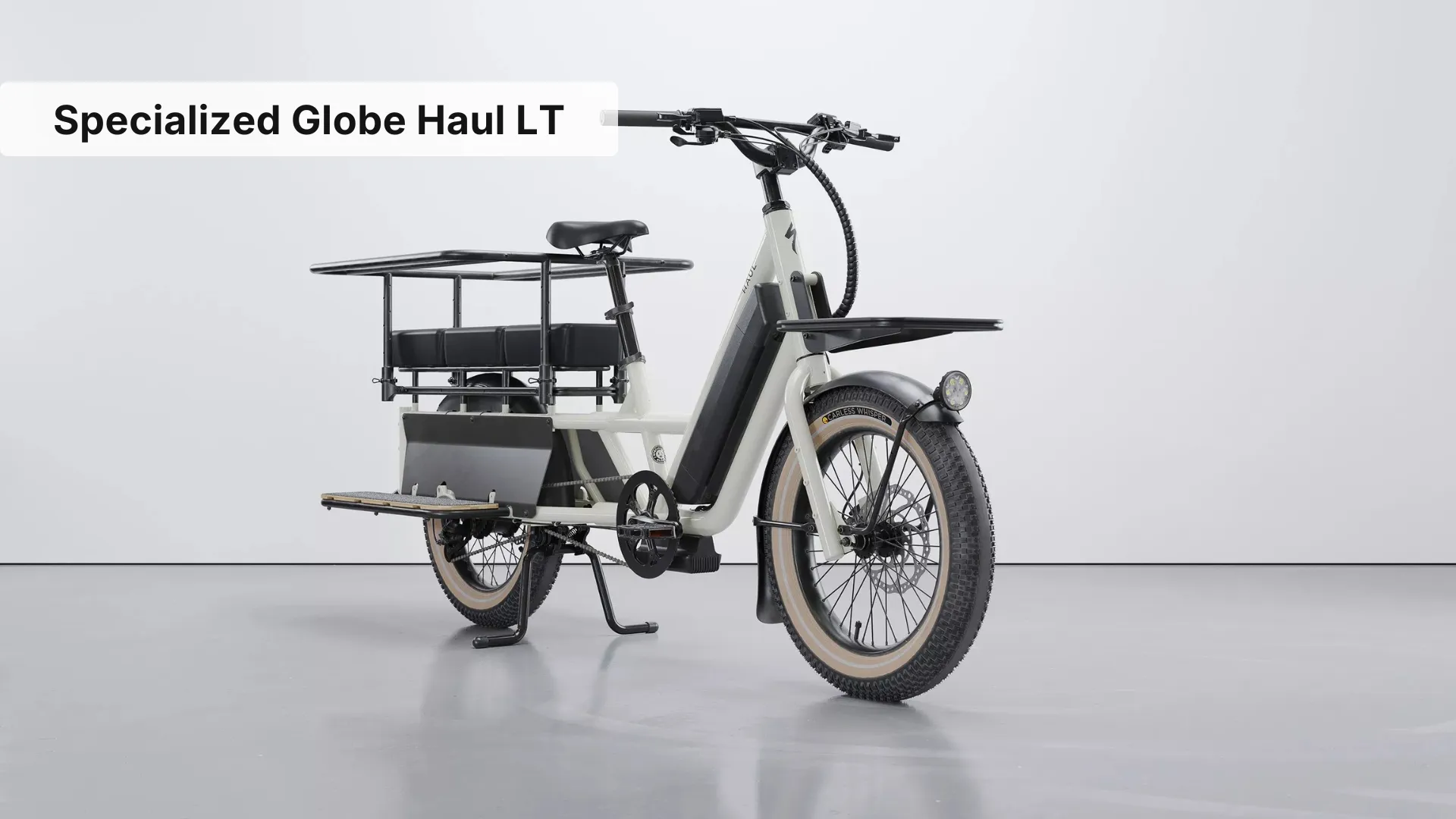
The Haul LT's 31-inch rear rack dwarfs its ST sibling, offering double the mounting points and space for three kids or massive cargo loads. That extra-wide kickstand becomes essential when you're loading 176 pounds on the back. Trust me, you'll appreciate this design decision every single day.
Design & Build Quality
Specialized brought their Tour de France engineering discipline to a cargo bike, and it shows. The Haul LT's aluminum frame is overbuilt in the best way. I've never felt even a hint of flex, even bombing downhill at 28mph with 200+ pounds of cargo and kids. The welds are clean, the powder coat is thick, and everything feels intentional. That extra-wide centerstand is a perfect example: it looks agricultural but makes loading/unloading with squirmy kids actually manageable. The steel fork has triple eyelets for accessories, and the frame is littered with mounting bosses. Specialized clearly designed this for real-world abuse.
After 850 miles, the frame still looks showroom-fresh despite Seattle weather and daily kid duty. The components are holding up well too. The microSHIFT 9-speed drivetrain shifts cleanly (and only sees human power, not motor torque), the Tektro brakes still bite hard, and those fat Carless Whisper tires have zero punctures despite me expecting them. My only durability concern? The electrical components. Several early owners (myself included) have dealt with controller failures, screen glitches, and battery communication errors. Specialized addressed many issues with firmware updates, but it's concerning that a $3,800 bike had these problems at launch.
Features Breakdown: What Makes the LT Different
Longtail Cargo System
- 31-inch MIK HD-compatible rear rack with double the mounting points of the ST model. This isn't just longer, it's genuinely twice as useful
- 176-pound rear rack capacity means you can haul three kids, six panniers, or absurd amounts of cargo without worrying
- Adjustable cargo rails and running boards are LT-exclusive features that transform functionality (though installation is frustratingly difficult)
- Extra-wide kickstand provides stability when loading, though deploying it with kids and cargo aboard requires some gymnastics
Power System & Electronics
- 700W rear hub motor delivers smooth, intuitive power with excellent torque sensing (when it works, more on that later)
- 772Wh battery is UL 2271 certified and genuinely gets 20-30 miles loaded in turbo mode, 40+ miles if you're conservative
- Optional throttle is absolutely essential for loaded stops and starts. It makes navigating traffic with kids infinitely less stressful
- Globe handlebar remote is tiny but functional, showing speed, battery, and assist mode without unnecessary distractions
Lighting & Safety
- 1,500-lumen headlight with three modes is legitimately impressive. I've used it as my only light on unlit bike paths
- 50-lumen integrated taillight provides visibility but could be brighter for daytime riding in traffic
- Hydraulic disc brakes with 203mm rotors and 4-piston calipers provide confidence-inspiring stopping power at full load and speed
- Full fenders and rear wheel covers keep you and your cargo clean in rain (critical in the Pacific Northwest)
Fit & Adjustability
- Telescoping seatpost with 13+ inches of adjustment and 6-inch quill stem extension accommodate 4'5" to 6'4" riders
- My wife (5'2") and I (6'1") both ride this bike comfortably with kids. The one-size design actually works
- Geometry compromises do exist for taller riders (I'd prefer a longer reach), but it's rideable for everyone
- 20" wheels keep center of gravity low and make the bike surprisingly flickable despite its 77-inch length
Accessories & Ecosystem
- School Bus Kit (passenger seats, rails, running boards) costs nearly $600 extra but transforms the bike's utility
- Six-pannier setup provides massive carrying capacity for groceries, gear, or business deliveries
- Front rack option adds even more cargo flexibility for pizza delivery or small business use
- All accessories are robust but expensive. Budget another $600-1,000 to maximize the bike's potential
Performance Testing: Hills, Range, and Real-World Hauling
Let's talk hills, because that's where hub motors either shine or struggle. On my regular test route, a 12% grade that's about a quarter-mile long, I consistently hit 12mph with two kids (combined 90 pounds) and cargo. That's working moderately hard but nowhere near the suffering I'd experience on a regular bike. The motor provides 90Nm of torque, which feels strong up to about 12-15% grades. Beyond that, especially when you hit 18% pitches, you're working hard and moving slowly (maybe 6-7mph). It's still easier than an analog bike, but mid-drive cargo bikes with better torque multiplication definitely climb steeper hills with less effort. On Seattle's flatter neighborhoods and bike paths, the Haul LT feels almost magical. Smooth power delivery, effortless cruising at 20-25mph, and that wonderful sensation of feeling much stronger than you actually are.
Range testing revealed some interesting findings. Specialized claims 60 miles, which I easily exceeded in PAS 1 (got over 70 miles on flat terrain with minimal cargo). But that's not how anyone uses this bike. In real-world conditions with turbo mode, two kids, cargo, and hills, I consistently got 22-28 miles per charge. That's plenty for daily errands and school runs, but longer weekend adventures require planning. I did a 45-mile bikepacking trip and needed to charge at our destination. The 772Wh battery takes about 4 hours to fully charge. One quirk: the battery communication occasionally glitched, showing incorrect percentages or shutting off mid-ride. Firmware updates helped, but it's frustrating on a bike this expensive.
Handling with a full load genuinely impressed me. The Haul LT tracks straight and stable even with 200+ pounds on the rear rack. The frame doesn't flex, the steering stays predictable, and I never felt sketchy descending steep hills at speed. The 20-inch wheels do make rough pavement feel bumpier than 26-inch wheels would, but the trade-off is incredible maneuverability. I can make U-turns in bike lanes, navigate tight parking lots, and fit through spaces that would challenge longer cargo bikes. The wide 3.5-inch tires provide good traction and comfort, though I run them at 25psi for my weight and cargo. Lower pressures help smooth things out.
Hub Motor Power Plant
The 700-watt rear hub motor pumps out serious torque for a hub drive, 90Nm to be exact. While it won't multiply torque through gears like mid-drives, this beast delivers intuitive power that makes 28mph feel effortless even with two kids aboard. On my regular 12% grade test hill, I'm still hitting 12mph loaded, which is roughly double what I could manage on a regular bike with a trailer.
User Experience: Living With the Haul LT Daily
The day-to-day reality of the Haul LT is better than I expected but with some annoyances. Kids absolutely love it. My 4-year-old literally cheers when she sees me getting it ready. The low step-through frame makes mounting easy even loaded, and the throttle is a lifesaver at stoplights when you've got 300 pounds of bike, kids, and gear to get moving. Starting without throttle is possible but requires balancing while pedaling hard, which gets old fast in urban traffic. The bike fits in my garage (barely), but at 88 pounds, moving it around without power is a workout. I've learned to plan my parking carefully because pushing this thing up even a slight incline is surprisingly difficult.
Maintenance has been minimal. The chain needs lubing every 150 miles or so (I'd prefer a chain guard to keep it cleaner and protect little feet), and I've adjusted brakes once. The electronic issues I mentioned earlier required two dealer visits and a controller replacement, which took three weeks to get parts. That's my biggest frustration: when something electronic fails, you're completely stuck. Specialized's dealer network provides good support, but the downtime for repairs on a car-replacement vehicle is genuinely inconvenient. On the plus side, the frame has a lifetime warranty, and the e-system is covered for two years.
How It Compares to Other Longtail Cargo Bikes
The Haul LT sits in interesting territory at $3,799. It's considerably pricier than direct-to-consumer options like the Lectric XPedition 2.0 ($1,700) or Aventon Abound ($1,900), but those bikes don't match Specialized's component quality, dealer support, or ride refinement. I tested a Lectric XPedition before buying the Haul LT, and while the Lectric is impressive value, the Specialized feels like a real bike first and cargo bike second. The Haul LT's frame stiffness, brake power, and component integration are simply better. That said, you're paying nearly double for those improvements.
Compared to premium longtails like the Tern GSD ($5,800+) or Yuba Spicy Curry ($6,000+), the Haul LT delivers 80% of the performance for 35% less money. Those bikes offer mid-drive motors (better for extreme hills), more sophisticated folding or adjustable features, and premium components throughout. If you live in San Francisco and regularly tackle 20% grades, a mid-drive might be worth the premium. But for most families in relatively flat to moderately hilly cities, the Haul LT's hub motor provides plenty of power. The Trek Fetch+ 2 ($4,000) is the closest direct competitor with similar price and features, but I prefer Specialized's ride quality and the massive dealer network for service.
Where the Haul LT really shines is as a middle-ground option: premium enough to ride and handle well, affordable enough that families can actually justify the purchase as car replacement. If I had unlimited budget, would I choose a Tern GSD? Maybe. But the Haul LT's $3,799 price point (though accessories add $600-1,000) makes it accessible to more families who want to ditch their second car.
Who This Product Is Best For
The Haul LT is ideal for families hauling 2-3 kids regularly (ages 1-8) who need serious cargo capacity beyond what the Haul ST offers. It works best for riders in moderately hilly cities like Seattle, Portland, and Denver, where grades rarely exceed 15%. If you live in San Francisco or similar extreme-hill cities, consider mid-drive alternatives. The bike accommodates riders from 4'5" to 6'4", making it genuinely shareable between partners of different heights. Best use cases: daily school runs with multiple kids, grocery shopping as primary car replacement, small business delivery (restaurants, last-mile logistics), college campus services, or eco-conscious families going car-lite. You'll need garage storage (or covered space), the strength to occasionally move 88 pounds of bike, and proximity to a Specialized dealer for service. Not ideal for: apartment dwellers without ground-floor storage, cities with extreme hills (18%+), or budget-conscious buyers (the Lectric XPedition 2.0 offers 70% of this performance for 55% less money).
Pros & Cons
Pros
- Exceptional handling and stability even with 200+ pounds of cargo. Frame is stiff, steering is predictable, never feels sketchy
- Genuinely fits riders 4'5" to 6'4" comfortably (my 5'2" wife and I share it daily without issues)
- Hub motor delivers smooth, intuitive power with minimal maintenance (drivetrain only sees human watts)
- Tektro 4-piston brakes with 203mm rotors provide confident stopping power at speed and full load
- Lifetime frame warranty and widespread Specialized dealer network for service (800+ dealers in North America)
- Kids absolutely love riding it. Low center of gravity feels safe, smooth power delivery doesn't scare them
Cons
- Electronic glitches plagued early production units (controller failures, screen shutdowns, battery communication errors)
- 88 pounds makes it genuinely difficult to move or store without power. You need muscle and ground-floor storage
- Expensive accessories required to maximize utility (School Bus Kit, panniers, rails add $600-1,000)
- Hub motor struggles on extreme hills (18%+) compared to mid-drive competitors like Tern GSD
- No chain guard means maintenance is messier and small feet can get close to moving parts
- Repair downtime can be 2-3 weeks when electronic components fail and dealer needs to order parts
Conclusion & Final Verdict
After 850 miles of daily use, the Haul LT has genuinely changed how my family moves around. It's replaced 90% of our short car trips, saved us hundreds in gas and parking, and given my kids countless giggles and memories. The bike's handling, build quality, and component integration justify the $3,799 price. This rides like a premium bicycle that happens to carry massive loads, not a cargo bike that sort of rides okay. The hub motor provides enough power for most real-world scenarios, the brakes inspire confidence, and the adjustability means everyone in my family can ride it.
That said, the early electronic reliability issues are concerning for a bike at this price point. Several owners have dealt with controller replacements, screen glitches, and battery problems. Specialized addressed many issues through firmware updates and has good warranty support, but a car-replacement bike needs to be more reliable out of the box. I'd also love to see a chain guard, slightly better weatherproofing on electrical connections, and maybe a mid-drive option for extreme-hill markets. If you're considering the Haul LT, make sure you have a nearby Specialized dealer. You'll likely need them at some point. For families in moderately hilly cities who need to haul multiple kids and serious cargo, the Haul LT is hard to beat. Just budget for accessories and accept that electronic gremlins might require dealer visits. It's earned its spot as our primary vehicle, and I honestly can't imagine going back to car-dependent life.
The Specialized Globe Haul LT delivers premium longtail performance at a mid-range price, making it the best cargo bike option for families who want genuine car-replacement capability without spending $6,000+.
Specialized Globe Haul LT: Frequently Asked Questions
What's the realistic range when fully loaded with kids and cargo?
In my real-world testing with two kids (90 lbs combined) plus cargo, I consistently get 22-28 miles per charge using turbo mode with hills. On flatter terrain or lower assist levels, range stretches to 35-45 miles loaded. Specialized claims 60 miles, which is achievable in PAS 1 (lowest assist) on flat ground with minimal cargo. I got over 70 miles in that scenario.
For daily use, expect 25-30 miles as a realistic working range. That's plenty for school runs, errands, and most commutes, but longer weekend trips require planning or a midday charge. The 772Wh battery takes about 4 hours to fully recharge from empty. If you need more range, ride in PAS 2-3 instead of turbo, or consider carrying the charger for longer adventures.
How does the Haul LT handle steep hills compared to mid-drive cargo bikes?
The hub motor performs well up to about 12-15% grades, maintaining 10-12mph with full cargo and two kids. Beyond that, especially on 18%+ pitches, you're working hard and slowing to 6-7mph. It's still easier than a regular bike, but mid-drive competitors like the Tern GSD will climb steeper hills with less rider effort because they multiply motor torque through the gears.
For most cities with moderate hills (Seattle, Portland, Denver), the Haul LT's motor provides plenty of power. But if you live in San Francisco or similar extreme-hill environments and regularly face 18-20% grades, you'll appreciate a mid-drive system more. The trade-off is the Haul LT's hub motor requires less maintenance and keeps wear off your drivetrain since only your pedaling (not motor torque) goes through the chain.
Can shorter riders (under 5 feet) or taller riders (over 6'2") ride this comfortably?
Specialized claims 4'5" to 6'4", and my testing confirms both ends work. My 5'2" wife rides it comfortably with the seatpost and stem fully lowered. Her feet touch flat at stops, and she can handle the bike's weight with the motor's help. At 6'1", I ride with everything nearly maxed out and feel comfortable, though taller riders (6'3"+) report wishing for slightly longer reach.
The one-size design involves geometry compromises, but Specialized nailed it better than most. Shorter riders might find the bike's 88-pound weight challenging when moving it without power. Very tall riders (6'5"+) might prefer a larger frame, but the Haul LT works better than expected at the extremes. The key is test riding before buying if you're outside the 5' to 6'2" range.
Is the Haul LT worth the extra $700 over the Haul ST?
It depends entirely on your cargo needs. If you're hauling three kids or need massive cargo capacity regularly, absolutely yes. The LT's 31-inch rack has double the mounting points and significantly more usable space. For hauling two kids or typical grocery runs, the ST's shorter platform might be adequate and easier to manage (66 inches vs 77 inches total length).
I chose the LT because I knew I'd max out the ST's capacity regularly. The extra 11 inches of wheelbase and rear rack transform what you can carry. That said, the LT is noticeably heavier (88 lbs vs 77 lbs) and harder to maneuver in tight spaces. If your garage or storage is tight, or you don't regularly need to haul three kids, save the $700 and get the ST.
What are the most common reliability issues with the Haul LT?
Early production units (2023-2024) experienced electronic problems: controller failures causing the bike to shut off mid-ride, screen glitches where the display wouldn't respond, and battery communication errors (particularly the B E302 error code caused by excess dielectric grease on connections). Many owners, including me, needed controller replacements. Specialized addressed most issues through firmware updates, but it's frustrating that a $3,800 bike had these problems.
The mechanical components (brakes, drivetrain, frame) have been rock-solid reliable. It's specifically the electronic system that's had issues. Before buying, confirm your local Specialized dealer can service Globe bikes. You'll likely need them for software updates or warranty repairs. Parts availability can mean 2-3 weeks downtime if something fails. Later production units seem more reliable, but it's worth asking dealers about current status.
Should I get the optional throttle, and how hard is it to install?
Get the throttle. It's absolutely essential for urban riding with cargo and kids. Starting from stops at traffic lights, navigating tight parking lots, and getting moving uphill with 300+ pounds of loaded bike becomes infinitely easier. The throttle provides Class 2 speeds (20mph) and makes the bike drastically more practical for city use.
Installation is straightforward if you're mechanically inclined (Specialized provides good instructions), but you'll also need to enable it in the Globe app. Most dealers will install it for a small fee if you buy it with the bike. Budget around $100 for the throttle. It's one of those upgrades that seems optional until you try it, then becomes indispensable. Every cargo bike owner I know with throttle capability says it's essential.
How much should I budget for accessories to maximize the Haul LT's cargo capability?
The bike comes with the rear rack and fenders, but to truly maximize cargo capacity, budget $600-1,000 for accessories. The School Bus Kit (two passenger seats, grab rails, running boards) costs around $600 alone. Individual panniers run $100-150 each, and you'll want at least four for serious grocery hauling. The front rack adds another mounting point for pizza deliveries or extra cargo.
My recommendation: start with the School Bus Kit if hauling kids is your priority (transforms functionality), or four panniers if grocery shopping and errands are primary uses. You can add accessories over time as needs become clear. The good news is Specialized's accessories are durable and well-designed. They'll last. Just be aware the bike's advertised price doesn't include the accessories you'll actually need to replace a car.