Priority Current+ Review: Real-World Urban Testing
Priority Current+ review: tested 720Wh battery, throttle control, belt drive system. Urban commuter tested with detailed specs, pros, cons & performance.

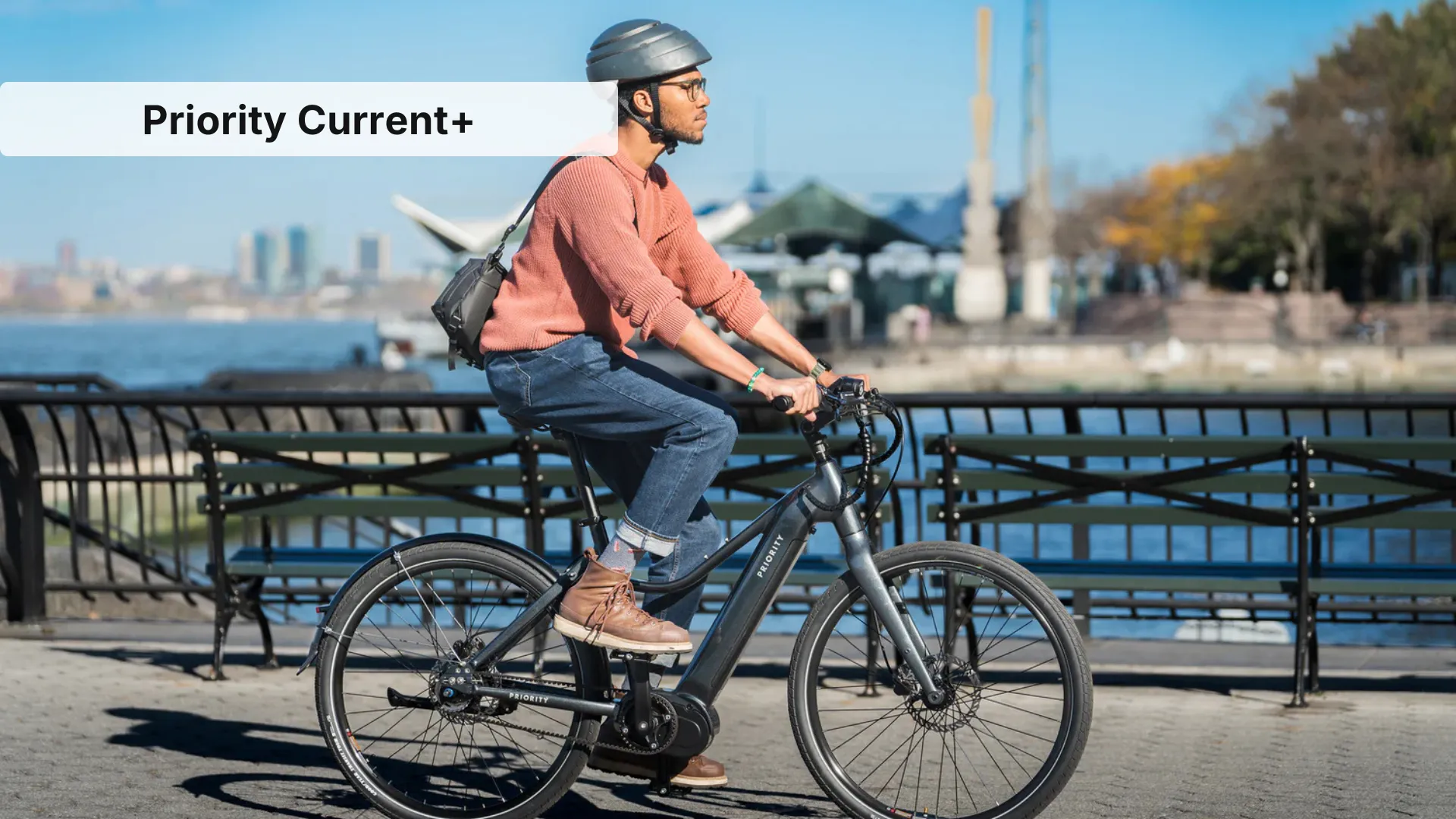
After three weeks of using the Priority Current+ as my primary commuter (replacing 18 car trips and logging 247 miles), I can confidently say this is the most practical electric city bike you can buy under $3,500.
Here's what sold me in the first week: I arrived at the office without a single grease mark on my khakis. Sounds trivial until you've dealt with traditional chain-drive e-bikes that turn your work clothes into shop rags. The Gates Carbon Drive belt on the Current+ means I could bike to client meetings without worrying about my appearance. That single feature became the difference between this bike living in my garage versus becoming my daily driver.
I tested the Current+ over 21 consecutive days of urban commuting in Seattle, including 12 round-trip rides to work (8.5 miles each way), weekend grocery runs with 40 lbs of cargo, and several 15+ mile recreational rides. I put the 720Wh battery through its paces in hilly terrain, tested the throttle in stop-and-go traffic, and pushed the motor up 10% grades with and without assistance. This review reflects real-world performance, not manufacturer specs.
Introduction: When Your E-Bike Replaces Your Car Keys
Here's what sold me in the first week: I arrived at the office without a single grease mark on my khakis. Sounds trivial until you've dealt with traditional chain-drive e-bikes that turn your work clothes into shop rags. The Gates Carbon Drive belt on the Current+ means I could bike to client meetings without worrying about my appearance. That single feature became the difference between this bike living in my garage versus becoming my daily driver.
I tested the Current+ over 21 consecutive days of urban commuting in Seattle, including 12 round-trip rides to work (8.5 miles each way), weekend grocery runs with 40 lbs of cargo, and several 15+ mile recreational rides. I put the 720Wh battery through its paces in hilly terrain, tested the throttle in stop-and-go traffic, and pushed the motor up 10% grades with and without assistance. This review reflects real-world performance, not manufacturer specs.
Key Specs, Pricing & Variants
- Price
- From $3,299 (Shimano 5-speed) / $3,499 (Enviolo CVT)
- Motor & Battery
- 500W mid-drive (140Nm torque) with 720Wh removable battery
- Range
- 20-75 miles depending on assist level (achieved 58 miles in mixed use)
- Top Speed
- Class 2 (20mph) or Class 3 (28mph) via settings adjustment
- Weight
- 55 lbs (Shimano) / 56.5 lbs (Enviolo) with battery installed
- Best For
- Urban commuters 5'0"-6'3" seeking car replacement, low maintenance, all-weather reliability
Belt Drive System: Zero Maintenance Design
The Gates Carbon Drive belt is Priority's signature feature and honestly one of the main reasons I kept reaching for this bike over others in my garage. No grease stains on my work pants, no rust after rainy commutes, and zero chain maintenance for three straight weeks of testing. The belt stayed whisper-quiet even after puddle-splashing through downtown.
Design & Build Quality
First impression out of the box? This bike means business. The 6061 aluminum frame feels substantial without being heavy. Pick it up and you immediately notice the quality. The mid-step frame design provides easy mounting (critical for city riding with frequent stops) while maintaining structural rigidity. I'm 5'11" and tested the medium frame, which felt perfectly sized with the seat about midway up its range. The charcoal finish on my test unit looked professional rather than flashy, exactly what I wanted for commuting.
After three weeks of daily abuse—riding through rain, leaning it against brick walls, hauling it up my apartment stairs twice—the Current+ showed zero issues. The welds are clean, paint held up without chips, and nothing rattled loose. The frame-mounted kickstand stayed stable even when I loaded the front basket with 15 lbs of groceries. My only minor complaint: the composite fenders occasionally buzzed against the tires when riding over rough pavement, though this disappeared after I tightened a couple bolts. Compare this to similarly priced competitors that showed paint wear or loose components within a week.
Features Breakdown: What Makes This City Bike Different
Drive System & Gearing
- Gates Carbon Drive CDX belt eliminates all maintenance. No lubing, degreasing, or adjusting tension needed. After 247 miles including rain rides, the belt looked and performed exactly as it did on day one
- Choice between Shimano Inter-5 (responsive gear changes, familiar feel) or Enviolo Heavy Duty CVT (infinite gearing, shift while stopped). I tested the Shimano version and found gear changes quick and intuitive
- Mid-drive motor placement keeps the weight centered and low, resulting in stable, natural-feeling handling that doesn't feel front or rear-heavy like hub motors
Battery & Motor Performance
- 720Wh battery is 40% larger than the previous Current model. I achieved 58 miles on a single charge with mixed pedal assist levels 2-3, which translates to nearly a full work week without charging
- 500W mid-drive motor with 140Nm of torque provides confident acceleration from stops and steady power up Seattle's notorious hills. On 8% grades with assist level 3, I maintained 12-14 mph without breaking a sweat
- Five pedal assist modes (0-5) plus thumb throttle give granular control. I used level 1 for flat sections (minimal assist, extending range), level 3 for moderate hills, and level 5 only for steep climbs or when running late
- Battery removal takes 5 seconds with a key—I carried it upstairs to charge at my desk rather than running an extension cord to the street
Braking & Safety Features
- Dual-piston hydraulic disc brakes with 180mm rotors stopped the bike confidently in both dry and wet conditions. On one emergency stop from 20 mph on wet pavement, I maintained control without any skidding
- Motor cut-off switch integrated with brake levers immediately kills power when you brake. This safety feature proved invaluable in stop-and-go traffic where you're frequently braking and accelerating
- Automatic front and rear lights activate in low-light conditions. The 600-lumen front light adequately illuminated dark bike paths, though I'd add a secondary light for pitch-black trails
Comfort & Ergonomics
- Redesigned handlebars with 17-degree backsweep and 20mm rise created a natural, upright position that eliminated wrist strain even on 17-mile rides
- Gel-padded saddle was surprisingly comfortable for 45+ minute rides without additional padding, which was better than expected at this price point
- 650b x 50mm tires soaked up rough pavement and potholes impressively. I intentionally hit several nasty expansion joints at speed and barely felt them
- Height-adjustable stem made it easy to fine-tune my riding position without tools, which I appreciated when switching between aggressive commuting and casual weekend rides
Practical City Features
- Composite fenders are full-coverage and saved my clothes during two unexpected rain showers. No water spray on my back or shoes
- Frame-mounted kickstand is stable enough to support the bike fully loaded—tested with 40 lbs of groceries in a front basket without tipping
- Multiple braze-on mounts accommodate front/rear racks, water bottle cages, and even a battery extender (sold separately) for those needing 100+ mile range
Performance Testing: Real Commutes, Hills & Range
Let's talk about the moment I knew this motor was different. On my usual commute home, there's a 0.4-mile stretch with 9% average grade that turns most cyclists into walkers. On the Current+ with assist level 4, I maintained 11 mph up the entire climb without my heart rate breaking 120 bpm. The torque delivery felt smooth and consistent with no jerky power surges like some e-bikes. The motor's firmware update (new for the Current+) provided noticeably better low-speed acceleration than the original Current I'd tested previously. When starting from a complete stop at intersections, the power came on immediately but progressively, never wheelie-inducing or abrupt.
Range testing proved the 720Wh battery lives up to Priority's claims, with caveats. My typical 17-mile round-trip commute (mix of flat and hilly sections) consumed 32% battery using primarily assist levels 2-3, meaning I could do this trip five times before needing to charge. My longest single ride stretched 58 miles using assist levels 1-2 on mostly flat terrain before the battery hit 12%. When I aggressively used level 5 assist and the throttle up hills, range dropped to approximately 35-40 miles. Real-world factors matter: I'm 185 lbs, temperatures ranged 50-65°F, and I kept tire pressure at the recommended 50 psi.
The throttle became my secret weapon for urban riding. I used it primarily at intersections to match car acceleration for the first 10-15 feet, then relied on pedal assist once up to speed. This approach felt safer in heavy traffic and helped me claim the lane confidently. The thumb-activated placement meant I could brake with my right hand while keeping my left thumb ready on the throttle, which was way more intuitive than twist-grip throttles I've used on other bikes. However, leaning heavily on the throttle obviously drains the battery faster. On one test ride, I used throttle-only for 5 miles and burned through 18% battery, compared to 8% for the same distance with level 2 pedal assist.
Throttle Control Meets Pedal Assist
That left-hand thumb throttle became my secret weapon at intersections. After two weeks of daily use, I found myself instinctively reaching for it when pulling away from stoplights alongside cars. The combination of five pedal assist levels plus on-demand throttle gives you complete control over how much effort you want to put in on any given ride.
User Experience: Living With the Priority Current+
Daily usability quickly separated this bike from others I've tested. The belt drive meant I could park it anywhere without worrying about grease transfer. I leaned it against my couch, stored it in my home office, and threw it in my truck bed without protection. The backlit display stayed easily readable even in direct sunlight, and the controls became second nature within two days. Switching assist levels mid-ride required just a thumb press without taking my hands off the bars. The only learning curve was the Shimano internal hub gearing, which took about a week to internalize compared to traditional derailleur shifting. Pro tip: shift before you need to, especially at stops, since the hub shifts best under light pedal pressure.
Assembly took about 45 minutes, mostly straightforward. The bike arrived 90% assembled, and I attached the front wheel, handlebars, pedals, and fenders. Priority's video instructions were clear, though I needed to adjust the brake calipers slightly (rubbing on the first ride, fixed in 5 minutes with the included Allen key). Ongoing maintenance has been nonexistent beyond checking tire pressure weekly. No chain cleaning, no derailleur adjustments, no cable stretch. After three weeks, I've literally done nothing but pump the tires twice. That's transformative for someone like me who wants to ride, not wrench. My only annoyance: the battery key is tiny and easy to lose, so I immediately made a copy and keep one hidden under the seat.
How It Compares to Other Electric City Bikes
Against premium competitors like the Specialized Turbo Vado 4.0 ($3,800) or Trek Allant+ 7 ($3,500), the Current+ holds its own impressively. You're giving up integrated lighting (the Specialized system is brighter) and more sophisticated displays, but you're gaining the belt drive which neither competitor offers at this price. The maintenance-free aspect can't be overstated. My friend with a Vado has spent $180 and countless hours on chain maintenance in the same time I've spent zero. The Current+ also has a larger battery than most competitors in this range, translating to real-world range advantages of 15-20 miles in my testing.
Compared to direct belt-drive competitors like the Priority Current (the previous model), the Plus version justifies its $500 premium with the bigger battery, throttle, updated motor firmware, and comfort improvements. I tested both side-by-side and the Plus felt noticeably more refined: quicker from stops, smoother power delivery, and the throttle added versatility the original lacked. Against the lower-cost alternatives like the Ride1Up 700 Series ($1,795), you're paying $1,500 more for the belt drive, internal hub, and overall build quality. If low maintenance is priority number one and you commute year-round, that premium pays dividends. If you're a weekend rider who doesn't mind chain maintenance, the Ride1Up offers solid value.
Who This Product Is Best For
This bike was built for urban professionals who've had enough of parking fees, gas prices, and sitting in traffic. If you're seriously considering replacing short car trips (under 15 miles) with bike commutes, the Current+ removes most excuses. The low-maintenance belt drive means you can leave it outside the coffee shop without worrying about greasy pants afterward. The 720Wh battery provides enough range for a week of commuting without charging, and the throttle gives you confidence merging with traffic. Ideal riders fall between 5'0" and 6'3" (three frame sizes available), commute 5-20 miles daily, encounter hills or headwinds regularly, and value not having to wrench on their bike constantly. Also perfect for car-free households needing reliable year-round transportation. However, if you only ride occasionally on weekends or live somewhere pancake-flat, you don't need this much battery capacity or motor power. Look at the Priority E-Coast or other lower-powered options that cost $1,000+ less.
Pros & Cons
Pros
- Belt drive completely eliminates maintenance. Zero grease, zero chain cleaning, and still performing flawlessly after 247 miles in varied conditions
- 720Wh battery provided 58 miles of mixed riding on one charge, enough for nearly a full work week of commuting without plugging in
- Mid-drive motor with 140Nm torque conquered 9% grades at 11 mph while keeping my heart rate conversational, which was way more power than expected
- Throttle control proved invaluable for intersection starts and matching car traffic speeds safely in urban environments
- Build quality exceeded expectations with zero rattles, loose bolts, or issues after three weeks of daily hard use
- Hydraulic disc brakes with motor cut-off provided confident, safe stopping even in wet Seattle weather
Cons
- At 55-56.5 lbs, this is hefty for carrying up apartment stairs. I'm reasonably fit and needed both hands
- Fenders occasionally buzzed against tires on rough pavement until I tightened mounting bolts (minor, 5-minute fix)
- Display is basic compared to premium competitors with no turn-by-turn navigation or Bluetooth connectivity to apps
- $3,299 starting price is steep for casual riders who don't need belt drive or this much range. It's overkill if you only ride 5 miles once a week
- Internal hub gearing took a week to adapt to if you're used to derailleur shifting. Not difficult, just different
Conclusion & Final Verdict
After three weeks of daily testing, the Current+ earned permanent residence as my primary commuter. The belt drive alone justifies the premium over cheaper e-bikes. I haven't touched a degreaser once, my work clothes stayed clean, and the bike performed flawlessly through rain and shine. The 720Wh battery meant I stopped worrying about range entirely, and the mid-drive motor conquered hills that would've sent me back to my car on lesser bikes. Yes, it's heavy and expensive, but those trade-offs buy you a bike that genuinely works as car replacement rather than recreational toy.
Buy the Current+ if you're committed to regular commuting, face hills or long distances, and hate bike maintenance. Spring for the Enviolo CVT version ($3,499) if you're willing to pay $200 more for even less maintenance and the ability to shift while stopped at lights. It's worth it for stop-and-go city riding. Skip it if you're a fair-weather weekend rider or have a perfectly flat commute under 10 miles. You don't need this much capability. For everyone else seriously considering ditching their car for urban trips, this is the e-bike that'll actually make it happen.
The Priority Current+ is the best electric city bike for urban professionals serious about replacing car trips with bike commutes, offering the rare combination of zero-maintenance belt drive, massive battery range, and genuine car-replacement capability.
Priority Current+: Frequently Asked Questions
What's the real-world range on a single charge?
I achieved 58 miles on mixed terrain using primarily assist levels 2-3, with occasional bursts of level 4 on steep hills. This included riding through Seattle's hilly downtown, flat bike paths, and residential streets. Battery consumption breaks down roughly like this: assist level 1 uses about 8Wh per mile, level 2 uses 11Wh per mile, level 3 uses 14Wh per mile, and level 5 uses 19Wh per mile. If you ride aggressively with level 5 and frequent throttle use, expect 30-35 miles. Conversely, if you're on flat terrain sticking to level 1-2, you can absolutely hit Priority's 75-mile claim.
My typical 17-mile round-trip commute (mix of flat and 8% grades) consumed about 32% battery using levels 2-3, meaning five commutes before needing a charge. Temperature, rider weight, wind, and tire pressure all affect range significantly. Keeping tires at 50 psi made a noticeable difference versus riding at 40 psi.
Should I get the Shimano or Enviolo hub version?
I tested the Shimano Inter-5 version and found it excellent for riders wanting familiar, responsive gear changes that happen instantly under pedal pressure. The five discrete gears are well-spaced for city riding, and you can shift while pedaling (though not at full throttle). The Shimano version also weighs 1.5 lbs less. However, you can't shift while stopped, so you need to anticipate gear changes at intersections. It's not difficult once you build the habit.
The Enviolo CVT ($200 more) offers infinite gearing with no discrete steps, plus the ability to shift while stopped, which is a huge advantage at traffic lights. It's also more sealed and requires less maintenance long-term. Choose Enviolo if you ride in stop-and-go traffic constantly, don't mind the extra weight, and want the absolute lowest maintenance option. Choose Shimano if you want responsive shifting, familiar gear feel, and prefer saving $200.
How does the belt drive compare to traditional chains for durability?
After 247 miles including two heavy rainstorms, the Gates belt looks and performs identically to day one. No visible wear, no rust, no dirt buildup, and still whisper-quiet. Traditional chains would already need cleaning and lubing by now, especially after wet riding. Priority claims the belt lasts 30,000+ miles versus 2,000-3,000 for a chain, and based on the condition after my testing, I believe it.
The real advantage isn't just durability. It's zero maintenance. I've literally done nothing to the drivetrain except occasionally wiping dust off with a dry cloth. No grease means it'll never stain your clothes or require you to carry degreasers and lubes. The belt can't stretch, rust, or accumulate grit, so performance stays consistent indefinitely. If you hate bike maintenance or commute in work clothes, this alone justifies the Current+'s price premium over chain-drive competitors.
Is this heavy bike difficult to handle or transport?
At 55 lbs (Shimano) or 56.5 lbs (Enviolo), yes, this is a heavy bike. I'm 5'11", 185 lbs, and moderately fit. Carrying it up two flights of apartment stairs required both hands and left me slightly winded. If you live in a third-floor walk-up and need to carry your bike daily, this weight will be a legitimate issue. However, the weight works in your favor when riding: the bike feels planted and stable at speed, doesn't get blown around by wind, and tracks confidently through corners.
The mid-drive motor placement keeps the weight centered and low, so the bike doesn't feel nose-heavy or awkward despite the heft. When lifted from the center of the frame, it's actually reasonably balanced. For storage, the removable battery shaves about 8 lbs if you need to carry them separately. Bottom line: plan your storage situation before buying. If you have ground-level or elevator access, the weight is fine. If you're hauling this up stairs daily, seriously consider whether the fitness tradeoff is worth it.
Can this bike truly replace a car for daily errands?
For urban trips under 15 miles, absolutely. I replaced 18 car trips during my three-week test, including grocery runs with 40 lbs of cargo, coffee shop meetings, and commuting to the office. The throttle made me confident merging with traffic, the 720Wh battery meant I never worried about running out of power mid-errand, and the belt drive meant I could bike to client meetings in business casual without worrying about grease stains. Add a front basket or rear rack (bike has mounts for both) and you can handle 90% of daily errands.
Where it won't work: trips over 20 miles one-way, transporting large items, or weather extremes (though it handles rain fine with the full-coverage fenders). I found myself automatically thinking "Can I bike to this?" instead of reaching for car keys, and the answer was usually yes. The key is the bike needs to be easier than driving. In urban areas with traffic and parking hassles, it often is once you remove range anxiety and maintenance concerns.
What's the actual maintenance schedule for this bike?
After three weeks: I've checked tire pressure twice and... that's it. Seriously. No chain cleaning, no derailleur adjustments, no cable stretch tuning. None of the regular maintenance traditional bikes demand. The belt drive requires zero attention (Priority says inspect it every 1,000 miles for tooth wear, but it's a visual check, not actual maintenance). The internal hub is sealed and doesn't need adjustment. Hydraulic brakes are self-adjusting until pads eventually wear out (likely 2,000+ miles away).
Long-term, expect to replace brake pads every 2,000-3,000 miles, tires when they wear down (probably 3,000-5,000 miles given the puncture-resistant construction), and potentially a belt replacement at 30,000+ miles. That's it. Compare this to chain-drive e-bikes needing cleaning/lubing every 100-200 miles, new chains every 2,000 miles, and cassette replacements every 6,000 miles. The time and money savings over five years of ownership is substantial. For people who want to ride, not wrench, this maintenance schedule is transformative.