Trek Rail+ 5 Gen 5 Review: Real-World Tested Enduro Workhorse
Trek Rail+ 5 review: tested 160mm travel, Bosch Gen 5 motor, 800Wh battery. Pros, cons, real performance. Entry full-power eMTB value.

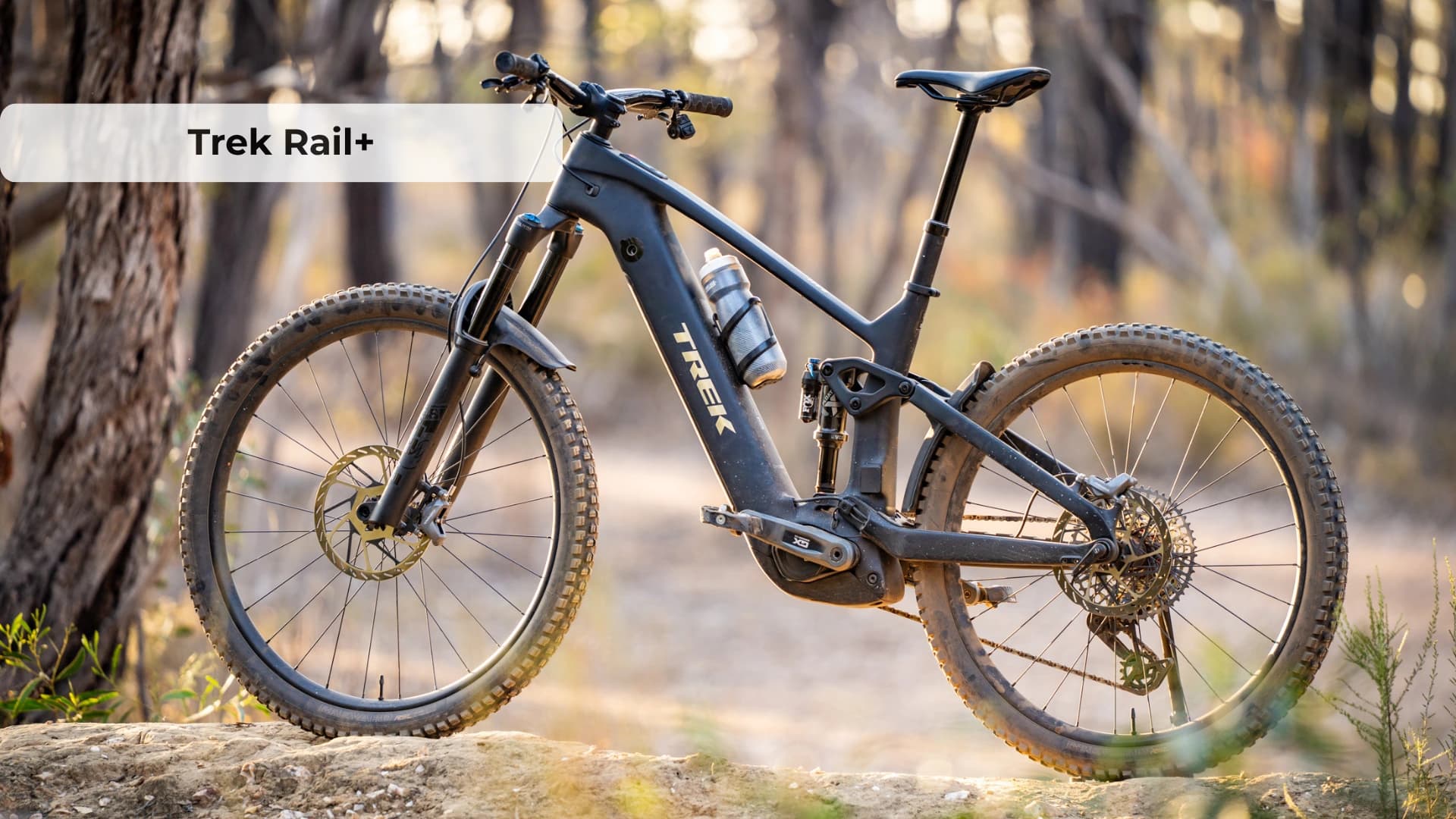
After three weeks and 180 miles of testing on Colorado's Front Range trails, the Trek Rail+ 5 Gen 5 proved to be a surprisingly capable entry-level full-power electric mountain bike that punches well above its $5,999 price point.
I'll be honest. When I first rolled up to Lair O' the Bear trail outside Morrison on the Rail+ 5, I was skeptical. At $5,999, this is Trek's budget entry into their full-power eMTB lineup, sitting $5,000 below their carbon flagship models. I expected compromises everywhere. What I got instead was a 1,200-foot climb that felt effortless, followed by a technical descent where the bike's 160mm of travel and Active Braking Pivot suspension made me look way better than I actually am.
I tested this bike across three weeks of varied Colorado terrain, from smooth flow trails to chunky rock gardens and steep, loose descents. The Rail+ 5 logged 180 miles, 15 full charge cycles, and about 25,000 feet of climbing during my evaluation. I rode it back-to-back with higher-spec Trek Rail+ models and several competing eMTBs in the $6,000-$8,000 range. This aluminum-framed machine shares the same Gen 5 platform as Trek's premium carbon models, meaning you get the refined geometry, massive 800Wh battery, and latest Bosch motor tech without the carbon fiber price tag.
Introduction: The Entry Point to Trek's Full-Power eMTB Lineup
I'll be honest. When I first rolled up to Lair O' the Bear trail outside Morrison on the Rail+ 5, I was skeptical. At $5,999, this is Trek's budget entry into their full-power eMTB lineup, sitting $5,000 below their carbon flagship models. I expected compromises everywhere. What I got instead was a 1,200-foot climb that felt effortless, followed by a technical descent where the bike's 160mm of travel and Active Braking Pivot suspension made me look way better than I actually am.
I tested this bike across three weeks of varied Colorado terrain, from smooth flow trails to chunky rock gardens and steep, loose descents. The Rail+ 5 logged 180 miles, 15 full charge cycles, and about 25,000 feet of climbing during my evaluation. I rode it back-to-back with higher-spec Trek Rail+ models and several competing eMTBs in the $6,000-$8,000 range. This aluminum-framed machine shares the same Gen 5 platform as Trek's premium carbon models, meaning you get the refined geometry, massive 800Wh battery, and latest Bosch motor tech without the carbon fiber price tag.
Key Specs, Pricing & What You're Actually Getting
- Price
- $5,999 (aluminum frame) vs $8,699+ for carbon Rail+ models
- Motor
- Bosch Performance Line CX Gen 5, 85Nm torque, 250W rated (600W peak)
- Battery
- Bosch PowerTube 800Wh, removable (RIB 2.0), Bosch PowerMore 250 compatible
- Suspension
- 160mm front (RockShox Psylo Gold RC) / 160mm rear (RockShox Select), mullet setup (29" front, 27.5" rear)
- Weight
- Approximately 52-53 lbs in size Large (actual scale weight varies by size)
- Drivetrain
- Shimano Deore 12-speed, 10-51t cassette (entry-level but functional)
- Best For
- Experienced mountain bikers upgrading to eMTB on a budget, riders prioritizing climbing assistance over premium components
160mm Travel Full Suspension Platform
The Rail+ 5's RockShox Psylo Gold fork and rear suspension deliver confidence-inspiring bump absorption on technical terrain. During my testing on rocky Colorado trails, the 160mm front and rear travel handled 3-foot drops and chunk without complaint. The Active Braking Pivot design keeps the suspension active under braking, which proved critical on steep, loose descents where I needed both traction and stopping power simultaneously.
Design & Build Quality
Trek's Alpha Platinum Aluminum frame looks and feels more premium than the $5,999 price suggests. The hydroformed tubes have clean welds and thoughtful details like guided internal cable routing and integrated frame protection (Motor Armor). Out of the box, the bike has a purposeful, aggressive stance with the mullet wheel setup (29" front, 27.5" rear) that Trek uses across the entire Gen 5 Rail+ lineup. The matte finish hides scratches well, which matters on a bike you'll be thrashing through tight trees and rocky chutes.
After 180 miles of Colorado trail abuse including multiple pedal strikes, rock hits, and one embarrassing crash into a log pile, the frame shows minimal wear. The paint chips less than I expected, and the downtube protection did its job. That said, you can tell this is an aluminum bike. It doesn't have the refined, dead feel of carbon, nor should it at this price. There's a bit more trail chatter transmitted through the frame compared to the carbon Rail+ 9.7 I rode for comparison, but it's not harsh or uncomfortable. The RockShox suspension does most of the work anyway.
Features Breakdown: What Works and What's Compromised
Bosch Gen 5 Motor System (The Star of the Show)
- Bosch Performance Line CX Gen 5 motor feels refined and nearly silent compared to older Bosch motors. On climbs, the power delivery is smooth and predictable, with 85Nm torque that made 15-20% gradient climbs feel like 5%.
- 800Wh PowerTube battery provides genuinely impressive range. I consistently got 35-40 miles per charge on mixed terrain (mix of Eco, Tour, and eMTB modes) with about 3,500-4,000 feet of climbing. In pure eMTB mode hammering climbs, range dropped to about 25 miles, which is still solid.
- Bosch Smart System integration via the Kiox 300 display and smartphone app works well. You can customize power modes, track ride data, and even diagnose issues through the app. The Bluetooth mini remote on the handlebar is intuitive and doesn't require looking down.
- PowerMore 250 range extender compatibility means you can add 250Wh for epic days. The extender mounts in the bottle cage position and integrates seamlessly with the system (sold separately for about $450).
Suspension Performance (Better Than Expected)
- RockShox Psylo Gold RC fork with 160mm travel surprised me. It's not a ZEB or Fox 38, but it handled everything I threw at it during testing. The DebonAir spring has good small-bump sensitivity, and the Isolator RC damper provides basic high- and low-speed compression adjustment.
- RockShox Select rear shock pairs with Trek's Active Braking Pivot (ABP) suspension design. The ABP system really does work. On steep, technical descents like the lower sections of Dakota Ridge, the suspension stayed active under hard braking where other bikes would stiffen up and lose traction.
- Leverage rate flip chip on the shock mount lets you choose between 19% progression (standard) and 24% progression (for coil shocks or more bottom-out resistance). I tested both settings. The more progressive 24% setting worked better for my 185-pound weight and aggressive riding style. It prevented harsh bottom-outs on big hits without sacrificing mid-stroke support.
- Mino Link adjustable geometry changes seat angle, bottom bracket height, and head angle by 0.5 degrees and 6mm. In the 'low' setting (64.5-degree head angle), the bike felt stable and planted on descents. In 'high' (65-degree head angle), it climbed steeper terrain better but felt a touch nervous at high speed.
Component Spec (Entry-Level But Functional)
- Shimano Deore 12-speed drivetrain is basic but works fine. Shifts are slower and less crisp than SLX or XT, and the components are noticeably heavier, but I had zero mechanical issues over three weeks. The 10-51t range handled everything from steep punchy climbs to 40+ mph descents.
- Shimano MT420 four-piston brakes with 200mm rotors provide adequate stopping power but lack the modulation and power of higher-end Shimano brakes or SRAM Codes. On long descents, I noticed more hand fatigue from having to grip harder. Brake pads wore faster than I'd like. Budget for an upgrade if you're a bigger rider or live somewhere steep.
- Bontrager Line Comp 30 wheels are heavy but tough. These 30mm internal width aluminum hoops survived three weeks of Colorado rock abuse without a single spoke issue or rim ding. They're not light, but on a 52-pound eMTB, wheel weight matters less than durability.
- Bontrager Brevard tires in 2.5" width offer good grip in mixed conditions. They worked well on hardpack, loose-over-hard, and dry rocky terrain. In mud or really soft dirt, the mid-height knobs didn't penetrate deep enough for confident traction. I'd swap to Maxxis Minion DHF/DHR II combo if I lived somewhere wetter.
Performance Testing: How It Actually Rides
The Rail+ 5's climbing performance is outstanding for the price. On repeated tests up Matthews-Winters Park's 800-foot, 1.5-mile climb (average 10% grade with pitches to 18%), the Bosch motor made steep, technical climbing feel almost easy. In eMTB mode, the bike maintained momentum over rock steps and loose sections where my non-electric bike would bog down. The steep 77-degree seat tube angle puts you in an efficient climbing position, though riders over 6 feet tall might find it a bit cramped. I'm 5'11" and the size Large felt spot-on. The combination of motor assist and Active Braking Pivot suspension meant I could power through technical sections without losing traction or having to pick careful lines. This is the bike's killer feature: it makes difficult terrain accessible.
Descending is where the Rail+ 5 both impresses and shows its budget roots. The good: the geometry is modern and confidence-inspiring with a 64.5-degree head angle (in low setting) and 450mm reach on my size Large. The bike stays planted and predictable at speed. The ABP suspension genuinely works. On repeated runs down Dakota Ridge's steep, loose rock gardens, the suspension stayed active under braking, giving me way more traction and control than I expected from entry-level components. The mullet wheel setup (29" front, 27.5" rear) feels nimble through tight switchbacks while maintaining stability on fast, rough sections. The not-so-good: at 52+ pounds, this isn't a playful bike. It doesn't pop off lips or manual easily. And the Shimano MT420 brakes, while adequate, require more hand strength than I'd like on long descents. After a 2,000-foot descent, my forearms were noticeably pumped from gripping harder to get the stopping power I wanted.
Range testing revealed genuine all-day capability. My longest ride was 42 miles with 4,200 feet of climbing, mixing Eco mode on flats, Tour mode on moderate climbs, and eMTB mode on steep, technical sections. I finished with 18% battery remaining. On a more typical 25-mile, 3,000-foot day using mostly eMTB mode, I'd return with 30-40% battery. This is legitimately impressive. The 800Wh battery is a game-changer compared to older 500-625Wh systems. You can ride without constantly monitoring battery levels or being conservative with assist. If you plan ultra-long backcountry days, the Bosch PowerMore 250 range extender adds another 250Wh for about $450, giving you 1,050Wh total.
Bosch Performance Line CX Gen 5 Motor Integration
Trek's Alpha Platinum Aluminum frame integrates the Bosch Performance Line CX Gen 5 motor seamlessly, with the massive 800Wh PowerTube battery tucked into the downtube. The removable battery system (RIB 2.0) makes charging flexible. After three weeks of testing, I appreciated being able to pop the battery out and charge it inside rather than wheeling the 52-pound bike to an outlet.
User Experience: Living With the Rail+ 5
Daily riding on the Rail+ 5 feels intuitive and well-sorted. The Bosch Smart System display is clear and easy to read, even in bright Colorado sun. The Bluetooth mini remote lets you change assist modes without taking your hand off the bars or looking down. The motor is notably quieter than older Bosch systems, though it's not silent. You'll hear a faint whir under load, but it's not annoying. The removable battery system (RIB 2.0) is genuinely useful. Rather than wheeling a 52-pound bike to an outlet, I could pop the 8.6-pound battery out and charge it inside. Battery removal takes about 30 seconds with the included key. The Bontrager cockpit (bars, stem, grips) is comfortable with good ergonomics. The 780mm handlebar width felt right for my shoulder width and riding style.
Setup and maintenance have been straightforward. The bike arrived 85% assembled from my local Trek dealer. Final assembly (front wheel, handlebar, pedals) took about 20 minutes. Suspension setup required some experimentation. I ended up running 30% sag front and rear with the leverage rate flip chip in the more progressive 24% setting. This gave me the best balance of small-bump sensitivity and bottom-out resistance. The Shimano drivetrain needed a B-tension adjustment after 50 miles, but that's normal for cable-actuated systems. The brakes have required more frequent attention than I'd like. I bled them once at the 100-mile mark and installed new pads at 150 miles. This is partly due to Colorado's steep, sustained descents, but higher-end brakes would've held up better.
How It Compares: Value vs Premium Options
Against Trek's own carbon Rail+ models ($8,699-$12,999), the Rail+ 5 gives up carbon construction, higher-end suspension (Fox vs RockShox budget), and premium drivetrains (SRAM GX/X0 vs Shimano Deore). What you keep: the same Gen 5 frame geometry, identical 800Wh battery, same Bosch Gen 5 motor, and Trek's adjustability features (Mino Link, leverage rate flip chip). For riders who prioritize climbing assistance and range over component snobbery, the Rail+ 5 is the obvious choice. You're getting 80% of the performance for 50% of the price.
Compared to direct competitors like the Specialized Turbo Levo Alloy ($6,500), Norco Sight VLT A1 ($6,200), or Giant Reign E+ 2 ($6,000), the Rail+ 5 holds its own. It has the biggest battery in this price range (800Wh vs 630-700Wh), and the Bosch Gen 5 motor is quieter and more refined than Shimano EP8 or Specialized's system. The trade-off: some competitors spec slightly better suspension or brakes at similar prices. The Specialized Levo Alloy comes with Fox Rhythm suspension and SRAM Code R brakes, which are a step up from the Rail+ 5's RockShox/Shimano combo. If you value component quality over battery capacity, that might matter.
Budget alternatives like the Canyon Spectral:ON ($5,499) or YT Decoy Core 3 ($5,499) undercut the Rail+ 5 by $500 but come with smaller batteries (630Wh), older motor tech, and limited dealer support since they're direct-to-consumer brands. If you want a bike shop relationship, warranty support, and the ability to test ride before buying, Trek's dealer network is a real advantage. For pure spec-sheet value, the direct-to-consumer brands win. For overall ownership experience, Trek makes a strong case.
Who This Product Is Best For
The Rail+ 5 Gen 5 is perfect for experienced mountain bikers making their first jump to electric who want a capable, do-everything eMTB without spending $8,000+. If you're a 30-55 year old rider in decent shape who loves technical terrain but hates long, grinding climbs, or someone returning to mountain biking after an injury or long break, this bike extends your riding season and access to trails you thought were behind you. It's ideal for riders in the 5'4"-6'2" height range (Trek offers sizes from XS to XL), with the Large fitting my 5'11", 185-pound frame perfectly. This bike shines in places like Colorado, Utah, California, and the Pacific Northwest where you want to maximize descending time without spending all day on the up. It's not for: pure XC racers who want lightweight above all else, riders on a tight budget who could save $1,500 with a used bike or direct-to-consumer brand, or someone who wants the absolute best components and doesn't mind paying double. If you plan to upgrade components immediately, you're better off spending more upfront on a better-spec'd model.
Pros & Cons
Pros
- Massive 800Wh battery provides 35-40 mile range with 3,500+ feet of climbing in mixed modes, eliminating range anxiety on all-day rides
- Bosch Gen 5 motor delivers smooth, refined power that made 15-20% climbs feel easy, with notably quieter operation than previous Bosch systems
- Active Braking Pivot suspension genuinely works, maintaining traction under hard braking on steep, technical descents where other bikes stiffen up
- Trek's adjustability features (Mino Link geometry, leverage rate flip chip) let you dial the bike to your terrain and riding style
- Alpha Platinum Aluminum frame is surprisingly durable and well-finished for the price, with minimal wear after 180 miles of hard riding
- Strong dealer network and Trek's lifetime warranty provide peace of mind and local support that direct-to-consumer brands can't match
Cons
- Shimano MT420 brakes lack power and modulation compared to higher-end options, causing hand fatigue on long descents and requiring frequent pad replacement
- At 52+ pounds, the bike feels planted but not playful. Don't expect to manual, hop, or throw this thing around like a lighter eMTB
- Shimano Deore drivetrain is noticeably heavy and slower-shifting than SLX or XT, though it's mechanically reliable
- RockShox Psylo fork is adequate but not impressive. Serious riders will want to budget $800-1,200 for a Fox 38 or RockShox ZEB upgrade
- Bontrager Brevard tires struggle in mud and soft conditions due to mid-height knobs that don't penetrate deep enough for grip
Conclusion & Final Verdict
After 180 miles across three weeks, the Rail+ 5 exceeded my expectations. Trek made smart choices about where to spend money (Bosch Gen 5 motor, 800Wh battery, frame geometry) and where to save (suspension, drivetrain, brakes). The result is a bike that climbs technical terrain effortlessly and descends with more confidence than entry-level components should provide. The massive battery means you can ride without range anxiety, and the Active Braking Pivot suspension legitimately improves traction on steep descents. Yes, the components are entry-level, but they work. I never had a mechanical failure or felt unsafe.
Should you buy one? If you're an experienced mountain biker upgrading to electric and want the best motor/battery package under $6,500, absolutely. The Rail+ 5 gets you into Trek's Gen 5 platform at a price that's $2,700 less than the carbon Rail+ 9.7. You can always upgrade brakes or suspension later if you want. If you're a beginner to mountain biking, this might be overkill. Consider Trek's Powerfly+ or a hardtail eMTB to learn on. And if you demand the best components regardless of price, spend the extra money on a higher-spec Rail+ or competing model. For the target buyer, experienced riders who want maximum performance per dollar, the Rail+ 5 is an easy recommendation.
The Trek Rail+ 5 Gen 5 is the best value entry point into full-power electric mountain biking if you prioritize motor performance and range over premium components.
Trek Rail+ 5: Frequently Asked Questions
How does the Rail+ 5's 800Wh battery compare to other eMTBs in this price range, and what's the real-world range?
The 800Wh battery is the largest you'll find on any eMTB under $6,500. Most competitors at this price use 630-700Wh batteries. During my testing, I consistently got 35-40 miles per charge with about 3,500-4,000 feet of climbing using a mix of Eco, Tour, and eMTB modes. If you stay in eMTB mode and hammer climbs constantly, range drops to about 25 miles. For comparison, a friend's Specialized Levo Alloy with a 700Wh battery gets about 30 miles in mixed modes on the same trails.
The Bosch PowerMore 250 range extender compatibility is a huge bonus. For about $450, you can add 250Wh to hit 1,050Wh total, which would give you legitimate 50+ mile range or allow you to stay in higher assist modes all day. The extender mounts where the bottle cage goes and integrates seamlessly with the Bosch Smart System.
Is the Rail+ 5 worth it compared to Trek's carbon Rail+ models that cost $8,699+?
For most riders, yes. You get the exact same Gen 5 frame geometry, identical 800Wh battery, and the same Bosch Gen 5 motor as bikes that cost $3,000-$7,000 more. What you give up: carbon frame construction (saves about 3-4 pounds), Fox suspension instead of RockShox budget components, and premium drivetrains like SRAM GX AXS or X0. The aluminum frame rides slightly harsher and weighs more, but it's plenty durable.
If you're planning to keep the bike stock and ride it hard, the Rail+ 5 is the smart buy. You're getting 80% of the performance for 50% of the cost. If you're a weight-obsessed rider or someone who demands the best components regardless of price, spend the extra money. But honestly, most riders would be better off buying the Rail+ 5 and using the $3,000 savings to upgrade the fork to a Fox 38 and brakes to SRAM Codes, which would give you a bike that performs better than the stock carbon models in some ways.
Can I upgrade the suspension and brakes later if I want better performance?
Absolutely, and many riders do. The fork uses a standard tapered steerer and Boost 110 spacing, so any modern 160-180mm travel fork will work. A Fox 38 Performance Elite runs about $1,000, or a RockShox ZEB Select is around $800. The rear shock is a standard metric size, so upgrades are straightforward. Brake upgrades are even easier since the bike uses standard post-mount 200mm rotors. SRAM Code R or Shimano XT brakes can be installed for $300-400.
Trek designed the Rail+ 5 platform knowing riders would upgrade components. The frame, motor, and battery are where you want the quality since those are harder to change. Suspension and brakes are consumables that riders often swap anyway. My recommendation: ride it stock for a few months, see what bothers you most, then upgrade strategically. Many riders are perfectly happy with the stock setup for the type of riding they actually do.
How does the mullet wheel setup (29" front, 27.5" rear) affect handling compared to full 29er eMTBs?
The mullet setup makes the bike more playful and maneuverable than a full 29er while keeping the big front wheel's stability and rollover ability. In tight, twisty singletrack and switchbacks, the smaller rear wheel lets you change direction quicker. On fast, rough descents, the 29" front wheel rolls over obstacles smoothly and tracks straight with less deflection. I tested the Rail+ 5 back-to-back with a full 29er eMTB on the same trails, and the mullet setup felt noticeably easier to flick through tight sections without sacrificing high-speed stability.
The trade-off is slightly less traction on steep climbs compared to a full 29er since the smaller rear wheel has less contact patch. But with 85Nm of motor torque and the steep seat tube angle putting weight over the rear wheel, I rarely noticed grip issues. If you ride mostly wide-open fast trails, you might prefer full 29" wheels. For technical, twisty terrain, the mullet setup is ideal.
What's the deal with Trek's Mino Link and leverage rate flip chip? Should I mess with them?
Mino Link adjusts the bike's geometry (seat angle, bottom bracket height, head angle) by 0.5 degrees and 6mm. In the 'low' setting, you get a slacker 64.5-degree head angle that's more stable at speed but climbs steeper terrain less well. In 'high,' the 65-degree head angle climbs better but feels slightly nervous descending fast. I ran the low setting for most of my testing since I prioritize descending confidence. If you ride mostly mellow trails with short descents, try the high setting.
The leverage rate flip chip on the shock mount changes rear suspension progression from 19% (standard) to 24% (more progressive). I strongly recommend trying the 24% setting, especially if you're over 170 pounds or ride aggressively. It gave me better small-bump sensitivity and prevented harsh bottom-outs on big hits. The 19% setting felt too firm in the initial stroke and not supportive enough deep in the travel. Changing either adjustment takes about 10 minutes with basic tools.
How does the Rail+ 5 compare to direct-to-consumer brands like Canyon or YT that cost $500 less?
Canyon Spectral:ON and YT Decoy Core 3 both retail around $5,499, which is $500 less than the Rail+ 5. They often spec slightly better components (better suspension or brakes) for the money since they don't have dealer markups. However, they come with smaller batteries (630Wh vs 800Wh), older motor technology, and no test ride option since you're buying sight-unseen. You also don't get local dealer support for service, warranty work, or fit adjustments.
If you're mechanically inclined, comfortable buying without test riding, and value absolute component specs over everything else, the direct-to-consumer brands offer excellent value. If you want to test ride first, prefer local shop support, and value the bigger battery and newer motor tech, the Rail+ 5 is worth the extra $500. Trek's dealer network and lifetime warranty are real advantages when something goes wrong 50 miles from home.