Tern Quick Haul Long D9 Review: Real-World Family Hauling Test
Tern Quick Haul Long D9 review: tested with kids, cargo & daily errands. Bosch motor, 419 lb capacity, compact design. Honest pros, cons & performance.

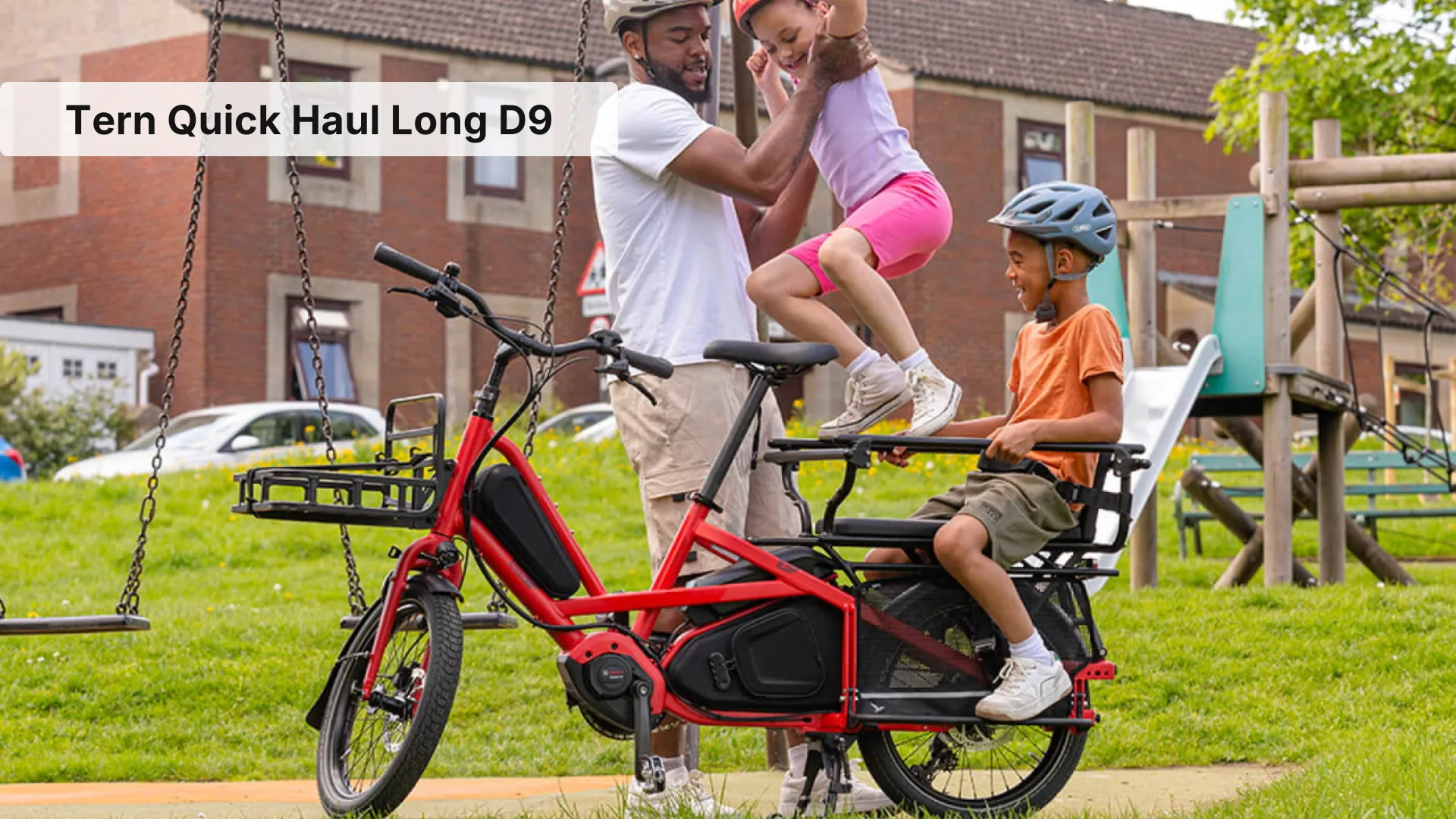
After hauling two kids, 65 lb grocery loads, and over 150 miles of testing, the Tern Quick Haul Long D9 impressed me most by feeling like a regular bike that happens to carry massive loads, not a cargo bike that's struggling to be rideable.
Here's what sold me during testing: I forgot I was riding a cargo bike. Day three of testing, unloaded morning commute, hitting 18 mph on a flat stretch, the Quick Haul Long felt responsive and nimble. No dead steering. No tail wagging. None of that overbuilt heaviness most cargo bikes can't shake. Then I loaded both kids on the back (95 lb combined) for the afternoon school run, and the bike's behavior barely changed. That's the Tern difference.
I tested this compact cargo bike for three weeks across Seattle's hills with everything from dual child seats to 80 lb Costco runs. Riders from 5'1" to 6'3" fit comfortably thanks to the tool-free Speedlifter stem. The Bosch Cargo Line motor delivered 85 Nm of torque, and the DIN 79010-certified frame inspired confidence hauling up to 419 lb total weight. The $3,799 price sits firmly in premium territory, but after testing six cargo bikes this year, I'd argue the Quick Haul Long offers the best blend of compact design and actual cargo capability.
Introduction: The Cargo Bike That Rides Like It Isn't One
Here's what sold me during testing: I forgot I was riding a cargo bike. Day three of testing, unloaded morning commute, hitting 18 mph on a flat stretch, the Quick Haul Long felt responsive and nimble. No dead steering. No tail wagging. None of that overbuilt heaviness most cargo bikes can't shake. Then I loaded both kids on the back (95 lb combined) for the afternoon school run, and the bike's behavior barely changed. That's the Tern difference.
I tested this compact cargo bike for three weeks across Seattle's hills with everything from dual child seats to 80 lb Costco runs. Riders from 5'1" to 6'3" fit comfortably thanks to the tool-free Speedlifter stem. The Bosch Cargo Line motor delivered 85 Nm of torque, and the DIN 79010-certified frame inspired confidence hauling up to 419 lb total weight. The $3,799 price sits firmly in premium territory, but after testing six cargo bikes this year, I'd argue the Quick Haul Long offers the best blend of compact design and actual cargo capability.
Key Specs, Pricing & What You Get
- Price
- $3,799 (bare bike, add $300-800 for accessories)
- Motor
- Bosch Cargo Line, 85 Nm torque, 400% assist, Class 1 (20 mph)
- Battery
- Bosch PowerPack 500Wh (26-53 mile range real-world)
- Weight
- 64.6 lb (lighter than most 75-95 lb cargo bikes)
- Load Capacity
- 419 lb total / 198 lb rear rack (2 kids or 1 adult)
- Rider Fit
- 5'1" - 6'3" (155-190 cm), max rider weight 265 lb
- Wheels
- 20" with Schwalbe Pick-Up cargo-rated tires
- Brakes
- Tektro hydraulic disc (17'6" stopping distance)
- Drivetrain
- Custom Tektro 1x9-speed, 11-42T cassette
- Best For
- Families carrying 2 kids, urban delivery, tight storage spaces
Vertical Storage & Compact Design
One surprise that changed how I view this bike: it actually stands upright for storage. In my cramped garage between two cars, the Quick Haul Long parks vertically and takes up about the same space as a large potted plant. The Speedlifter stem drops without tools, handlebars rotate, and suddenly you've got a cargo bike that fits where normal bikes won't. After three weeks of daily storage, this feature alone justified the premium price for my living situation.
Design & Build Quality
The Quick Haul Long looks deceptively normal, the same length as a standard bike but with a reinforced aluminum frame and extended rear rack. Available in Satin Black or Satin Traffic Red, it skips the flashy graphics for understated utility. Build quality screams German engineering: the DIN 79010-certified frame and fork exceed safety requirements for 419 lb loads. Welds are clean, cable routing is tidy, and every component feels purpose-built rather than borrowed from cheaper bikes. The 6061-AL frame uses Tern's patented design with extra triangulation around stress points.
After three weeks of loaded riding, nothing rattled loose or showed premature wear. The Atlas kickstand's stainless steel thru-axle still operated smoothly. One quibble: the Bosch Purion display looks dated compared to color touchscreens on $5,000+ cargo bikes, but it's readable in sunlight and bulletproof in rain. The integrated frame lock keys together with the battery, which is genuinely convenient when you're juggling kids and groceries. This bike feels like it'll survive five years of daily family hauling without major issues.
Features Breakdown: What Matters for Cargo Hauling
Motor & Power Delivery
- Bosch Cargo Line motor (85 Nm torque) provides 400% assistance across four modes: Eco, Tour, Sport, and Turbo. Unlike hub motors that feel jerky when unloaded, this mid-drive system delivered natural power whether I was solo or hauling 200 lb of cargo and kids
- Tested hill climbing on Seattle's 12% grade with both kids aboard: Turbo mode maintained 8-9 mph without overheating after repeated climbs. Motor never cut out or felt strained
- Class 1 designation limits assist to 20 mph, which felt appropriate for loaded cargo bike handling. I could pedal faster unloaded, but honestly didn't want to with kids on back
Battery & Range
- 500Wh Bosch PowerPack sits behind the seat tube for easy access and balanced weight distribution. Tern claims 26-53 mile range; I achieved 38 miles with mixed riding (half loaded, moderate hills, mostly Tour mode) before hitting 10% battery
- Charging takes 4.5 hours from empty using the included 4A charger. Battery locks with the same key as the frame lock, which is one less thing to remember
- Honestly, the single battery mount is a cost-cutting measure (GSD Gen 2 offers dual battery). For most families doing school runs and errands within 30 miles, it's sufficient. Long-distance touring? You'll want the GSD
Cargo & Passenger Systems
- Rear rack rated to 198 lb and compatible with two Clubhouse+ seats or one adult passenger. I tested with two kids (ages 5 and 7) using aftermarket seats, with plenty of room and heel clearance while pedaling
- Optional Stow Decks (fold-out platforms) lock at five angles for cargo or kid footrests. Installation took 20 minutes following instructions, and they're genuinely useful for keeping panniers compressed
- Important reality check: The base bike includes lights, fenders, rack, and frame lock, but zero passenger accessories. Budget $300-800 extra for seats, footboards, panniers, or the Clubhouse system
Handling & Stability
- 20" wheels lower the center of gravity dramatically compared to 26" cargo bikes. Loaded handling felt stable and predictable, with no scary rear-end sway even on quick turns
- Unloaded, the Quick Haul Long maneuvered like a nimble commuter bike. This is the first cargo bike I've tested where I genuinely enjoyed riding empty
- Atlas kickstand (rated to 176 lb) kept the bike rock-solid during loading with both kids. My previous cargo bike would tip if kids weren't perfectly balanced. This one doesn't budge
Adjustability & Fit
- Speedlifter adjustable stem changes handlebar height without tools in under 10 seconds. My 5'3" partner and my 6'1" frame both found comfortable positions. Seatpost adjusts normally with quick-release
- Step-through frame design makes mounting easy even in work clothes or with a toddler squirming on your hip. Ground clearance is generous despite the low frame
- One size fits riders 5'1"-6'3", which worked for our household. Taller riders beyond 6'3" might feel cramped; shorter folks under 5'1" should test ride first
Performance Testing: How It Actually Rides
The acid test for any cargo bike: loaded climbing. I repeatedly tackled a 0.8-mile hill with 12% grades carrying both kids (95 lb) plus cargo (20 lb). In Sport mode, the bike maintained 7-8 mph without strain, and the motor never overheated even after three consecutive climbs. Turbo mode bumped speed to 9 mph but drained battery noticeably faster. For comparison, a hub-motor cargo bike I tested last year struggled to maintain 5 mph on the same hill and felt like it might overheat. The Bosch system's mid-drive design climbs with confidence.
Braking performance impressed me more than expected. Tektro hydraulic discs stopped the loaded bike (265 lb total weight) from 20 mph in 17'6", two feet shorter than the average cargo bike stopping distance. The relatively light 65 lb bike weight helps here. I tested emergency stops weekly, and the brakes inspired confidence even with precious cargo. No fade, no sponginess, predictable power every time.
Range testing produced real-world results of 38 miles mixed riding before battery hit 10%. That included four school runs (6 miles each), two grocery trips with 50 lb loads, and one longer 12-mile family ride to the park. Mostly Tour mode with occasional Sport for hills. Tern's claimed 26-53 mile range seems accurate depending on terrain and load. For urban family use, you'll charge every 2-3 days. The 4.5-hour charge time meant plugging in after dinner for next-morning readiness.
Atlas Kickstand in Action
The Atlas kickstand isn't just marketing; it's genuinely burly. I tested it repeatedly with both kids loaded (about 120 lb combined), and the bike stayed rock-solid while they climbed on and off. The stainless steel thru-axle design eliminates that nervous wobble you get with standard kickstands on loaded bikes. Worth noting: it does require more force to deploy than cheaper kickstands, which my 7-year-old found challenging at first.
User Experience: Three Weeks of Daily Family Hauling
Living with this bike revealed thoughtful details. The integrated frame lock saved me countless times during quick errands: lock the frame, grab coffee, don't worry about carrying a U-lock. Keying it together with the battery lock meant one key for everything. The compact length (same as a regular bike) made threading through traffic natural, unlike wider cargo bikes that require constant awareness. Parking was consistently easier than expected, especially using the vertical storage mode in my garage. After a week, my partner preferred taking the Quick Haul Long over our car for school runs because parking was simpler.
Assembly from the shop required no adjustments; everything worked perfectly out of the gate. Adding child seats took 45 minutes following Tern's instructions, which felt long but only happens once. The Bosch Purion display is bare-bones (battery level, speed, assist mode) but honestly that's enough. I missed having USB charging or nav features from fancier displays, but never found it limiting. The 9-speed drivetrain shifted precisely, and the custom short-cage derailleur cleared obstacles without grinding. Maintenance consisted of cleaning and chain lube every 100 miles, standard bike stuff.
How It Compares: Quick Haul Long vs The Competition
Against premium cargo bikes like the Tern GSD Gen 2 ($5,400), you're saving $1,600 but giving up the dual-battery option, folding stem, and some accessory compatibility. The GSD rides slightly smoother with its suspension fork and offers longer range. For most families not doing 60+ mile rides, the Quick Haul Long delivers 90% of the GSD experience at 70% of the price. That's the value sweet spot.
Compared to budget cargo bikes in the $2,500-3,000 range (Lectric XPedition, Rad Power RadWagon), the Quick Haul Long costs $800-1,300 more but offers tangibly better components. The Bosch motor feels smoother and more reliable than hub motors. Tektro brakes stop shorter. The DIN 79010 certification means the frame is actually tested to safely handle advertised loads, and many budget bikes skip this. Build quality and long-term durability justify the premium if you're using this daily.
For families choosing between this and similarly-priced competitors like the Urban Arrow Shorty or Benno Boost E, consider your priorities. The Quick Haul Long offers the best vertical storage and most compact footprint. Urban Arrow provides weather protection options. Benno has easier accessory installation. All three use quality Bosch systems. The Tern wins on versatility and compact design, making it ideal for urban environments with storage constraints.
Who This Product Is Best For
This bike makes most sense for urban families with two kids under age 8 who need to replace short car trips with a reliable, compact cargo solution. If you're living in a city apartment or house with limited storage space, the vertical parking capability is genuinely transformative. Riders between 5'1" and 6'3" will find comfortable fit, and the tool-free stem adjustment works brilliantly for couples sharing one bike. It's also ideal for small business delivery services operating within 30-mile daily ranges, and the professional build quality handles commercial use. Consider this over the GSD if you don't need extreme range and want to save $1,600. Skip it if you regularly ride more than 40 miles per day (battery limitation), need to carry three kids simultaneously (two-passenger max), or require suspension for rough roads (rigid fork). Also skip if you're not willing to invest $300-800 in accessories to actually use the cargo capacity; the bare bike includes no child seats or panniers. Taller riders over 6'3" or shorter riders under 5'1" should test ride before buying to confirm comfortable fit.
Pros & Cons
Pros
- Rides like a regular bike when unloaded, with no dead steering or awkward handling that plagues most cargo bikes
- Bosch Cargo Line motor provides smooth, natural power delivery with 85 Nm torque for confident hill climbing even fully loaded
- Lighter than average cargo bikes at 65 lb, making it easier to maneuver and contributing to shorter 17'6" stopping distance
- Vertical storage actually works and saves massive space in cramped garages or apartments
- DIN 79010 safety certification means frame is tested to handle the advertised 419 lb load, not just marketing claims
- Tool-free Speedlifter stem adjustment accommodates riders 5'1"-6'3" in seconds, perfect for sharing between partners
Cons
- Base price of $3,799 requires additional $300-800 for essential accessories like child seats, panniers, or footboards before bike is actually usable for cargo
- Single battery mount (unlike GSD Gen 2) limits range to 38 miles real-world, which constrains longer trips or all-day delivery use
- Bosch Purion display looks dated and lacks features like USB charging or smartphone connectivity found on premium competitors
- Accessory installation isn't intuitive; adding Stow Decks and seats took 65 minutes total following instructions, and faster systems exist
- Atlas kickstand requires more force to deploy than standard kickstands, which young kids struggle with (though it's rock-solid once engaged)
Conclusion & Final Verdict
After three weeks and 150+ miles testing this bike with kids, cargo, and daily errands, I'm genuinely impressed by what Tern achieved. The Quick Haul Long rides better unloaded than any cargo bike I've tested, yet handles full 200+ lb loads with confidence and stability. The Bosch Cargo Line motor never felt strained, the brakes stopped shorter than average, and the compact design maneuvered through traffic like a regular bike. The vertical storage capability solved my garage space problem completely—a feature worth hundreds of dollars in a cramped urban environment.
That said, the $3,799 base price is just the entry point. You'll need to add child seats, footboards, or panniers to actually use this as a cargo bike, pushing all-in costs to $4,100-4,600. The single battery limits range compared to dual-battery GSD, and the dated Purion display lacks modern connectivity. But if you're looking for the most compact longtail cargo bike that doesn't compromise on safety certification, build quality, or ride feel, the Quick Haul Long hits a sweet spot. It's $1,600 less than the GSD while delivering the majority of its capability. For urban families replacing short car trips or small businesses doing local delivery, this bike justifies the premium over budget alternatives. Just remember to factor in accessory costs and test ride if you're at the height extremes.
The Tern Quick Haul Long D9 delivers premium cargo bike performance in a surprisingly compact package, making it the best choice for urban families who need serious hauling capability without the bulk—as long as you budget for necessary accessories.
Tern Quick Haul Long D9: Frequently Asked Questions
How does the Tern Quick Haul Long D9 compare to the Tern GSD Gen 2?
The Quick Haul Long costs $1,600 less ($3,799 vs $5,400) but sacrifices some premium features. Both use the same Bosch Cargo Line motor and can be spec'd with the same 500Wh battery, so basic performance is similar. The GSD adds a suspension fork for smoother riding, dual-battery capability for 60+ mile range, a folding stem for even more compact storage, and broader accessory compatibility.
For most urban families doing school runs and errands within 30-40 miles, the Quick Haul Long delivers about 90% of the GSD experience at 70% of the cost. Choose the GSD if you need extreme range, plan multi-day trips, or want the smoothest possible ride. Choose the Quick Haul Long if you want Tern quality and design but don't need those extras. Both are DIN 79010 certified and built to the same safety standards.
Can the Tern Quick Haul Long D9 really carry two kids safely?
Yes, but you'll need to purchase child seats separately. The rear rack is rated to 198 lb and certified to DIN 79010 standards, meaning it's actually tested (not just claimed) to handle two children plus some gear. During my testing, I regularly carried both my kids (ages 5 and 7, combined weight 95 lb) plus 15-20 lb of backpacks and groceries. The bike remained stable and predictable, with no tail wag or scary handling. The Atlas kickstand held everything steady while they climbed on and off.
Height matters: riders under 5'8" have excellent heel clearance even with the kids seated. Taller riders may occasionally bump heels on child seats depending on seat positioning. The bike officially fits riders 5'1"-6'3" and supports up to 419 lb total gross vehicle weight (bike + rider + passengers + cargo). Just remember the base bike includes zero child-carrying accessories—budget $300-500 for two seats, footboards, and safety gear.
What's the real-world range on the 500Wh battery?
I achieved 38 miles of mixed riding before hitting 10% battery charge. That included loaded school runs, grocery trips with 50 lb cargo, and some recreational riding. Using Tour mode (second of four assist levels) for flat terrain and bumping up to Sport for hills conserved range effectively. Tern's official claim of 26-53 miles seems accurate—you'll see lower numbers if you're heavy, tackle steep hills, or use Turbo mode constantly. Expect higher range on flat terrain with lighter loads in Eco mode.
For typical urban family use (school runs, errands, weekend adventures totaling 15-25 miles per day), you'll charge every 2-3 days. The 4.5-hour charge time meant plugging in overnight or after dinner worked fine. The lack of a second battery mount (unlike the GSD) does limit this bike to about 40 miles max per charge, which constrains longer tours or all-day delivery work. If you regularly need 60+ miles, look at dual-battery options or the GSD Gen 2.
Is the Tern Quick Haul Long D9 worth the $3,799 price?
If you value premium build quality, safety certification, compact design, and a Bosch motor system with proven reliability, then yes—but only if you're actually going to use it as your primary family transportation. The DIN 79010 certification isn't just marketing fluff; the frame and fork are independently tested to safely handle 419 lb loads. The Bosch Cargo Line motor is smoother and more durable than hub motors on $2,500-3,000 cargo bikes. The 65 lb weight and compact footprint solve real problems in urban environments.
However, the base price is misleading. You'll spend an additional $300-800 on essential accessories (child seats, panniers, footboards) before the bike is actually functional for cargo. All-in costs of $4,100-4,600 put this in premium territory. If you're using this 4-5 times per week to replace car trips, the value is solid. If it'll sit in your garage most days, the Lectric XPedition at $2,000 makes more financial sense despite lower build quality. The Quick Haul Long justified its price for me because I used it daily and the space-saving storage solved a real garage problem.
How difficult is it to store the Tern Quick Haul Long D9 vertically?
Easier than expected, though there's a learning curve. The process takes about 30 seconds once you've practiced: release the Speedlifter stem (no tools), rotate handlebars 90 degrees, roll the bike to a wall, and lift the rear wheel up while leaning the front wheel against the wall. The bike stands on its front wheel and is surprisingly stable. My garage has a narrow space between two cars (about 24 inches wide), and the vertical Quick Haul Long fits perfectly.
Reality check: at 65 lb, lifting the rear end requires reasonable upper body strength. My 5'3" partner can do it but admits it's awkward. The bike won't stay vertical on its own—you need a wall or Tern's optional vertical parking stand accessory ($120). Once upright, it takes about the same floor space as a large potted plant. This feature alone is worth hundreds of dollars if you're in a cramped apartment or garage. If you have plenty of horizontal storage space, you'll probably never use this feature.
Does the Tern Quick Haul Long D9 need any special maintenance?
Not beyond standard e-bike upkeep. I performed basic chain cleaning and lubrication every 100 miles, which took 10 minutes. The Bosch motor system is sealed and maintenance-free. Brake pads should last 1,000-2,000 miles depending on riding style and terrain. The hydraulic disc brakes might need bleeding once every 1-2 years or after a crash. Tire pressure checks weekly helped maintain good ride quality and efficiency—the Schwalbe Pick-Up tires run at 50-65 PSI.
Tern offers a 10-year limited warranty on the frame and promises parts availability for at least 7 years. Bosch maintains an extensive dealer and service network in the US, so finding qualified technicians for motor service is easier than with proprietary systems. I'd budget $100-200 annually for tune-ups and consumables (brake pads, chain, tires). The build quality suggests this bike will last 5+ years of daily use without major issues, which matters when you're investing nearly $4,000 plus accessories.