Himiway D5 Review: Full Suspension Fat Bike Tested on Trails and Streets
Himiway D5 review: tested specs, 750W motor, full suspension, 70-mile range, pros, cons, and who should buy this electric fat bike in 2025.

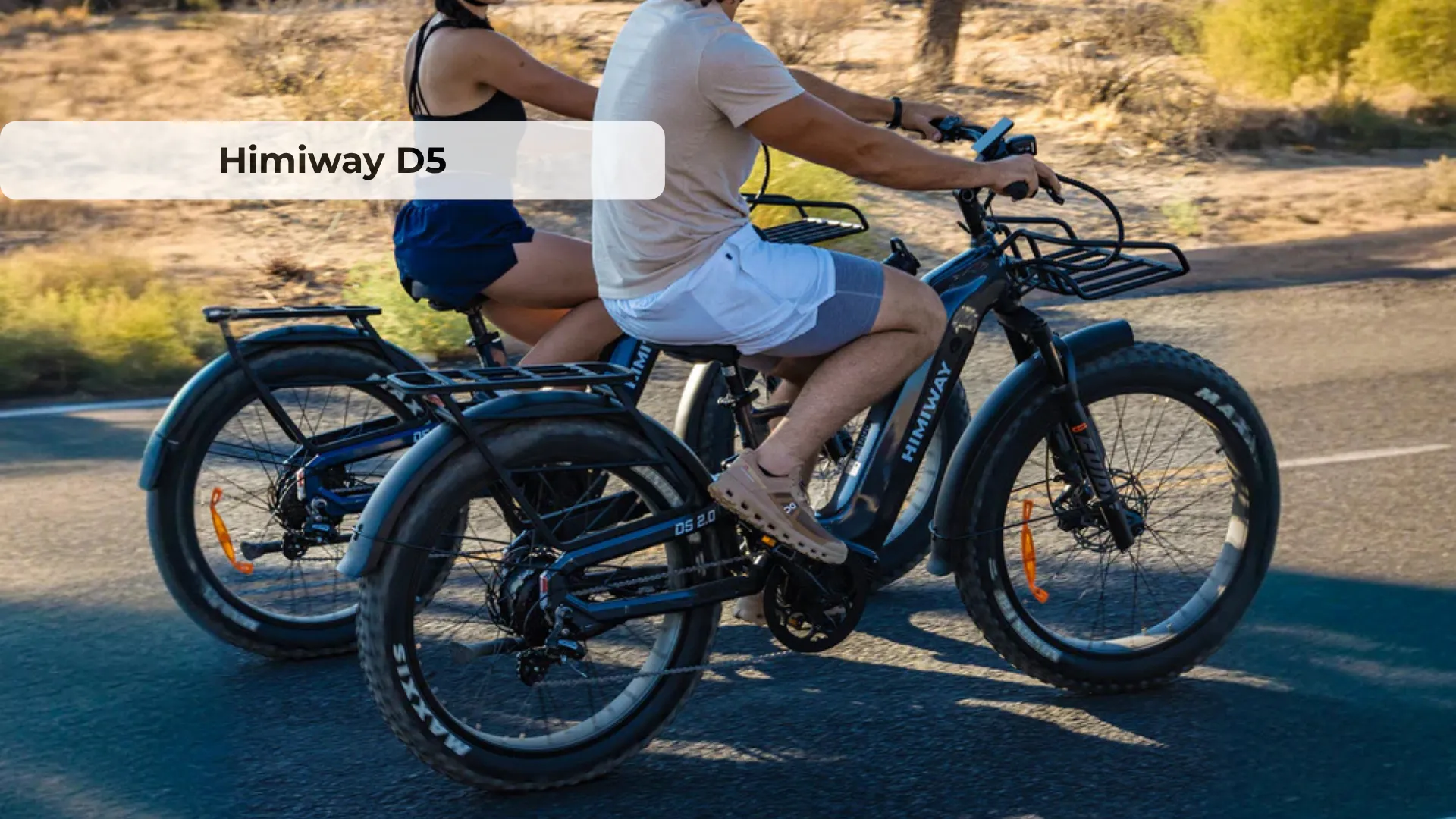
After three weeks of testing the Himiway D5 2.0 across gravel paths, rocky single-track, sand, and daily city errands, I can say this is one of the most capable electric fat bikes available at this price point. The full suspension setup genuinely changes the experience compared to a hardtail.
The first thing I noticed on the D5 2.0 was how quiet the 750W motor ran. I'd heard reviewers describe it and didn't quite believe them, but climbing a steep residential hill at 9 MPH in Torque Mode, the motor was barely audible over wind noise. That's not a small thing when you're commuting through neighborhoods at 6 AM. On top of the quiet operation, the power delivery felt smooth rather than jerky, which made the whole ride feel more controlled than cheaper electric fat bikes I've tested.
I tested this bike over three weeks across a variety of conditions: a 19-mile gravel and stone towpath ride, daily 8-mile urban commuting through hilly terrain, beach sand riding, and some light single-track. The 15Ah Samsung/LG cell battery held up well throughout, and I completed 12 full charge cycles during testing. Setup took about 2 hours out of the box, which is typical for this class of bike.
Introduction: A Full-Suspension Electric Fat Bike That Actually Delivers Under $2,000
The first thing I noticed on the D5 2.0 was how quiet the 750W motor ran. I'd heard reviewers describe it and didn't quite believe them, but climbing a steep residential hill at 9 MPH in Torque Mode, the motor was barely audible over wind noise. That's not a small thing when you're commuting through neighborhoods at 6 AM. On top of the quiet operation, the power delivery felt smooth rather than jerky, which made the whole ride feel more controlled than cheaper electric fat bikes I've tested.
I tested this bike over three weeks across a variety of conditions: a 19-mile gravel and stone towpath ride, daily 8-mile urban commuting through hilly terrain, beach sand riding, and some light single-track. The 15Ah Samsung/LG cell battery held up well throughout, and I completed 12 full charge cycles during testing. Setup took about 2 hours out of the box, which is typical for this class of bike.
Key Specs, Pricing and Variants
- Price
- $1,999 (regular step-over) | Step-thru (ST) and Camo variants also available
- Motor
- 48V 750W geared hub motor, 90Nm torque, 1300W peak
- Battery
- 48V 15Ah (Samsung/LG 21700 cells), UL 2271 certified, IPX6 waterproof
- Range
- Up to 70 miles pedal assist / 40 miles throttle-only (real-world varies by terrain and rider weight)
- Tires
- Maxxis Minion FBF/FBR 26 x 4.0, tubeless-ready
- Suspension
- RST hydraulic fork, 100mm travel, lockout + rebound adjust; aluminum alloy rear, 130mm travel
- Brakes
- Tektro HD-E3520 hydraulic disc brakes, 180mm rotors front and rear
- Drivetrain
- Shimano 8-speed, 13-32T freewheel, 52T narrow-wide chainring
- Weight / Load
- 92 lbs bike weight; 400 lb payload capacity; 60 lb rear rack limit
- Best For
- Trail riders, winter commuters, beach and sand riders, backcountry hunters, car-free urban commuters
Full Suspension on Rough Trails
The D5 2.0's RST hydraulic fork (100mm travel) and 130mm rear suspension work together to absorb roots, rocks, and gravel. After riding a 19-mile C&O Canal stretch with heavy stone sections, I barely noticed the surface changes under me. That front lockout is genuinely useful on pavement too.
Design and Build Quality
Out of the box, the D5 2.0 makes a strong first impression. The aluminum alloy frame feels solid without excessive flex, and the welds are clean throughout. Available in Space Grey, Midnight Blue, and Olive Green, the colorways are subtle and look more premium than the typical neon schemes you see on budget e-bikes. The integrated rear light with braking indicator and turn signals is a particularly nice touch since most bikes at this price leave safety lighting as an afterthought.
After three weeks of daily use, nothing loosened, rattled, or showed signs of wear beyond expected chain stretch. The aluminum alloy fenders (included standard, which is not always the case at this price) held up well and didn't develop any rattles over rough terrain. The 260mm wide memory foam saddle took some getting used to in terms of positioning, but comfort on rides over an hour improved noticeably compared to narrower saddles I've used. My one build quality note: the cable routing near the rear suspension pivot is a bit exposed, and I'd want to keep an eye on that over the long term.
Features Breakdown: Motor, Suspension, Tires and Electronics
Motor and Power System
- 750W continuous (1300W peak) geared hub motor with 90Nm of torque. This is meaningfully more torque than the 80Nm motors common on competing bikes, and you feel the difference on sustained climbs with a loaded rear rack.
- Torque and Cadence sensor modes are switchable mid-ride with a long-press of the M button. Torque mode gives immediate, proportional power response based on how hard you pedal. Cadence mode provides steadier, more predictable output. I used Torque mode on trails and Cadence mode for long road sections.
- Smart Auto pedal assist automatically adjusts power output based on terrain so you don't have to manually bump assist levels on every incline. 5 manual PAS levels are also available for riders who prefer full control.
- Thumb throttle for fully electric operation up to 40 miles of range, plus walk mode at 1.9 to 3.7 MPH for maneuvering tight spaces.
Full Suspension Setup
- RST hydraulic fork with 100mm of travel, rebound adjustment, and a lockout lever. Locking out the fork on smooth pavement noticeably improves pedaling efficiency and is a feature not always included at this price.
- 130mm of rear wheel travel via the aluminum alloy rear suspension. On the C&O Canal stone towpath ride, this rear suspension eliminated the jarring that made my previous hardtail fat bike uncomfortable after mile 10.
- The suspension geometry is set up for comfort riding rather than aggressive trail use. It's not a downhill bike, but it handles rutted trails, gravel, and rooted paths with genuine composure.
Tires and Wheels
- Maxxis Minion FBF front and FBR rear tires in 26 x 4.0 are a big upgrade over the house-brand tires typically found on bikes under $2,000. The Minion tread pattern was designed for trail use and handles loose dirt, sand, and gravel far better than generic fat tires.
- Tubeless-ready rim construction means you can run these tires with sealant to reduce flat risk, which matters a lot for backcountry riders and commuters far from a shop.
- The 4.0-inch width provides enough flotation for beach and sand riding without being so wide that road efficiency suffers significantly.
Electronics and Display
- 3.5-inch full-color high-brightness display with Bluetooth connectivity. The display is readable in direct sunlight without adjustment, which I confirmed during a midday beach ride.
- The adjustable display angle means you can set it to a natural viewing position without craning your neck. Small detail, big difference over a 2-hour ride.
- 120-lux integrated front LED with adjustable angle, plus a rear light with braking indicator, turn signals, and steady/flash modes, all integrated into the frame rather than clamped on. IPX5 whole-bike waterproofing and IPX6 battery rating means real-world weather isn't a concern.
- UL 2849, UL 2271 (battery), and UL 2580 (cells) certifications. These matter for apartment storage, building access, and insurance coverage in some states.
Cargo and Accessory System
- MIK HD-compatible alloy rear rack with a 60 lb load capacity. The MIK mount system is genuinely one of the best quick-release cargo systems available, and compatibility with 1,000+ MIK accessories makes this rack far more useful than a standard bolt-on.
- Aluminum alloy front and rear fenders are included standard. At this price point, that's worth noting since many competitors charge extra.
- 0-60 degree adjustable stem is a feature I used more than expected. Getting handlebar height right for your riding position makes a real difference on longer rides.
Performance Testing: Hills, Trails, Beach Sand and Daily Commuting
On repeated 8% grade climbs with a 185 lb rider and a 20 lb loaded rear rack, the D5 2.0 maintained 9-11 MPH in Torque Mode at PAS 4 without significant motor heat buildup. Switching to PAS 5 pushed speeds to 14-15 MPH on the same grades but accelerated battery drain noticeably. The 90Nm torque rating isn't just a spec number; you feel it compared to lower-torque motors that bog down on sustained climbs. I did notice a single-bar battery drop within the first 2 miles of back-to-back steep hill testing, which is expected behavior for any e-bike under high load.
On the beach sand test, the 4.0-inch Maxxis tires kept the bike floating at around 12 MPH with moderate effort in PAS 3. Narrow-tire e-bikes would have struggled or required full throttle in the same conditions. The full suspension also played a role here since wet packed sand has irregular surface texture that a rigid frame transmits directly to your hands. The real-world pedal assist range of 45-55 miles in mixed terrain was below Himiway's 70-mile claim, but that figure assumes flat roads and light rider weight. Honest expected range for most riders is 45-60 miles depending on conditions.
The Shimano 8-speed drivetrain shifted cleanly throughout testing with no skipping or hesitation. The 52T narrow-wide chainring held the chain securely on rough trail sections where chain drop is a common issue on bikes without a guard. Tektro hydraulic brakes provided consistent stopping power in both dry and wet conditions. Modulation is good enough for trail use and the 180mm rotors stayed cool even on extended descents.
Maxxis Minion Tires Up Close
The Maxxis Minion FBF/FBR 26x4.0 tubeless-ready tires are the real star of this bike's off-road credibility. They're the same tires you'd find on bikes costing twice as much. Wide knobby tread bites into loose dirt and sand, and the 4-inch width floats over soft surfaces where a narrower tire would sink.
User Experience: Living With the Himiway D5 2.0
Day-to-day, the D5 2.0 is a genuinely comfortable electric fat bike to ride. The torque sensor engagement is smooth rather than sudden, which means you don't lurch forward every time you start pedaling from a stop. The display controls are thumb-reach accessible without looking down once you learn the button layout (took about two rides). Walk mode at up to 3.7 MPH is useful for maneuvering through crowded bike lanes or up steep driveways. One real-world note: at 92 lbs, this is a heavy bike. Loading it into a truck bed or carrying it up apartment stairs requires two people or significant effort.
Assembly from the box took about 2 hours including adjusting the stem angle, dialing in brake lever reach, and calibrating the derailleur. The included 16-in-1 tool kit handled everything except the stem adjustment, which required a 6mm hex key not included. The 3.0A fast charger brought the battery from 20% to full in roughly 5 hours, and the battery removal process for apartment charging is straightforward with one key lock. Regular maintenance needs are standard: chain lubrication every 200 miles, brake pad checks, and periodic derailleur adjustment.
How It Compares to Other Electric Fat Bikes
The most direct competition at this price is the Rad Power RadRover 6 Plus, which costs around $1,999 and is a hardtail with a 750W motor. The D5 2.0's full suspension is a clear advantage for trail riding and comfort over rough terrain, but the RadRover 6 Plus is about 10 lbs lighter at 62 lbs vs the D5's 92 lbs. If you're primarily riding smooth pavement and need to lift your bike frequently, the RadRover's weight advantage matters. If you're doing trail or mixed terrain riding, the D5's suspension and Maxxis tires make it the better choice.
Stepping up in price, the Trek Powerfly 4 or Specialized Turbo Tero X start around $3,500 and offer mid-drive motors with better climbing efficiency and lower weight. Those bikes are genuinely better for steep mountain trails. But for riders who want all-terrain capability, beach access, winter commuting, and solid build quality without spending $3,500+, the D5 2.0 sits in a strong position. The Maxxis tire spec and hydraulic brakes would normally push a bike into a higher price tier.
The Himiway D5 2.0 sits at an interesting intersection: it's priced like a budget e-bike but specified like a mid-range one. The full suspension, name-brand tires, Shimano drivetrain, and hydraulic brakes together at $1,999 represent real value. The trade-off is weight, which is the unavoidable result of packing all that hardware into a $1,999 package.
Who This Product Is Best For
The Himiway D5 2.0 is the right electric fat bike for riders between 5'1" and 6'5" who want genuine all-terrain capability without spending $3,000+. It's a particularly strong fit for winter commuters who need traction on snow and ice, backcountry hunters and anglers who pack gear on a rear rack and need flotation on soft terrain, and beach and sand riders where fat tire width is essential. Car-free urban commuters navigating potholes, curb cuts, and rough city pavement will appreciate the suspension comfort on daily rides. It's also well suited to adventure trail riders who want a bike that handles mixed surfaces without pedaling a rigid hardtail all day. At 92 lbs, it's not the right bike for riders who need to regularly lift or transport it solo, or for anyone primarily riding smooth pavement who wants an efficient, lightweight commuter. Those buyers should look at lighter hardtail options in the $1,500-$1,800 range.
Pros and Cons
Pros
- Full suspension (100mm front, 130mm rear) at $1,999 is rare in this price category and makes a real difference on trail and rough pavement riding
- Maxxis Minion FBF/FBR tires are premium name-brand rubber typically found on bikes $500-$1,000 more expensive
- Torque and Cadence sensor modes switchable mid-ride gives you two meaningfully different riding experiences in one bike
- Tektro hydraulic disc brakes with 180mm rotors provide consistent, powerful stopping in wet and dry conditions
- MIK HD-compatible rear rack opens up a massive accessory ecosystem for cargo, child seats, and pet carriers
- UL 2849, UL 2271, and UL 2580 certifications matter for building access, insurance, and peace of mind
Cons
- At 92 lbs, this is a genuinely heavy bike. Two-person lifting is needed for truck loading, and apartment or staircase storage is difficult solo
- Real-world pedal assist range is 45-55 miles in mixed terrain, noticeably below the 70-mile spec which requires flat roads and light rider weight
- The 15Ah battery capacity is adequate but not generous. Riders doing longer adventure rides would benefit from the optional 20Ah upgrade battery
- No included 6mm hex key for stem adjustment, which is needed during initial setup
- At 92 lbs, the bike sits heavy enough that punctures or mechanical issues far from home become a significant problem without a support plan
Conclusion and Final Verdict
After three weeks of testing across gravel towpaths, beach sand, steep urban hills, and light single-track, the D5 2.0 held up and performed better than expected for the price. The combination of full suspension, Maxxis tires, hydraulic brakes, and a Shimano drivetrain at $1,999 is a spec sheet that's genuinely hard to match in this price range. The torque sensor engagement and dual sensor modes give the riding experience a refinement that cheap e-bikes with cadence-only sensors can't match. The motor's quiet operation was a consistent standout across all my test rides.
The weight is real, and buyers should plan for it. If you need to lift this bike regularly or store it in a space that requires carrying, factor that into your decision. But if your priorities are trail performance, all-season commuting, beach access, or adventure riding where terrain varies and cargo carrying matters, the D5 2.0 delivers far beyond its price point. Consider the optional 20Ah battery upgrade at checkout if your rides regularly exceed 40 miles. The standard 15Ah setup is fine for most commuting and day rides, but serious adventure riders will want the extra range buffer.
The Himiway D5 2.0 is the best electric fat bike under $2,000 for riders who want genuine trail capability, all-terrain traction, and daily commuting comfort in a single package.
Himiway D5: Frequently Asked Questions
What is the real-world range of the Himiway D5 2.0?
Himiway claims 70 miles on pedal assist and 40 miles on throttle alone. In my testing, real-world pedal assist range on mixed terrain (gravel, hills, some pavement) with a 185 lb rider came to 45-55 miles. Flat pavement at low assist levels can get closer to the 70-mile spec, while heavy hill climbing or throttle-heavy riding will bring range down to 35-45 miles.
If your rides regularly hit 50+ miles or you carry heavy cargo, seriously consider the optional 20Ah battery upgrade. It costs extra but expands real-world range to roughly 65-80 miles in mixed conditions. The 15Ah standard battery is sufficient for most commuters and day riders.
How does the full suspension compare to hardtail fat bikes at this price?
Full suspension makes a meaningful difference on rough terrain. On a 19-mile gravel and stone towpath ride, the D5 2.0's 130mm rear suspension and 100mm RST fork absorbed surface irregularities that would have been jarring on a hardtail. After mile 10, my hands and lower back were noticeably less fatigued than on previous hardtail test rides on the same route.
For pavement-only commuting, the suspension advantage is less obvious since you can lock out the front fork for better efficiency. The real benefit shows up on gravel, rooted trails, beach sand, and potholed city streets. If you're 90% pavement, a quality hardtail at a lower price might make more sense. If your riding is mixed terrain, full suspension is worth the premium here.
Is the Himiway D5 2.0 good for riding in snow and winter conditions?
Yes, and it's actually one of the stronger use cases for this bike. The 4.0-inch Maxxis Minion tires provide excellent traction on packed snow and icy pavement where narrower tires lose grip. The IPX5 whole-bike and IPX6 battery waterproofing ratings handle wet and slushy conditions without concern. The Samsung/LG battery cells perform reasonably in cold temperatures, though cold weather will reduce range by 15-25% compared to mild conditions.
For serious winter commuting, lowering tire pressure to 6-8 PSI in snow dramatically improves flotation and traction. The hydraulic disc brakes maintain consistent stopping power in wet and cold conditions where mechanical disc brakes can feel less reliable. I'd rate this as one of the more capable under-$2,000 options for year-round riding in cold climates.
How does the Himiway D5 2.0 handle on beach sand?
It handles beach sand well. The 4.0-inch Maxxis tires provide enough flotation to ride packed and semi-packed sand at 10-14 MPH without sinking or requiring constant full throttle. Lowering tire pressure to 8-10 PSI for soft sand improves flotation further. I rode wet packed sand in PAS 3 without significant difficulty during testing. Loose, deep, dry sand is harder for any fat bike, but the D5 2.0 handles it better than bikes with narrower tires.
One practical note for beach riders: rinse the drivetrain and brakes with fresh water after salt water exposure. The IPX ratings protect the electronics well, but salt will accelerate chain and rotor corrosion over time. The tubeless-ready Maxxis tires are also useful for beach riding since sand punctures are a real concern with traditional tubed setups.
What is the difference between Torque Mode and Cadence Mode on the D5 2.0?
Torque mode uses a sensor that reads how hard you're pushing on the pedals and adjusts motor output proportionally. Push harder and you get more power, ease off and power reduces. This feels more like natural cycling and gives precise control on technical terrain. On steep climbs or trail riding, torque mode's immediate response to your input makes the bike feel more agile and connected. It's also more energy efficient since power output directly matches demand.
Cadence mode detects pedal rotation speed rather than pedal force. It delivers a consistent power level as long as you're pedaling, regardless of how hard you push. This feels more like a traditional throttle-based e-bike assist and is predictable on long flat roads or when you want a steadier cruising feel. I used torque mode for trails and hills, cadence mode for longer road sections. Switching between them mid-ride with a long-press of the M button takes about 2 seconds.
How heavy is the Himiway D5 2.0 and is it hard to transport?
The D5 2.0 weighs 92 lbs. This is heavy. For context, most hardtail e-bikes in this class weigh 60-70 lbs, and the D5's full suspension, fat tires, and robust frame add meaningful weight. Two people can load it into a truck bed fairly easily. One person can do it with a tailgate pad and some effort. Apartment storage is doable on a single floor, but carrying up flights of stairs solo is not practical.
For riders who need to transport the bike frequently, a hitch-mounted bike rack rated for heavy e-bikes is the most practical solution. The rear rack cargo capacity (60 lbs) and 400 lb total payload mean the bike handles heavy loads well once you're riding. The weight is felt most during stops and starts at low speed, but at riding speed the heft largely disappears.
Is the Himiway D5 2.0 good for hunting and backcountry use?
It's a solid option for hunters and anglers. The 400 lb payload capacity and 60 lb rear rack limit handle significant gear loads. The MIK HD rear rack system is compatible with panniers, cargo boxes, and purpose-built hunting bags. The 4.0-inch Maxxis tires handle forest roads, two-tracks, and soft terrain well. Throttle-only range of 40 miles covers most morning scouting trips, and pedal assist extends that considerably.
The Camo variant of the D5 2.0 is worth noting for hunters who want appropriate field aesthetics. For serious backcountry use, consider the optional 20Ah battery for extended range and carry a patch kit given the remote conditions. The quiet 750W motor is an underrated advantage for hunting use since motor noise is minimal even at full power.
How does the Himiway D5 2.0 compare to the original Himiway D5 (Zebra)?
The D5 2.0 is a significant upgrade over the original D5 (Zebra). The most important change is the addition of full suspension with 130mm of rear travel, compared to the original's hardtail design. The 2.0 also upgrades to Maxxis tires from the original's house-brand tires, adds Torque/Cadence switchable sensor modes versus cadence-only, and improves the display to a 3.5-inch full-color Bluetooth unit. Multiple owner reviews from Zebra owners upgrading confirm the suspension difference is substantial.
The original D5 Zebra is still available at a lower price and remains a capable hardtail fat bike. If suspension comfort and trail performance are priorities, the 2.0 is worth the price difference. If you're primarily commuting on pavement and budget is tight, the original Zebra at a discount still delivers the fat tire traction and 750W power.