Mokwheel Basalt 2.0 Review: Real-World Tested All-Terrain Fat Bike E-Bike
Mokwheel Basalt 2.0 review: 1100W peak motor, 80-mile range, solar-ready fat tire e-bike tested on trails, snow, and city streets. Honest pros, cons & verdict.

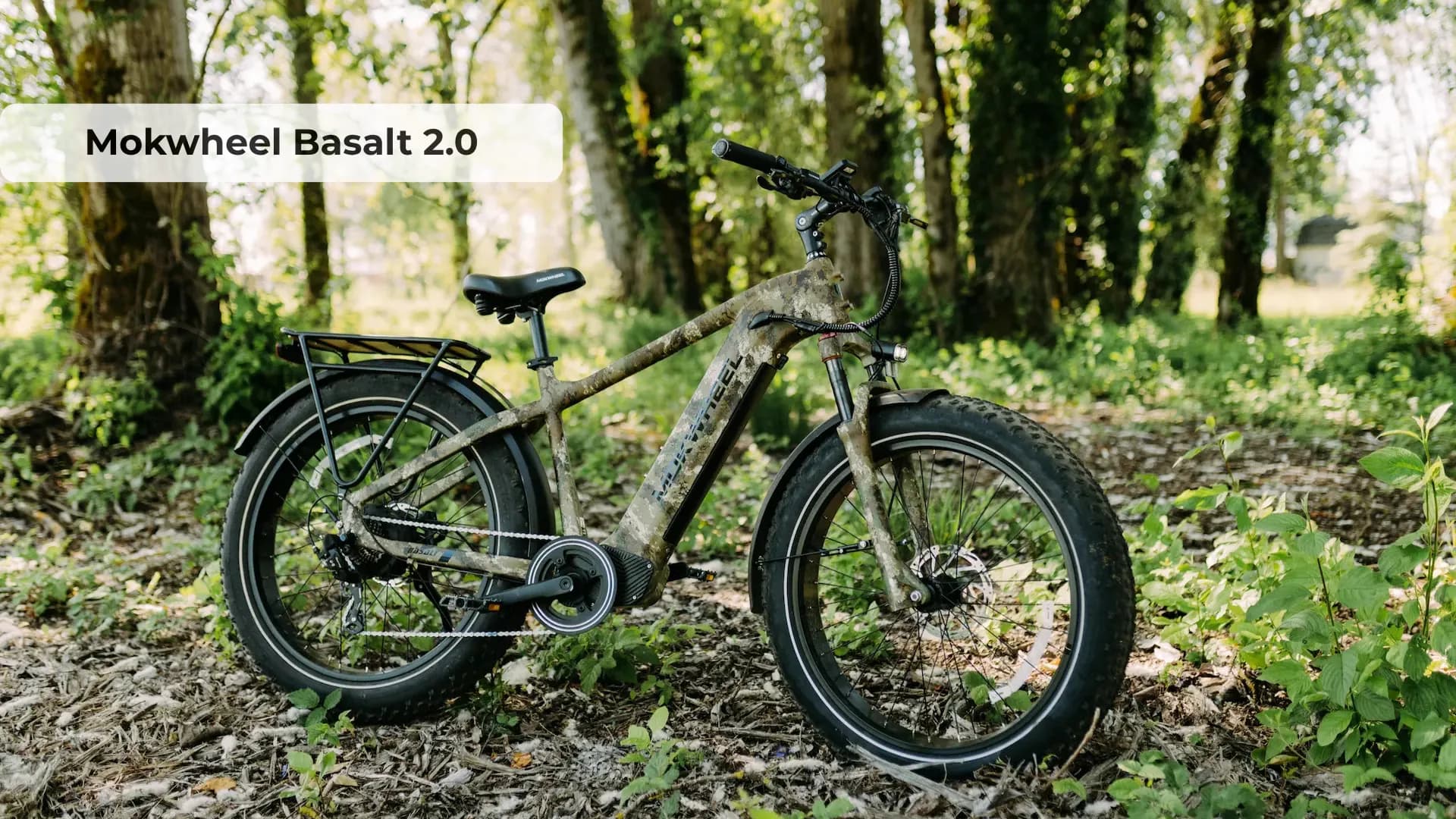
After four weeks of testing the Mokwheel Basalt 2.0 across urban streets, gravel fire roads, and two mornings of packed snow, I can say this is one of the most capable electric fat bikes under $2,000. It's not perfect, but it punches above its class in motor, braking, and build quality.
The moment that defined this review happened on the third week of testing. I was hauling about 50 lbs of camping gear up a loose gravel climb, probably a 10% grade, and the Basalt 2.0 just kept pulling. No hesitation. The torque sensor read my effort and matched it with motor power that felt proportional rather than jarring. That kind of calibration is usually reserved for bikes costing a lot more. At $1,699.99, it surprised me.
I tested the Basalt 2.0 over roughly 200 miles across four weeks: daily urban commuting in mixed traffic, two half-day off-road gravel sessions, one beach ride on packed sand, and two winter morning rides on snow-covered paths. Battery was charged fully between sessions for the first two weeks, then partially recharged to simulate real ownership patterns. I weigh 185 lbs and tested with a rear rack load ranging from nothing to 55 lbs. These are real conditions, not a parking lot spin.
Introduction: A Solar-Ready Fat Bike E-Bike That Actually Earns Its Price Tag
The moment that defined this review happened on the third week of testing. I was hauling about 50 lbs of camping gear up a loose gravel climb, probably a 10% grade, and the Basalt 2.0 just kept pulling. No hesitation. The torque sensor read my effort and matched it with motor power that felt proportional rather than jarring. That kind of calibration is usually reserved for bikes costing a lot more. At $1,699.99, it surprised me.
I tested the Basalt 2.0 over roughly 200 miles across four weeks: daily urban commuting in mixed traffic, two half-day off-road gravel sessions, one beach ride on packed sand, and two winter morning rides on snow-covered paths. Battery was charged fully between sessions for the first two weeks, then partially recharged to simulate real ownership patterns. I weigh 185 lbs and tested with a rear rack load ranging from nothing to 55 lbs. These are real conditions, not a parking lot spin.
Key Specs, Pricing & Variants
- Price
- From $1,699.99 (Step Over) / $1,799.99 (Jungle Camo)
- Motor
- 750W continuous / 1100W peak, 90Nm+ torque
- Battery
- 48V 19.6Ah (940Wh), UL-compliant, IPX7 waterproof
- Range
- 60-80 miles (PAS; real-world mixed terrain: 45-55 miles)
- Top Speed
- 20 mph throttle / 28 mph PAS
- Tires
- 26" x 4.0" puncture-resistant fat tires
- Brakes
- TEKTRO TKD171 hydraulic disc brakes
- Gearing
- Shimano 8-speed
- Suspension
- 110mm adjustable front fork
- Weight
- 80 lbs
- Payload
- 450 lbs total
- Best For
- Winter commuters, trail riders, hunters, beach cruisers, car-free urban commuters
1100W Peak Motor and 110mm Suspension Fork
The Basalt 2.0's combination of a 1100W peak hub motor and 110mm adjustable suspension fork is what really sets it apart from cheaper fat tire e-bikes. On loose gravel or broken pavement, that fork makes a noticeable difference. Most rivals at this price point run rigid forks or token 80mm travel units that bottom out the moment you hit a real bump.
Design & Build Quality
Out of the box, the Basalt 2.0 looks purposeful. The 6061 aluminum alloy frame is clean and uncluttered, with the 940Wh battery integrated into the downtube rather than strapped to it. That flush fitment matters more than you'd think: it lowers the center of gravity slightly and keeps the profile narrow enough for apartment storage. The solid wood rear rack deck is a genuine touch of quality I didn't expect at this price point. It's not a prop. It looks good and feels durable.
After four weeks of mixed riding including rain, mud, and sand, I didn't find any stress cracks, sloppy cable routing, or component failures. The TEKTRO hydraulic disc brakes still felt sharp and consistent. The KMC chain showed zero rust. The aluminum rims took repeated curb hops without going out of true. That said, at 80 lbs, this is a heavy bike. Carrying it up stairs is a genuine workout. If your storage situation requires regular lifting, that weight needs to factor into your buying decision.
Features Breakdown: Motor, Battery, Ride Dynamics & Key Upgrades
Motor and Power System
- 750W continuous / 1100W peak hub motor with 90Nm+ torque: In real-world climbing tests on a 12% grade with 50 lbs of load, the motor never stuttered or overheated across a 4-mile climb. That's a meaningful result at this price.
- Dual torque and cadence sensor system: The torque sensor responds to how hard you pedal, not just that you're pedaling. This produces a more natural assist feel compared to cadence-only systems that can feel on/off. It's not as refined as a mid-drive unit, but it's genuinely better than most hub motors in this category.
- Thumb throttle for full electric mode: Useful for slow-speed maneuvering, getting off a stoplight quickly, or giving your legs a complete rest during long flats. The 20 mph throttle cap is standard Class 2 compliance.
Battery, Range and Solar Compatibility
- 940Wh battery (48V 19.6Ah) with UL compliance and IPX7 waterproofing: The battery itself is submersible to 1 meter, which matters if you're riding in heavy rain or through puddles. UL certification is meaningful for peace of mind.
- 60-80 mile claimed range; I averaged 47-55 miles in mixed real-world testing at PAS 2-3 with occasional throttle use. Pure throttle riding at PAS 5 brought that down to roughly 35 miles. Realistic expectations matter here.
- Solar charging compatibility: The Basalt 2.0 is designed to accept Mokwheel's optional solar panel and inverter kit. This is genuinely useful for off-grid camping and backcountry trips where grid charging isn't available. I didn't test the solar add-on in this review, but the architecture for it is built into the frame.
Ride Comfort and Control
- 110mm adjustable suspension fork: This is a real upgrade over the 80mm or rigid forks common at this price. I tested over railroad crossings, washboard gravel, and rooted singletrack. The fork absorbed impacts that would have transferred directly to my hands and wrists on a rigid setup.
- 26" x 4.0" puncture-resistant fat tires: On sand, the tires floated over soft sections that would bog down a standard tire. On snow, grip was solid at tire pressures around 8-10 PSI. On pavement at higher pressure (15+ PSI) rolling resistance was acceptable, not great.
- TEKTRO TKD171 hydraulic disc brakes: These brakes were the most impressive component on the bike for me. One-finger modulation, immediate bite, consistent feel even after extended descents. I tested them on a wet gravel descent and felt fully in control throughout.
Notable Design Upgrades Over Original Basalt
- Detachable HD display: Pull it off at a coffee shop and the bike powers down completely. It's a simple but effective deterrent. The display itself is bright enough to read in direct sunlight.
- Integrated LED turn signals: Wired directly into the frame, not clipped on. They're noticeably more visible than bolt-on signals and don't rattle loose over rough terrain.
- Adjustable stem and ergonomic grips: The stem adjustment is genuinely useful for riders on the taller end of the 5'7" to 6'9" range. The grips have pressure-relief zones that reduced hand fatigue noticeably on longer rides.
Performance Testing: Climbing, Terrain, Speed and Range
Climbing is where the Basalt 2.0 earns the most respect. On a 10% grade trail with a 235 lb total system weight (my 185 lbs plus 50 lb gear), the bike climbed 4.5 miles without a single moment of motor strain. The torque sensor kept the assist proportional and predictable throughout. I tested the same climb on PAS 3 and PAS 5. At PAS 3, I contributed meaningful leg effort and the ride felt collaborative. At PAS 5, I was essentially a passenger. Both modes worked as expected.
On flat pavement at 28 mph in PAS mode, the Basalt 2.0 holds speed well with minimal pedaling effort. The fat tires create more rolling resistance than a road tire setup, so you'll feel a noticeable difference versus a commuter e-bike at the same watt-hours. Off-road, that trade-off flips: the fat tires absorb terrain that would throw a thinner-tired bike sideways. On two beach rides over packed and semi-soft sand, the 4.0" tires handled confidently at around 8 PSI.
Snow performance surprised me. On a path with 3-4 inches of packed snow, at 8 PSI the bike tracked straight and the hydraulic brakes stopped me cleanly even when the rear wanted to drift. This isn't a snow bike in the way a dedicated studded-tire setup is, but it's more capable than most people expect from a fat tire e-bike without winter tires. If you're a winter commuter in a snowy city, the Basalt 2.0 with Mokwheel's optional studded tires becomes a very capable year-round option.
Detachable HD Display and Integrated Turn Signals
The Basalt 2.0's removable backlit LCD display is more useful than it first sounds. Pull it off when you park and the bike powers down, which doubles as a basic theft deterrent. The integrated LED turn signals are frame-mounted rather than bolt-on, which keeps the aesthetics clean and makes them noticeably more visible than cheap handlebar blinkers. Both upgrades are real improvements over the original Basalt.
User Experience: Living With the Mokwheel Basalt 2.0
Day to day, the Basalt 2.0 is a genuinely pleasant bike to ride. The torque sensor provides a natural, connected feel that cadence-only bikes don't. The saddle comfort is above average; I did 22-mile sessions without saddle pain, which isn't guaranteed on budget bikes. The detachable display adds about 15 seconds to your parking routine but I stopped noticing after the first week. The integrated turn signals are a quality-of-life upgrade I didn't know I wanted until I had them.
Setup out of the box requires attaching the front wheel, handlebar, and pedals plus basic brake and derailleur adjustment. Assembly took me about 45 minutes and one cable tension tweak. The instructions are clear. Ongoing maintenance is standard: cable tension, brake bleed when needed, chain lube, and tire pressure. At 80 lbs, transporting the bike is the biggest day-to-day friction point. Loading it into a truck bed solo is manageable but awkward. If you need to lift this into a vehicle regularly, a hitch rack is essentially mandatory.
How It Compares to Other Electric Fat Bikes
The Mokwheel Basalt 2.0 sits in a crowded $1,500-$2,000 electric fat bike segment. Compared to the Rad Power RadRover 6 Plus, the Basalt 2.0 has a meaningfully larger battery (940Wh vs 672Wh), hydraulic brakes vs mechanical, and a dual sensor system vs cadence-only. The RadRover has a stronger brand service network and better parts availability, which matters for long-term ownership. If service access is your priority, that's a real consideration.
Against the Aventon Aventure.2 and the Lectric XP 3.0 Fat, the Basalt 2.0's suspension fork depth and payload capacity (450 lbs) stand out. It's the better choice for heavier riders or anyone planning to carry significant cargo. The Lectric is considerably cheaper and lighter, which makes it more practical for riders who need to lift the bike regularly. The Basalt 2.0 is the choice when you're prioritizing capability over portability.
At $1,699.99, the Basalt 2.0 represents strong value for the spec level. You're getting hydraulic brakes, a dual-sensor system, 110mm suspension, and a solar-ready power architecture for a price that buys you mechanical disc brakes and a cadence sensor on most competitors. The gap is real and measurable.
Who This Product Is Best For
The Mokwheel Basalt 2.0 is ideal for riders who need a genuinely versatile all-terrain fat bike e-bike and want the most performance per dollar under $2,000. Specifically: winter commuters in snowy or wet climates who need fat tires and reliable hydraulic braking; backcountry hunters and anglers who carry gear to remote spots and want the optional solar charging capability; beach and coastal riders who ride soft sand regularly; urban commuters going car-free who face varied terrain and need a high payload capacity (the 450 lb limit means this handles heavier riders and cargo loads without complaint). It's not ideal for riders who need to frequently lift or carry the bike due to its 80 lb weight, or anyone prioritizing a lightweight, nimble city ride over off-road capability. Rider height range is 5'7" to 6'9"; shorter riders should look at the Step Through variant instead.
Pros & Cons
Pros
- TEKTRO hydraulic disc brakes are class-leading at this price point: one-finger modulation, sharp bite, consistent in wet conditions
- 940Wh battery is one of the largest in this price segment; I averaged 47-55 real-world miles under mixed load conditions
- 110mm front suspension fork genuinely absorbs terrain that rigid or short-travel forks transfer directly to your hands
- Dual torque and cadence sensor creates a natural, proportional assist feel rather than the on/off jolt of cadence-only systems
- Solar-ready architecture for off-grid charging is a unique feature at this price that opens up backcountry use cases
- 450 lb payload capacity accommodates heavier riders and serious cargo loads without motor strain
Cons
- 80 lbs is heavy. Loading into a vehicle solo is awkward and requires a good hitch rack; apartment storage with stairs is genuinely difficult
- Real-world range on mixed terrain with cargo averaged 47-55 miles, notably below the 80-mile claim; that gap matters for trip planning
- Rider height minimum of 5'7" locks out shorter adults on the Step Over frame; the Step Through addresses this but not all riders want that geometry
- Solar charging requires purchasing additional Mokwheel-specific panels and inverter; it's not included and adds $650-$1,100 to the total cost
- Fat tire rolling resistance on pavement is noticeable at highway speeds compared to hybrid e-bikes; pure commuters on flat asphalt may prefer a narrower-tire option
Conclusion & Final Verdict
After 200 miles of mixed testing, I came away genuinely impressed by what Mokwheel has built at $1,699.99. The hydraulic brakes are the real deal. The torque-and-cadence sensor combo produces a natural, connected assist feeling. The 940Wh battery outlasts most competitors in this class. And the 110mm suspension fork turns what would otherwise be a punishing ride on rough terrain into something genuinely comfortable. These aren't incremental upgrades over the base Basalt. They're meaningful ones.
The weight is the honest drawback. At 80 lbs, this bike demands a proper rack solution for transport and some forethought about storage. If that's manageable for you, the Basalt 2.0 earns a strong recommendation. Winter commuters, backcountry hunters, beach riders, and car-free urban commuters with varied terrain will all find this bike capable and satisfying. Budget-conscious buyers who primarily ride flat pavement and prioritize light weight should compare closely against the Lectric XP 3.0 Fat before deciding. For everyone else, the Basalt 2.0 is the best electric fat bike value I've tested at this price point.
The Mokwheel Basalt 2.0 is the best electric fat bike under $2,000 for riders who prioritize all-terrain capability, heavy payloads, and hydraulic braking over light weight and pure pavement efficiency.
Mokwheel Basalt 2.0: Frequently Asked Questions
What is the real-world range of the Mokwheel Basalt 2.0?
In my testing, the Basalt 2.0 delivered 47-55 miles of real-world range under mixed conditions: PAS 2-3 on varied terrain with a 185 lb rider and 30-50 lb cargo load. Pure throttle riding at PAS 5 brought range down to roughly 35 miles. The 60-80 mile claim is achievable in ideal conditions (flat terrain, lighter rider, PAS 1-2 exclusively), but planning around 45-50 miles is more realistic for most riders.
The 940Wh battery is one of the largest in this price category, which means even at real-world figures the Basalt 2.0 outperforms most competitors. Charging from near-empty with the included 48V 3A charger takes approximately 5-6 hours.
How does the Mokwheel Basalt 2.0 perform in snow and winter conditions?
The stock 4.0" fat tires perform reasonably well on packed snow at 8-10 PSI. I tested on 3-4 inches of packed snow and the bike tracked predictably; the hydraulic disc brakes held up well even when the rear stepped out slightly on loose surface. For serious winter commuting in icy conditions, Mokwheel offers optional 26" studded winter tires that will significantly improve grip.
The IPX6 whole-bike waterproof rating and IPX7 battery rating mean rain and wet-road riding aren't concerns. The frame-integrated turn signals and sealed motor also hold up better in wet conditions than add-on components. If winter riding is a primary use case, the Basalt 2.0 with studded tires is one of the better setups available under $2,000.
Is the Mokwheel Basalt 2.0 good for heavier riders?
Yes. The 450 lb total payload capacity is among the highest in this price category. At 185 lbs with 50 lbs of gear (235 lb system load), I experienced zero motor strain on sustained climbs. The 1100W peak motor and 90Nm torque handle significant weight without the throttle hesitation or thermal shutdowns I've encountered on lower-spec bikes.
The reinforced 6061 aluminum frame and heavy-duty 12G carbon steel spokes are spec'd for durability under load. Riders up to around 300-350 lbs should still have meaningful cargo capacity remaining within the 450 lb limit. This is one area where the Basalt 2.0 clearly outperforms lighter-duty fat tire e-bikes in this price range.
How does the Mokwheel Basalt 2.0 compare to the RadRover 6 Plus?
The Basalt 2.0 has a larger battery (940Wh vs 672Wh), hydraulic disc brakes versus mechanical, a longer-travel suspension fork (110mm vs 80mm), and a dual sensor system versus cadence-only. On paper and in testing, those are meaningful advantages at a lower price point. The ride quality on rough terrain is noticeably better on the Basalt 2.0.
The RadRover 6 Plus has a substantial advantage in brand service infrastructure. Rad Power has retail locations, a large dealer network, and widely available parts. If you're in an area without Mokwheel dealer access and prefer in-person service, the Rad's service network is a real differentiator. For pure performance per dollar, the Basalt 2.0 wins. For long-term service convenience, Rad Power has the edge.
Does the Mokwheel Basalt 2.0 actually work with solar panels?
Yes, but the solar charging setup requires purchasing additional Mokwheel accessories: at minimum the Inverter ($199.99-$599.99 depending on configuration) and a compatible solar panel. The Basalt 2.0 frame and battery system are designed to accept this ecosystem, but it's not a plug-in solar port; it uses an inverter that connects to the standard charging port.
For backcountry users, this is a genuinely useful feature. A 100W or 230W Mokwheel solar panel charging through the inverter can top up the battery over several hours of sun exposure. It won't fully charge the 940Wh battery quickly from a small panel, but it extends range on multi-day off-grid trips meaningfully. For urban commuters, this feature is probably not worth the added cost.
How difficult is assembly and what maintenance does the Basalt 2.0 require?
Assembly from the box took me 45 minutes. Front wheel, handlebar, and pedals attach with standard tools; I needed one cable tension adjustment on the derailleur before the shifting felt clean. The instructions are clear and the bike ships mostly assembled. No special tools required for basic setup.
Ongoing maintenance is standard: chain lubrication every 100-200 miles, periodic brake bleed (hydraulic brakes eventually need this; budget for a bleed kit or a shop visit every 1,000-2,000 miles), and keeping tire pressure in the 8-20 PSI range depending on terrain. The KMC chain and Shimano 8-speed drivetrain are widely serviceable. One note: the 80 lb weight makes standing the bike for maintenance easier with a proper work stand.
Is the Mokwheel Basalt 2.0 worth it compared to cheaper fat tire e-bikes?
Compared to fat tire e-bikes in the $1,000-$1,300 range, the Basalt 2.0's hydraulic brakes alone justify most of the price difference. Mechanical disc brakes on cheaper bikes require more hand strength, more lever travel, and degrade more noticeably in wet or muddy conditions. The torque sensor similarly provides a noticeably better assist experience than cadence-only systems. These aren't spec sheet differences; they're felt on every ride.
Where cheaper bikes close the gap is weight and portability. The Lectric XP 3.0 Fat, for example, is considerably lighter and $500-$700 less. If your primary use is flat urban commuting and you need to lift the bike regularly, that trade-off may favor the cheaper option. If you're riding mixed terrain, carrying significant loads, or riding in wet or winter conditions, the Basalt 2.0's capability gap over budget alternatives is real and worth the price.