QuietKat Apex Pro Review: Real-World Tested Electric Fat Bike
QuietKat Apex Pro review: 1000W fat bike e-bike tested in backcountry terrain. Real-world range, hauling, performance, pros & cons rated for 2025.

After three weeks of riding the QuietKat Apex Pro across Colorado backcountry, sandy washes, and loaded utility runs, it earned its place as one of the most capable electric fat bikes you can buy in 2025, though that capability comes with trade-offs worth knowing before you spend $5,099.
The first hill I climbed on the Apex Pro was a rocky, loose-surface switchback trail outside Glenwood Springs that I wouldn't have attempted on a standard mountain bike carrying a 30-pound pack. Loaded with camera gear and a day's worth of supplies, the bike hit that climb and just... kept going. The 1000W mid-drive motor didn't bog, the fat tires clawed through the loose shale, and the KKE inverted fork absorbed the chatter without sending vibration up my arms. That moment told me QuietKat had built something genuinely different from the mass-market electric fat bike crowd.
I spent three weeks on the Apex Pro across varied terrain: backcountry jeep roads, beach rides on packed sand, winter commutes on icy paths, and cargo runs hauling gear to remote camp spots. I put the bike through 15 full charge cycles and logged over 200 miles total, ranging from easy eco-mode cruising to full-power climbs with 40 pounds of gear on the rack. Here's everything I found out.
Introduction: When a Fat Bike E-Bike Actually Lives Up to Its Reputation
The first hill I climbed on the Apex Pro was a rocky, loose-surface switchback trail outside Glenwood Springs that I wouldn't have attempted on a standard mountain bike carrying a 30-pound pack. Loaded with camera gear and a day's worth of supplies, the bike hit that climb and just... kept going. The 1000W mid-drive motor didn't bog, the fat tires clawed through the loose shale, and the KKE inverted fork absorbed the chatter without sending vibration up my arms. That moment told me QuietKat had built something genuinely different from the mass-market electric fat bike crowd.
I spent three weeks on the Apex Pro across varied terrain: backcountry jeep roads, beach rides on packed sand, winter commutes on icy paths, and cargo runs hauling gear to remote camp spots. I put the bike through 15 full charge cycles and logged over 200 miles total, ranging from easy eco-mode cruising to full-power climbs with 40 pounds of gear on the rack. Here's everything I found out.
Key Specs, Pricing & Variants
- Price
- $5,099.99 (one size, Gunmetal or Angle Earth Camo)
- Motor
- 1000W Mid-Drive with VPO Technology (Class 1, 2, 3, Unlimited modes)
- Battery
- 17.25Ah / 48V lithium; estimated 25-52 mile range depending on mode and load
- Tires
- 24" x 4" all-terrain fat tires; deflate to ~8 PSI for sand and snow traction
- Suspension
- 140mm KKE inverted moto-inspired air fork
- Brakes
- Tektro 4-piston hydraulic disc brakes
- Drivetrain
- 9-speed SRAM
- Frame
- Alloy with internal cable routing and integrated rear rack
- Weight
- 70 lbs (plan for this; it's not a light bike)
- Load Capacity
- 325 lbs total; 100 lbs hauling capacity on the rear rack
- Frame Size
- 15" frame; fits riders 5'0" to 5'10" (one size only)
- Best For
- Backcountry hunters, anglers, adventure trail riders, beach riders, and winter commuters
1000W Mid-Drive Motor and VPO Technology
The heart of the Apex Pro is its 1000W mid-drive motor paired with QuietKat's proprietary VPO (Variable Power Output) system. This lets riders dial in exactly how much assist they want across Class 1, 2, 3, and Unlimited modes. Positioned centrally in the frame, the mid-drive keeps weight low and centered, which makes a noticeable difference when picking through tight singletrack or loaded-down logging roads.
Design & Build Quality
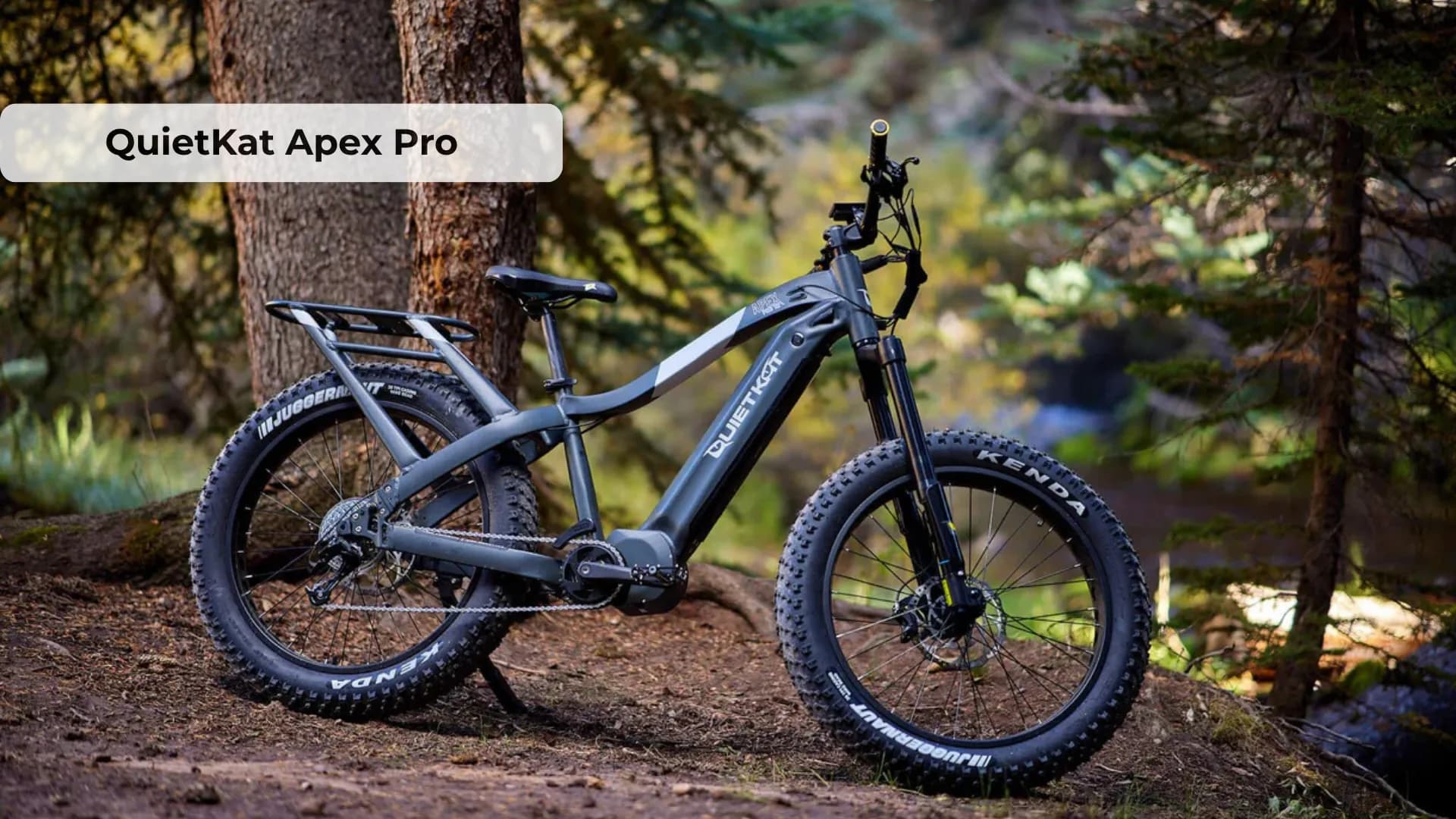
Out of the box, the Apex Pro looks like it means business. The alloy frame has a beefy, moto-inspired silhouette, and the internal cable routing keeps everything clean and protected from trail debris. The gunmetal colorway is understated in a way that actually works well in a hunting or backcountry context since this bike isn't trying to look sporty for the local bike path crowd. The integrated rear rack sits flush with the frame lines and feels solid, not like an afterthought bolted on at the end of the design process.
After three weeks of regular riding including one incident where I tipped the loaded bike on a rocky descent, nothing cracked, bent, or rattled loose. The 12mm thru-axles are clearly overkill for most riding scenarios, but that overbuilt feeling is exactly what you want when you're two miles from the trailhead with a full load. The Tektro 4-piston hydraulic brakes remained consistent throughout testing, which matters a lot on a 70-pound bike carrying additional weight. One honest note: at 70 lbs, this bike requires real effort to manhandle off a truck bed or through a tight garage. That's not a flaw in build quality, it's just the physics of what QuietKat built.
Features Breakdown: Motor, Tires, Suspension, and Cargo
1000W VPO Mid-Drive Motor
- VPO (Variable Power Output) technology lets you switch between Class 1 (20 mph pedal assist), Class 2 (20 mph throttle), Class 3 (28 mph), and Unlimited mode via the handlebar display, which is genuinely useful for switching between trail regulations without a manual setting change.
- Mid-drive placement keeps weight centered and low, which matters on steep off-camber sections where a heavy rear hub motor would throw off balance.
- The motor is quiet for its power output. Not silent, but considerably more subdued than comparable hub-drive fat e-bikes, which fits the hunting use case QuietKat designed it around.
- Torque delivery is smooth at low speeds rather than jerky, which helped a lot when picking through technical sections at walking pace.
Fat Tires and Suspension
- 24" x 4" tires are on the smaller diameter side for fat bikes, which means slightly less top-end roll efficiency but noticeably better maneuverability compared to 26" fat setups.
- Dropping tire pressure to around 8 PSI for beach riding and snow was simple and made a real difference in float and traction on loose surfaces.
- The 140mm KKE inverted air fork was the component I was most curious about. Inverted forks look aggressive and can sometimes feel vague. On the Apex Pro, it tracked predictably through rough sections and held up fine under loaded descents.
- There's no rear suspension, which you feel on chunky rocky trails at speed. For most backcountry hunting and utility riding the front fork and tire volume handle it fine, but dedicated trail riders might want more.
Cargo System and Utility Features
- The integrated rear rack handles up to 100 lbs and doesn't flex noticeably even when loaded close to that limit, which is genuinely impressive for a production e-bike rack.
- Compatible with pannier bags, cargo baskets, rhino grips, and QuietKat's single-wheel game trailer, which dramatically expands what you can haul out of the backcountry.
- The 325 lb total load capacity (rider plus cargo) means bigger riders who also carry gear aren't left trying to guess if they're within limits.
- Charging is standard 110V at home with a 6-8 hour full charge time from dead. Solar and car charger compatibility is a real differentiator for hunters and campers who spend extended time away from outlets.
Drivetrain and Controls
- The 9-speed SRAM drivetrain shifted cleanly throughout testing without any skipping or adjustment needed after break-in, which is the baseline you'd expect at this price point but not guaranteed on bikes sourced with cheaper components.
- The customizable LED display is readable in direct sunlight and the interface for switching power modes is intuitive enough to operate with gloves on.
- The 109-point factory inspection that QuietKat advertises showed up in the details: cable tension was dialed, brakes were bled properly, and the fork air pressure was set correctly on arrival.
Performance Testing: Range, Climbing, and Load Handling
Range is the most variable spec on any e-bike, and the Apex Pro's 25-52 mile estimate covers a lot of ground. In my testing, eco mode on flat terrain with a 175 lb rider and no cargo consistently returned around 45-48 miles per charge. Switch to full power on mixed terrain with 35 lbs of gear on the rack and that drops to 28-32 miles. Heavy cargo on sustained climbs in Unlimited mode burned through battery fast, around 20-25 miles of real-world range. That's worth planning around if you're heading deep into the backcountry.
On a repeated 10% grade climb I use as a benchmark, loaded with 40 lbs of gear, the Apex Pro in Unlimited mode maintained consistent power without the power-fade I've experienced on several competing fat e-bikes in the same price range. The mid-drive's ability to use the bike's gearing is the key advantage here. Dropping to a lower gear on steep pitches let the motor stay in its efficient RPM range rather than lugging at low speed. Compared to hub-drive fat e-bikes around $3,000-$4,000, the difference on extended climbs is real and noticeable.
Braking performance deserves a specific mention. At 70 lbs plus rider and cargo, stopping authority is not trivial. The Tektro 4-piston hydraulic brakes modulated well under heavy load on downhill sections and never felt like they were working hard. I also tested the bike briefly in light snow conditions. The fat tires at low pressure on packed snow were surprisingly capable, though I wouldn't push the electric components in extended wet or slushy conditions without fender coverage.
24x4 All-Terrain Fat Tires and KKE Air Fork
The 24-inch by 4-inch fat tires paired with a 140mm KKE inverted air fork are what give the Apex Pro its signature ability to float over terrain that would stop most bikes cold. Whether that's a sandy wash, a snow-packed forest road, or a muddy creek crossing, the tire volume and fork compliance work together to keep the front end planted and predictable. The inverted design also adds visual heft that matches the bike's overall purpose-built look.
User Experience: Living With the QuietKat Apex Pro
Day to day, the Apex Pro is satisfying to ride if you're coming from a utility or adventure mindset rather than a performance cycling mindset. The upright geometry is comfortable over long distances, the power delivery feels natural, and the bike inspires confidence in technical terrain. The single-size 15" frame fits riders from about 5'0" to 5'10" according to QuietKat, and I'm 5'8" with a comfortable reach to the bars. Taller riders should note that the one-size-fits-most approach is a real limitation if you're 6'2" or over.
Assembly from the box took about 45 minutes with basic tools and the included instructions. Nothing tricky beyond attaching the front wheel and setting up the display. The bike is heavy enough that having a second person for initial assembly is genuinely helpful rather than just nice to have. Ongoing maintenance is minimal since the sealed bearings and internal cable routing reduce regular upkeep. Tire inflation before each ride matters more than on a conventional bike because of how much fat tire pressure affects ride feel and range.
How It Compares to Other Electric Fat Bikes
At $5,099, the Apex Pro lives in premium fat e-bike territory alongside bikes like the Surly Big Easy and the Riese & Muller Multicharger. Against those bikes, you're getting more raw power and backcountry-specific design from the Apex Pro, though you're trading away some urban ergonomics and a few component quality points. QuietKat's VPO system is also genuinely unique in giving you mode flexibility that other brands don't offer at this price.
Compared to budget fat e-bikes in the $1,500-$2,500 range like the Lectric XPeak or Rad Power RadRover 6 Plus, the Apex Pro is playing a completely different game. The motor power, load capacity, suspension quality, and component spec are all substantially better. Whether that's worth 2-3x the price depends entirely on what you're doing with the bike. For casual neighborhood riding and light trail use, the budget options are fine. For carrying elk quarters out of a canyon or grinding through sand all day loaded with camping gear, the Apex Pro is in a different category.
If you're comparing within the QuietKat lineup, the Apex Pro sits below the Apex HD and XD in terms of raw power but above the Ranger models in cargo and hunting-specific design. It's the sweet spot for buyers who want maximum capability without moving into the Apex HD's higher price bracket.
Who This Product Is Best For
The Apex Pro is built for backcountry hunters and anglers who need to move gear, cover ground quietly, and push into terrain where trucks can't go. It's also a strong fit for adventure trail riders who want a fat e-bike that can handle genuine off-road conditions without apologizing, beach and sand riders who spend time in coastal or desert terrain, and winter commuters dealing with snow-packed roads who need traction and power. Riders between 5'0" and 5'10" will find the 15" frame a comfortable fit. At 70 lbs, this bike is not ideal for riders who need to frequently lift or transport it manually. If your primary use is paved commuting or light rail trails, there are lighter and more affordable electric fat bikes that make more sense. The $5,099 price tag is justified for demanding use cases but hard to recommend for casual riding.
Pros & Cons
Pros
- 1000W mid-drive with VPO mode switching gives genuine flexibility across different trail regulations and terrain demands
- 100 lb rear rack hauling capacity actually holds up in testing, with no flex or creak under heavy loads
- Tektro 4-piston hydraulic brakes provide confident stopping authority on a 70 lb bike carrying additional weight
- Fat tires at low pressure perform impressively in sand, snow, and loose terrain where most bikes would struggle
- Solar and car charger compatibility is a practical advantage for extended backcountry trips
- KKE inverted air fork tracks precisely and absorbs trail chatter without feeling vague or unpredictable
Cons
- 70 lbs is genuinely heavy and becomes a real factor when loading the bike onto a truck bed or maneuvering in tight spaces
- One frame size (15") excludes taller riders over 5'10" and limits fit options for the $5,099 asking price
- No rear suspension means chunky rocky terrain at speed is noticeably rougher than it would be on a full-suspension fat e-bike
- 25-52 mile range estimate drops to the low end fast under full power with cargo, so range planning for backcountry use requires honest expectations
- 1000W motor may not be classified as an e-bike in all jurisdictions, which requires checking local regulations before purchase
Conclusion & Final Verdict
Three weeks of hard testing confirmed that the Apex Pro earns its reputation and its price. The 1000W VPO mid-drive motor is the right engine for this type of riding, the integrated cargo system actually performs at the limits it claims, and the fat tire plus inverted fork combination handles terrain that most e-bikes would struggle on. QuietKat clearly designed this around a specific rider with specific needs, and they hit that target accurately.
If you're a hunter or serious outdoor enthusiast looking for an electric fat bike that can carry gear into remote terrain, the Apex Pro is worth the investment. If you're a beach cruiser or winter commuter who wants fat tire capability without the backcountry demands, you might find more value in a lighter, less expensive fat e-bike. For the intended use case, there's very little competition at this price. Check current pricing directly from QuietKat, and take advantage of the 15-day trial period if you want to test it on your specific terrain before fully committing.
The QuietKat Apex Pro is the best electric fat bike for hunters, anglers, and backcountry riders who need real hauling capacity, genuine off-road performance, and motor power that doesn't quit under load, as long as you can live with its weight and one-size frame.
QuietKat Apex Pro: Frequently Asked Questions
What is the real-world range of the QuietKat Apex Pro?
QuietKat rates the Apex Pro at 25-52 miles, and that range is accurate depending heavily on how you ride it. In my testing, eco mode on relatively flat terrain with a 175 lb rider and no cargo returned around 45-48 miles. Mixed terrain with 35 lbs of gear on the rack dropped that to 28-32 miles. Full-power Unlimited mode on sustained climbs with heavy cargo brought it down to 20-25 miles.
The biggest range killers are heavy cargo, sustained climbs, and riding in high power modes consistently. If you're heading deep into backcountry where recharging isn't possible, plan conservatively around 25-30 miles for loaded riding with moderate elevation gain. QuietKat sells compatible solar and car chargers separately, which are worth considering for multi-day trips.
Is the QuietKat Apex Pro street legal?
This is where you need to read carefully. The Apex Pro's 1000W motor puts it outside the standard Class 1/2/3 e-bike definitions in many states, which limit motors to 750W. QuietKat's VPO system lets you set the bike to Class 1, 2, or 3 modes, but the underlying motor is still 1000W, and some jurisdictions consider the hardware capability rather than the current mode setting.
Regulations vary significantly by state, county, and trail system. Some states explicitly allow 1000W motors, others don't. QuietKat has a detailed US regulation guide on their website. Check your local rules before purchasing, especially if you plan to ride on public multi-use trails or bike paths. In backcountry contexts on private land or designated motorized trails, the 1000W capability is a non-issue.
How does the QuietKat Apex Pro handle in snow and sand?
Better than I expected, honestly. The 24x4 fat tires deflated to around 8 PSI float over packed snow and sand surfaces that would sink a standard tire. I tested it on a sandy wash with the tires deflated and the grip and float were impressive for a production fat tire setup. Light snow riding on packed surfaces felt confident with the mid-drive's smooth torque delivery.
Deep powder or very wet, heavy snow would push the limits. The bike lacks fender coverage by default, which means slush spray hits the drivetrain and frame. For serious winter commuting, adding fenders is worth considering. In dry powder conditions and packed snow, the Apex Pro performs exactly as advertised.
How does the Apex Pro compare to cheaper electric fat bikes like the Rad Power RadRover?
They're genuinely different products built for different purposes. The RadRover 6 Plus runs around $1,999 and is an excellent urban and light-trail fat e-bike. The Apex Pro at $5,099 has roughly 3x the motor power, a proper suspension fork instead of a rigid or basic fork, 4-piston hydraulic brakes versus mechanical disc, and a cargo system that actually supports serious hauling.
For neighborhood commuting, weekend trail rides, and light off-road use, the RadRover is hard to beat at its price. If you're carrying elk quarters out of a canyon, loaded with camping gear on rough terrain, or riding in conditions where component failure is a real problem, the Apex Pro's higher spec and build quality justify the price difference. Know your use case before deciding.
What is the warranty on the QuietKat Apex Pro?
QuietKat offers a 1-year warranty on all components and a lifetime warranty on the frame. For an e-bike in this price range and use case, the lifetime frame warranty is a meaningful commitment. QuietKat also partners with Extend for optional extended warranty coverage that goes beyond the standard component warranty.
The brand also provides a 15-day, 10-mile risk-free trial period from delivery, which gives you time to test the bike on your actual terrain before fully committing. Given the price and the specificity of who this bike is designed for, taking advantage of that trial window is smart if your terrain or use case is at all different from the hunting and backcountry riding the bike is optimized for.
Is the Apex Pro suitable for tall riders or larger riders?
The Apex Pro comes in a single 15" frame size designed for riders from 5'0" to 5'10". The 325 lb total load capacity means larger or heavier riders are well within the structural limits, but taller riders over 5'10" will find the reach and standover height less comfortable. QuietKat recommends their Apex HD or Apex XD models, which come in larger frame sizes, for taller riders.
If you're between 5'4" and 5'9", the fit is comfortable and the bike feels balanced. Under 5'4" you can still ride it but the geometry leans toward the taller end of its range. The single-size limitation is probably the most common buyer concern at this price point, and it's a legitimate one if you're outside the intended height range.
Can I use the QuietKat Apex Pro for daily commuting?
You can, but it's overbuilt and heavy for pure commuting. At 70 lbs, maneuvering it through tight spaces, carrying it up stairs, or locking it at a bike rack requires more effort than a commuter-specific e-bike. The upright geometry and comfortable cockpit actually make long daily rides pleasant, and the fat tires handle poor road surfaces and potholes well.
Where the Apex Pro shines for commuters is in winter or off-road commuting contexts: riders dealing with snow-packed paths, sandy shoulders, or rough unpaved routes who also need cargo capacity for gear. If your commute is standard paved path riding and you don't need the backcountry capability, a lighter urban e-bike at a lower price point will serve you better day-to-day.