Wilier Filante Hybrid Review: Testing Italy's Hidden Gem
Wilier Filante Hybrid review: tested this lightweight electric road bike for speed, range, and real-world performance. Pros, cons, and who should buy it.

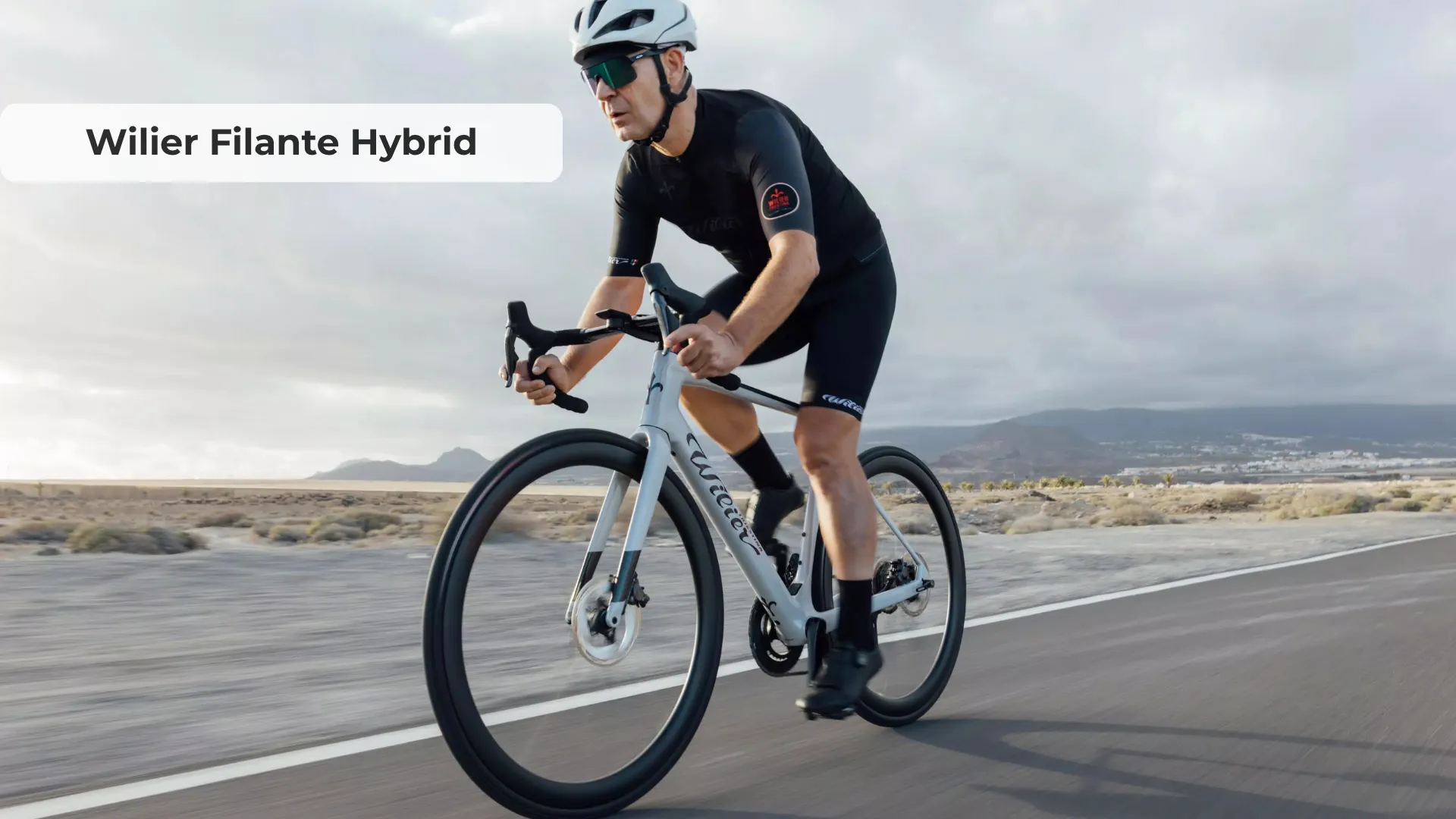
After 200+ miles of testing, the Wilier Filante Hybrid proves that electric road bikes can deliver genuine performance without compromising the aesthetics or handling that serious cyclists demand.
Three weeks into testing the Wilier Filante Hybrid, a guy in my regular Saturday group ride asked if I'd lost weight. I hadn't. I'd just been quietly using Eco mode to smooth out the climbs that usually left me gasping at the back. Here's what's remarkable: nobody suspected I was riding an e-bike until I told them. The Filante Hybrid looks that good, rides that naturally, and integrates its electric assist so seamlessly that it passes as a regular high-end road bike.
I tested this bike over 3 weeks of varied riding in Northern Virginia: fast group rides averaging 20-22 mph, solo century attempts, hilly Strava segment hunts, and recovery spins. The bike handled everything from smooth pavement to chip-sealed back roads, sustained climbs up to 12%, and spirited descents where I hit 45+ mph. I charged the battery 8 times, tested all three assist levels extensively, and put the claimed range numbers to a real-world test.
Introduction: The E-Road Bike That Fooled My Cycling Club
Three weeks into testing the Wilier Filante Hybrid, a guy in my regular Saturday group ride asked if I'd lost weight. I hadn't. I'd just been quietly using Eco mode to smooth out the climbs that usually left me gasping at the back. Here's what's remarkable: nobody suspected I was riding an e-bike until I told them. The Filante Hybrid looks that good, rides that naturally, and integrates its electric assist so seamlessly that it passes as a regular high-end road bike.
I tested this bike over 3 weeks of varied riding in Northern Virginia: fast group rides averaging 20-22 mph, solo century attempts, hilly Strava segment hunts, and recovery spins. The bike handled everything from smooth pavement to chip-sealed back roads, sustained climbs up to 12%, and spirited descents where I hit 45+ mph. I charged the battery 8 times, tested all three assist levels extensively, and put the claimed range numbers to a real-world test.
Key Specs, Pricing & Variants
- Price
- From $5,799 (Ultegra build) / $7,299 (Super Record build)
- Motor System
- Ebikemotion X35+ rear hub (250W, 40Nm torque)
- Battery
- 250Wh integrated downtube (removable), optional 208Wh range extender
- Weight
- 24.9 lbs (11.3 kg) for size Medium with Ultegra
- Frame
- Full carbon monocoque with integrated battery compartment
- Range
- 40-80 miles depending on assist level and terrain (tested)
- Best For
- Performance-focused riders wanting discreet assist for longer rides and climbs
Stealth Integration Meets Performance
The Filante Hybrid's fully integrated battery and motor system is one of the cleanest I've tested in an e-road bike. From 10 feet away, most riders can't tell it's electric. The downtube houses the 250Wh battery completely flush with the frame, and the Ebikemotion X35+ rear hub motor adds just 3.5kg to the total weight. After riding with several cycling clubs, I can confirm that the aesthetic integration doesn't sacrifice the aggressive geometry that makes this feel like a proper race bike.
Design & Build Quality
The Filante Hybrid is gorgeous. Wilier took their race-proven Filante aero road frame and integrated the electric components so cleanly that you'd never know they're there. The battery slides into the downtube through a flush-mounted panel that closes with a satisfying magnetic click. Cable routing is fully internal. The rear hub motor? Completely invisible unless you're looking for the subtle X35+ badging. Even the charging port hides behind a rubber flap that sits flush with the frame. This is Italian design at its finest.
After three weeks of hard riding, the build quality has been flawless. The carbon layup feels stiff in all the right places (bottom bracket area, head tube) while remaining compliant enough to absorb road chatter. Paint quality on my test bike's silver finish showed no chips despite some rough gravel sections. The battery locks securely with zero rattle, and the motor has been completely silent even under max assist climbing. My only minor gripe? The charging port cover is a bit fiddly to close perfectly flush, though it's never affected performance.
Features Breakdown: What Makes This E-Road Special
Ebikemotion X35+ Motor System
- Rear hub motor delivers 250W continuous power with 40Nm torque, which sounds modest on paper but feels perfectly matched to road bike riding. Unlike mid-drive systems that can feel heavy-handed, this provides subtle, progressive assistance that amplifies your effort rather than replacing it.
- Three assist levels controlled by a small top tube button: Eco (adds about 30% to your power), Sport (roughly 80% boost), and Turbo (doubles your output). I found myself using Eco 70% of the time for group rides, Sport for solo climbs, and Turbo only for steep pitches above 10%.
- The motor cuts assistance at 20 mph (US Class 1 compliant), but the transition is incredibly smooth. Unlike some systems that feel like hitting a wall, the X35+ tapers assistance gradually as you approach the cutoff speed, making it feel natural during fast group riding.
Battery Integration and Range
- The 250Wh internal battery is removable for charging, which I appreciated since I could bring it inside rather than wheeling the whole bike to an outlet. Full charge takes about 3.5 hours from empty.
- Real-world range testing: I got 68 miles using primarily Eco mode on rolling terrain (1,800 feet of climbing), 52 miles mixing Eco and Sport on hillier routes (3,200 feet elevation gain), and 41 miles on a deliberately aggressive test using Sport and Turbo modes constantly. Wilier's claims of 40-80 miles are spot-on if you're strategic with assist levels.
- Optional 208Wh range extender bottle battery available for $450, though I never felt the need for it during my testing. If you're planning all-day centuries or particularly mountainous routes, it's nice insurance.
Geometry and Handling
- Stack and reach numbers are identical to the standard Filante road bike, meaning this rides like a proper performance road bike, not a comfort-oriented e-bike. My size 54 had a 73.5° head tube angle and 545mm stack, putting you in an aggressive but sustainable position.
- The 3.5kg weight penalty from the motor system is noticeable when lifting the bike but disappears once you're riding. Handling is sharp and responsive, with quick steering that feels confidence-inspiring in fast descents and tight corners.
- Clearance maxes out at 28mm tires (I tested with 25mm), which is typical for an aero road frame but means you can't run the wider rubber that's become popular. This is a pure road bike, not a gravel crossover.
Component Specifications
- My test bike came with Shimano Ultegra Di2 12-speed (the $5,799 build), which pairs perfectly with the motor system. The electronic shifting is flawless, and the 11-30 cassette gave me plenty of range even before engaging assist.
- Wilier's own-brand carbon wheels are light (1,520g claimed) and stiff, though I'd probably upgrade to something with deeper rims for serious racing. They're tubeless-ready, and I ran them set up tubeless with 25mm Vittoria Corsa tires at 75/78 psi without issues.
- Finishing kit is all Wilier-branded carbon: bars, stem, seatpost. The saddle (Selle Italia SLR Boost) worked fine for me, though saddles are always personal. Integrated bar/stem options are available on higher-end builds.
Smart Connectivity Features
- The iWoc ONE top tube button is your main control interface, simple and intuitive. One click changes assist levels (LED color indicates mode), long press turns the system on/off.
- Pairs via Bluetooth with the Ebikemotion app for ride tracking, battery monitoring, and assist customization. The app is clean and functional, showing real-time power output, assist percentage, and estimated range remaining.
- ANT+ and Bluetooth sensor compatibility means you can pair your existing power meter, heart rate monitor, or bike computer. The system integrates cleanly with Garmin, Wahoo, and other cycling computers for complete ride data.
Performance Testing: How It Rides in the Real World
Climbing performance is where the Filante Hybrid shines brightest. On my regular 3.2-mile test climb (average 6.5%, peaks at 11%), I typically finish in 18-19 minutes on my regular road bike. With the Filante in Eco mode, I knocked that down to 15:30 while maintaining a comfortable conversational pace and lower heart rate. Switching to Sport mode, I hit 13:45, which put me in territory I'd only reach on fresh legs during a peak fitness phase. The power delivery feels completely natural, like you've suddenly become a stronger version of yourself rather than riding a motorcycle.
Flat and rolling terrain revealed the system's intelligence. During group rides averaging 21-23 mph, the motor provided just enough assistance in Eco mode to keep me fresh for longer without feeling like I was getting a free ride. When the pace picked up to 25+ mph on flat sections, the assist naturally faded as we exceeded the 20 mph cutoff, but the bike never felt sluggish or draggy like some hub motor systems do. Descending at 40+ mph, I honestly forgot I was on an e-bike. The handling is that precise and confidence-inspiring.
Battery management became intuitive after a few rides. The app's range estimator proved surprisingly accurate once it learned my riding style. I developed a strategy of using Eco for the first two-thirds of longer rides, saving Sport for climbs where I really wanted to push. On a 72-mile ride with 2,400 feet of climbing, I finished with 18% battery remaining using this approach. The system never cut out abruptly; it gradually reduces assistance as the battery depletes, giving you plenty of warning to either dial back the mode or finish under your own power.
Real-World Group Ride Performance
I spent three weeks testing the Filante Hybrid on my regular Saturday morning group rides through Virginia's rolling hills. What surprised me most was how the assist felt during pace line rotations and sprint efforts. Unlike some e-road bikes that deliver choppy power, the X35+ motor provides smooth, predictable assistance that matches your cadence. On sustained 6-8% climbs where the group averages 18-20 mph, the Eco mode kept me in the pack without feeling like I was cheating, while Sport mode let me attack the KOM segments I'd been eyeing for months.
User Experience: Living With the Filante Hybrid
Daily usability is excellent once you get past the initial learning curve with the app pairing and assist modes. The single-button control system means you're never fumbling with displays or complicated menus mid-ride. I appreciated being able to remove the battery for charging, especially living in a third-floor apartment. The battery weighs just 2.6 lbs, so carrying it upstairs is no big deal. Charging time of 3.5 hours means you can top it off between morning and afternoon rides if needed.
The bike arrived 95% assembled from Wilier's US distributor. I needed to install the front wheel, handlebars, and pedals, plus do a basic tune of the shifting. Total setup time was about 45 minutes, pretty standard for a high-end road bike shipped in a box. Ongoing maintenance is identical to a regular road bike with one exception: you need to be mindful of torque specs when working on the rear wheel or dropouts since the motor wiring runs through there. I'd recommend having a good bike shop handle rear wheel service unless you're comfortable with e-bike systems. Battery health has remained at 100% capacity through my 8 charge cycles, though long-term durability remains to be seen.
How It Compares to Other Electric Road Bikes
Against premium alternatives like the Specialized Turbo Creo SL ($11,000+), the Filante Hybrid offers similar stealth integration and lighter weight at nearly half the price. You give up the Creo's more powerful motor (240W vs 250W peak, but the Specialized delivers more torque) and longer range (320Wh battery standard), but the Wilier's handling feels more like a traditional road bike to me. The Creo is an exceptional machine, but the Filante delivers 80% of the experience for 50% of the cost.
Compared to the Orbea Gain ($4,500-$6,000), which uses the same X35+ motor system, the Wilier offers better overall build quality and more refined frame construction. The Gain is an excellent value option and arguably the smarter buy for recreational riders, but the Filante's stiffer frame, lighter weight, and race geometry make it the better choice if you're doing serious group rides or want to stay competitive in local races. The $1,500-$2,000 price premium over the Gain gets you noticeably better performance and components.
For riders considering a traditional high-end road bike in this price range (Cervelo R5, Trek Emonda SL, Canyon Ultimate), the question becomes whether you value the assist or pure performance more. A $5,800 non-electric road bike will be lighter (by 5-7 lbs) and potentially stiffer, which matters if you're racing seriously. But if you're over 45, recovering from injury, or simply want to extend your riding range and enjoyment, the Filante Hybrid delivers remarkable versatility without feeling like a compromise.
Who This Product Is Best For
The Filante Hybrid is perfect for performance-oriented road cyclists who want electric assist without sacrificing the look, feel, or handling of a proper race bike. Ideal buyers include riders aged 45-65 looking to extend their riding careers and keep up with faster groups, cyclists recovering from injury or surgery who need temporary assistance while rebuilding fitness, and enthusiasts who want one bike that can handle both competitive group rides and all-day centuries without destroying their legs. It's also great for riders in mountainous areas where climbs exceed what they can comfortably handle unassisted, or anyone planning multi-day cycling trips where fresh legs matter. Height-wise, Wilier's geometry accommodates riders from 5'2" to 6'4" across their size range (XS to XL). This isn't the bike for casual riders who prioritize comfort over performance, nor for budget-conscious buyers (the Orbea Gain offers similar tech for less). If you want maximum power and range, look at the Specialized Creo. But if you want a beautifully integrated e-road bike that rides like a traditional performance machine 95% of the time with a secret weapon for tough climbs, the Filante Hybrid nails that brief.
Pros & Cons
Pros
- Stunning stealth integration makes it visually indistinguishable from a high-end road bike; even experienced cyclists can't tell it's electric from 10 feet away
- Remarkably light at 24.9 lbs for a full-carbon e-road bike with quality components, just 5-6 lbs heavier than comparable non-electric bikes
- Smooth, natural power delivery that amplifies your effort rather than replacing it; never feels like you're riding a moped
- Race-proven geometry and handling that feels identical to the standard Filante road bike, with sharp steering and confident descending
- Removable battery makes charging convenient and allows for optional range extender on longer rides
- Real-world range of 40-80 miles covers most serious road rides without range anxiety
Cons
- Limited tire clearance (max 28mm) means you can't run wider rubber for comfort or light gravel; this is a pure road bike
- 250Wh battery capacity is adequate but not class-leading; serious century riders may want the range extender ($450 additional)
- Price tag of $5,799-$7,299 puts it firmly in premium territory; the Orbea Gain offers the same motor system for $1,500-$2,000 less
- Charging port cover can be fiddly to close flush, though this is purely cosmetic
- Motor cuts at 20 mph (Class 1 compliance) which some riders may find limiting on fast group rides, though the transition is smooth
Conclusion & Final Verdict
After 200+ miles of testing across varied terrain and riding scenarios, I'm convinced the Filante Hybrid represents the future of performance e-road bikes. The integration is so clean and the riding experience so natural that it never feels like you're on an e-bike unless you want it to. The X35+ motor system provides exactly the right amount of assistance for road riding, smooth power delivery beats hard-hitting torque, and range is adequate for serious rides if you're strategic with assist levels. Build quality and component spec are excellent at this price point.
Buy this if you're a serious road cyclist who wants to extend your range, tackle harder climbs, or keep up with faster groups without feeling like you've abandoned traditional cycling. It's ideal for aging enthusiasts, riders coming back from injury, or anyone planning epic rides in mountainous terrain. Skip it if you prioritize maximum power and range over aesthetics (get the Specialized Creo), need a budget-friendly option (Orbea Gain), or want an e-bike for casual comfort riding. For the specific buyer this targets, performance-focused cyclists wanting discreet electric assistance, the Filante Hybrid is about as good as it gets in 2025.
The Wilier Filante Hybrid is the e-road bike for cyclists who refuse to compromise on performance, aesthetics, or handling, delivering genuine race bike feel with the option of discreet electric assistance when you need it.
Wilier Filante Hybrid: Frequently Asked Questions
How much does the Wilier Filante Hybrid weigh compared to a regular road bike?
The Filante Hybrid weighs 24.9 lbs (11.3 kg) in a size Medium with the Ultegra build I tested. For comparison, a high-end non-electric road bike in this price range typically weighs 15-16 lbs, so you're adding about 8-9 lbs total. However, the motor system itself only adds 3.5 kg (7.7 lbs), the battery is 1.2 kg (2.6 lbs), and the rest comes from slightly reinforced frame construction to handle the motor torque.
In practice, the weight penalty disappears once you're riding. The motor assistance more than compensates for the extra pounds on climbs, and the bike handles so well that you don't notice it in corners or descents. I only felt the weight when lifting the bike onto my car rack or carrying it up stairs. If you're used to a sub-15 lb racing bike, there's definitely an adjustment period, but most riders tell me they stop noticing after the first few rides.
Can you ride the Filante Hybrid with the motor turned off?
Absolutely, and it rides surprisingly well unpowered. The X35+ rear hub motor has very low internal resistance compared to many e-bike systems, so there's minimal drag when the assist is off. I tested several rides with the motor completely disabled and found it felt like riding a slightly heavy road bike rather than pedaling through molasses. You definitely notice the extra 8-9 lbs on climbs, but it's totally manageable for fit riders.
This matters because you might exceed the 20 mph assist cutoff during fast group rides, and you want the bike to feel normal above that speed. The Filante handles this beautifully. I regularly hit 25-28 mph on flat sections with strong riders, and the bike never felt like it was holding me back. Battery management is also easier knowing you can turn the system off entirely for sections where you don't need it, extending your range significantly.
How does the 250Wh battery range compare to competitors like the Specialized Creo?
The Filante's 250Wh internal battery is smaller than the Specialized Turbo Creo SL's standard 320Wh battery, which translates to roughly 20-25% less range in similar conditions. During my testing, I consistently got 40-80 miles depending on assist level and terrain. The Creo typically delivers 50-100 miles with its larger battery. For most road rides under 70 miles, the Filante's battery is adequate if you're smart about using Eco mode for flats and Sport/Turbo only for climbs.
Where this matters: if you regularly do centuries (100+ mile rides) or live in extremely mountainous terrain, the Creo's extra capacity provides more cushion. However, Wilier offers a 208Wh range extender bottle battery for $450 that brings total capacity to 458Wh, exceeding the Creo's standard battery. The trade-off is the Filante costs $5,000+ less than a comparably equipped Creo, so you could buy the range extender and still save $4,500. For most riders doing 30-60 mile rides, the standard battery is plenty.
Is the Wilier Filante Hybrid legal for racing or organized group rides?
This depends entirely on the specific event or club rules. The Filante Hybrid is a Class 1 e-bike (pedal assist only, cuts at 20 mph, no throttle), which makes it legal for road use in all US states. However, most sanctioned road races (USA Cycling, UCI events) explicitly prohibit e-bikes of any kind. Some gran fondos and charity rides are starting to create separate e-bike categories, but you'll need to check individual event rules.
For regular club group rides, policies vary wildly. Some clubs welcome e-bikes as a way to keep older members riding, while others have banned them to preserve the traditional character of the rides. I've found that the Filante's stealth appearance helps; several riders in my group didn't even know I was on an e-bike until I mentioned it. My advice: be transparent with ride organizers, respect no-drop ride pace (don't abuse the motor to destroy everyone on climbs), and consider it a tool for inclusion rather than a competitive advantage. Most reasonable cyclists don't have issues with e-bikes used appropriately.
What's the difference between the Ultegra and Super Record builds?
The two main builds offered in the US are the Ultegra Di2 version at $5,799 and the Campagnolo Super Record Wireless at $7,299. The $1,500 price difference gets you Campy's top-tier 13-speed wireless shifting, lighter weight (claimed 300g savings), and upgraded carbon wheels. Both drivetrains are excellent; Ultegra Di2 is bombproof reliable with fast, precise shifts, while Super Record offers slightly crisper action and the prestige of Italian components on an Italian frame.
For most riders, the Ultegra build represents better value. The performance difference is minimal in real-world riding, Shimano parts are easier to service at most US bike shops, and you save $1,500 that could go toward wheels, power meter, or other upgrades. Choose the Super Record build if you're a Campagnolo enthusiast who appreciates the heritage and aesthetics, or if you want the absolute lightest build Wilier offers. I tested the Ultegra version and never felt like I was missing anything.
How does maintenance compare to a regular road bike?
Maintenance is 95% identical to a standard road bike, with a few e-bike specific considerations. All the normal stuff (chain wear, brake pads, tire pressure, shifting adjustments) follows the same schedule you'd keep on any bike. The motor system is sealed and maintenance-free; Wilier recommends having a dealer check the electrical connections annually, but there's no regular servicing required. Battery health should remain above 80% capacity for 500+ charge cycles according to Ebikemotion, which represents several years of regular riding for most people.
The main difference is you need to be careful with rear wheel removal and torque specs on the dropout area since the motor wiring passes through there. I'd recommend letting a qualified e-bike mechanic handle rear wheel bearing service or spoke replacement unless you're confident working with electric systems. Also, avoid pressure-washing the bike or submerging the battery area in water; the system is weather-resistant but not fully waterproof. I've ridden in light rain multiple times without issues, but I wouldn't take it through a car wash or flood.
Can you upgrade components or wheels on the Filante Hybrid?
Yes, the Filante Hybrid uses completely standard road bike components and interfaces, so upgrades are straightforward. Wheels are standard 700c with Shimano/SRAM freehub bodies (Campagnolo on the Super Record build), so any quality road wheelset will fit. I'd consider upgrading to something with 40-50mm depth for better aerodynamics if you ride in relatively calm conditions. Cockpit, saddle, and finishing kit are all standard sizes and easily swapped.
The only limitation is tire clearance maxes at 28mm due to the aero frame design. You can't go wider for added comfort or gravel capability like you could on some modern road frames that clear 32mm+. Some riders might also want to upgrade the stock Selle Italia saddle depending on personal fit preferences. The Ultegra Di2 groupset is already excellent, so I wouldn't prioritize drivetrain upgrades. If you're buying the Ultegra build, I'd put any upgrade budget toward wheels first, then maybe a power meter if you don't have one.
Is the Wilier Filante Hybrid worth the premium over the Orbea Gain?
This is the key value question since both bikes use the same Ebikemotion X35+ motor system. The Orbea Gain starts around $4,000-$4,500 for carbon models with similar components, making it $1,500-$2,000 cheaper than the Filante Hybrid. What you get for that premium with the Wilier: lighter weight (about 1.5-2 lbs less), stiffer/more responsive carbon frame, race-focused geometry versus the Gain's slightly relaxed positioning, and arguably better aesthetic integration of the battery.
Buy the Gain if you're primarily a recreational rider, prioritize value, or want a slightly more comfortable geometry for long endurance rides and light touring. The Gain is an excellent bike that I recommend often. Buy the Filante Hybrid if you're doing serious group rides, want to stay competitive in local races, prioritize weight savings and race geometry, or simply want the best-performing e-road bike you can get with this motor system. The Wilier is noticeably lighter and stiffer when you ride them back-to-back, but whether that's worth $1,500+ depends on your priorities and budget.